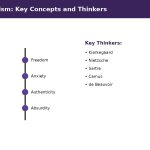
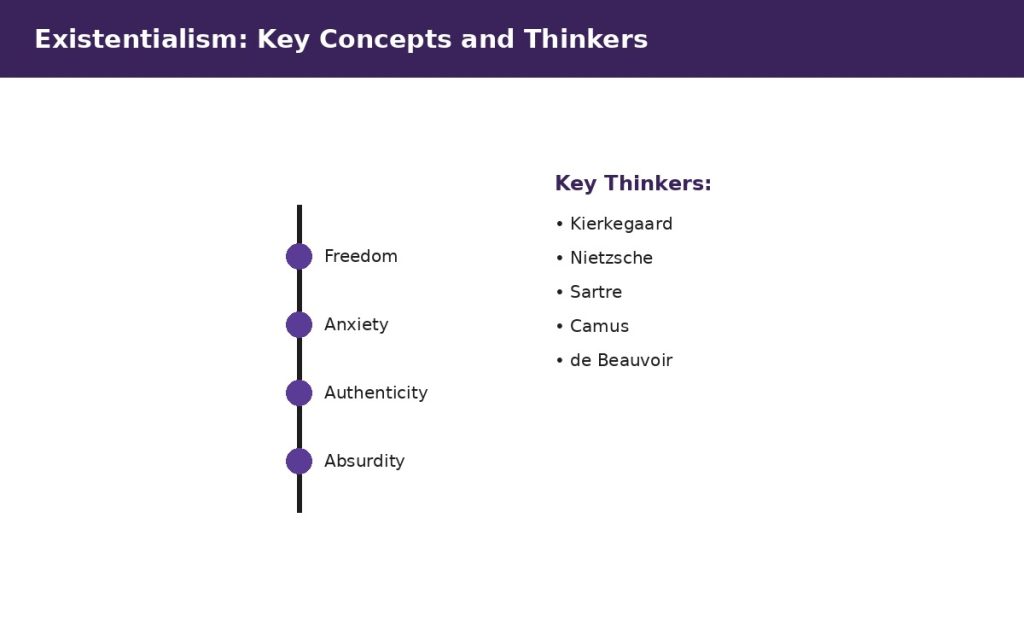
Existentialism is less a single doctrine than a family of philosophical approaches united by a shared starting point: the lived, concrete experience of individual human existence, confronting freedom, anxiety, and the search for meaning in a world that offers no ready-made answers. This guide covers the movement’s key thinkers and concepts — Kierkegaard, Nietzsche, Sartre, Camus, and de Beauvoir — with detailed worked examples for assignments. Existentialism engages directly with free will and determinism (freedom as a defining condition) and aesthetics (Sartre and Camus both wrote extensively on how artistic creation embodies the same freedom and meaning-making they describe philosophically).
Table of Contents
Toggle1. What Unites Existentialist Thought?
Though existentialist thinkers disagree on many specifics (and some, like Sartre, embraced the label while others, like Camus, rejected it), several recurring themes characterize the tradition:
- Existence precedes essence: for human beings specifically, there is no pre-given “human nature” or fixed purpose that determines who we are — we exist first, and then define ourselves through our choices.
- Radical freedom: humans are fundamentally free, and this freedom is often experienced as a burden rather than simply a gift.
- Anxiety/anguish: confronting the weight of one’s own freedom and the absence of external guarantees produces existential anxiety (distinct from ordinary fear, which has a specific object).
- Authenticity: living in genuine accordance with one’s own freely chosen values, rather than conforming unreflectively to social expectations or fleeing from the responsibility of choice.
- The search for meaning in a universe that does not supply meaning ready-made.
2. Søren Kierkegaard: The Leap of Faith
Often considered the “father of existentialism,” Kierkegaard (writing in 19th-century Denmark) was deeply critical of abstract, impersonal philosophical systems (particularly Hegel’s) that he felt lost sight of the concrete, subjective individual.
2.1 Subjective Truth
Kierkegaard famously claimed “truth is subjectivity,” by which he meant that for the most important questions in life — especially religious faith — what matters is not detached, objective certainty but the passionate, personal way an individual relates to and commits themselves to a belief.
2.2 The Three Stages of Life
Kierkegaard described three possible modes of existence:
- The aesthetic stage: living for immediate pleasure, novelty, and sensation, avoiding commitment (exemplified by his figure of the seducer, who pursues romantic conquest without genuine attachment).
- The ethical stage: committing to universal moral duties and social roles (marriage, career, civic responsibility).
- The religious stage: a “leap of faith” beyond rational or ethical justification into a direct, passionate relationship with God.
Worked Example — Fear and Trembling and Abraham: Kierkegaard analyzes the biblical story of Abraham, commanded by God to sacrifice his son Isaac. Ethically speaking, this command is monstrous — murder of an innocent child violates universal moral law. Yet Kierkegaard argues that genuine religious faith requires a “teleological suspension of the ethical” — a leap beyond ordinary rational and ethical categories entirely, which cannot be justified from within those categories themselves. This illustrates Kierkegaard’s central idea that authentic faith is inherently non-rational, deeply personal, and cannot be reduced to a set of justifiable, universal ethical principles.
3. Friedrich Nietzsche: The Death of God and Self-Creation
Nietzsche’s proclamation that “God is dead” is often misunderstood as a simple statement of atheism; it is actually a diagnosis of a cultural crisis — the collapse of the shared metaphysical and religious foundation that had grounded meaning and morality in European civilization.
3.1 Nihilism as a Danger
Nietzsche worried that once people recognized that traditional religious/metaphysical foundations for meaning and morality had lost their credibility, the result could be nihilism — the belief that life is fundamentally meaningless and that no values have any real grounding.
3.2 The Übermensch and Self-Overcoming
Rather than succumbing to nihilism, Nietzsche called for the creation of new values through radical self-overcoming, embodied in his image of the Übermensch (“overman” or “superman”) — an individual who creates their own values rather than passively inheriting them from religious tradition or “herd morality.”
Worked Example — Master and Slave Morality: Nietzsche’s On the Genealogy of Morals argues that what we now call conventional morality (valuing humility, meekness, and self-sacrifice as “good”) originated historically as a “slave revolt in morality” — a reaction by the socially weak against the strength, pride, and vitality of the socially powerful, who originally called their own strength and nobility “good” and weakness “bad.” Nietzsche is not simply endorsing the “master” perspective wholesale, but using this genealogy to question whether our inherited moral values actually reflect life-affirming values, or a resentment-driven reaction (which he calls ressentiment) against strength and vitality.
3.3 Eternal Recurrence
Nietzsche’s thought experiment of eternal recurrence asks you to imagine that you must live your exact life over again, in every detail, for eternity — and uses your reaction to this prospect (horror, or joyful affirmation) as a test of whether you have genuinely embraced (“said yes to”) your own existence.
4. Jean-Paul Sartre: Radical Freedom and Bad Faith
Sartre, writing in mid-20th-century France, offered the most systematic and explicitly “existentialist” philosophy in the tradition, developed in his major work Being and Nothingness.
4.1 Existence Precedes Essence
Worked Example: Sartre contrasts a manufactured object, like a paper knife, whose essence (its intended purpose as a cutting tool) precedes its existence — the manufacturer conceived its purpose before making it — with a human being, who simply exists first, without any predetermined essence or purpose, and only later, through their free choices and actions, defines who and what they are. There is no God to have designed us for a purpose, and no fixed “human nature” dictating who we must become — Sartre summarizes this as “existence precedes essence.”
4.2 Radical Freedom and “Condemned to Be Free”
Because there is no pre-given human essence, Sartre argues humans are radically free — free even in situations that seem constrained, since we always retain the freedom to interpret and respond to our circumstances. Famously, Sartre claims we are “condemned to be free” — freedom is not simply a privilege but an inescapable, sometimes terrifying burden, since it means we bear full responsibility for who we become, with no external excuse.
4.3 Bad Faith (Mauvaise Foi)
Bad faith is Sartre’s term for the various strategies people use to deny or flee from their own radical freedom and responsibility, pretending they are more fixed or determined than they actually are.
Worked Example — The Waiter: Sartre’s famous example describes a café waiter who performs his role with exaggerated, almost mechanical precision — moving with excessive rigidity, speaking with excessive formality — as though he simply were a waiter in the same fixed way that an inkwell simply is an inkwell. Sartre argues this represents bad faith: the waiter is (falsely) treating his social role as though it were a fixed essence rather than a role he is continuously, freely choosing to perform, and could, in principle, choose to abandon at any moment.
5. Albert Camus: The Absurd
Though Camus resisted the “existentialist” label, his work on the absurd is central to the broader tradition.
5.1 Defining the Absurd
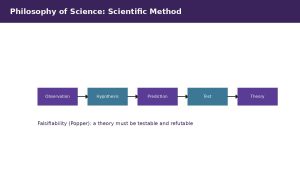
Camus’ insistence that the universe offers no answers to our demand for meaning echoes debates in Philosophy of Science and the Scientific Method about whether science itself can ever supply ultimate explanations, rather than merely describing regularities.
For Camus, the absurd arises not from the world itself, nor from human consciousness alone, but from the collision between humanity’s deep desire for meaning, clarity, and purpose, and a universe that remains fundamentally silent and indifferent to that desire.
5.2 The Myth of Sisyphus
Worked Example: Camus uses the Greek myth of Sisyphus — condemned by the gods to eternally push a boulder up a mountain, only to watch it roll back down each time, forever — as an image of the human condition: repetitive, ultimately purposeless labor within an indifferent universe. Rather than concluding that life is therefore not worth living (which Camus explicitly rejects, opposing suicide as a “solution” to the absurd), he famously concludes that “one must imagine Sisyphus happy” — arguing that Sisyphus can achieve a kind of defiant, meaning-generating freedom precisely through his conscious awareness and acceptance of his absurd condition, refusing to be crushed by it or to seek false consolation (whether religious or otherwise) that denies the absurd’s reality.
5.3 Philosophical Suicide
Camus criticizes what he calls “philosophical suicide” — attempts (including Kierkegaard’s leap of faith, in Camus’s reading) to escape the absurd by leaping to an unjustified metaphysical or religious consolation, rather than honestly confronting the absurd and living in permanent, lucid revolt against it.
6. Simone de Beauvoir: Existentialist Ethics and Feminism
De Beauvoir, Sartre’s lifelong intellectual partner, developed existentialist themes in her own distinctive directions, especially regarding ethics and gender.
6.1 Ambiguity and Ethics
In The Ethics of Ambiguity, de Beauvoir addressed a gap in Sartre’s early work: if we are radically free, what stops one person’s freedom from justifying the oppression of others? She argued that authentic freedom is inherently relational — genuinely willing your own freedom requires also willing the freedom of others, since human freedom is always situated within a shared world of other free beings whose own projects and freedom matter.
6.2 The Second Sex and “Woman as Other”
Worked Example: In The Second Sex, de Beauvoir applies existentialist categories to the situation of women, famously declaring “one is not born, but rather becomes, a woman.” She argues that womanhood, far from being a fixed biological essence, is a socially constructed category defined in relation to men as the assumed default or “Self,” with women cast as “the Other” — and that this construction can and should be critically examined and transformed, echoing the existentialist claim that existence precedes essence, now applied specifically to the social construction of gender.
7. Common Assignment Pitfalls
- Treating existentialism as a single unified doctrine — Kierkegaard’s religious existentialism and Sartre’s atheistic existentialism reach very different conclusions from similar starting concerns, and Camus explicitly rejected the label altogether.
- Confusing Nietzsche’s “God is dead” with a simple statement of personal atheism — it’s a broader cultural/historical diagnosis about the collapse of a shared metaphysical foundation for meaning and morality.
- Assuming Camus concludes that life is meaningless and not worth living — he explicitly argues the opposite, that we should live in lucid defiance of the absurd rather than seeking escape through suicide or unjustified metaphysical consolation.
- Overlooking de Beauvoir when discussing existentialism — she made substantial independent philosophical contributions (particularly on ethics and gender), not merely a restatement of Sartre’s ideas.
8. Applying These Concepts: A Sample Assignment Response
Question: “Compare Sartre’s and Camus’s responses to the absence of inherent meaning in the universe.”
Sample structured answer: Explain Sartre’s position: since existence precedes essence and there is no pre-given human nature or divine purpose, humans must radically create their own meaning and values through free choice and action, bearing full responsibility for the result (with “bad faith” as the failure mode to avoid). Explain Camus’s position: rather than actively creating meaning to fill the void, Camus argues we should consciously accept and live in permanent, lucid revolt against the fundamental absurdity of the human condition, refusing both despair (suicide) and false consolation (unjustified metaphysical/religious leaps). Compare: Sartre’s emphasis on active meaning-creation through radical freedom versus Camus’s emphasis on defiant acceptance of a condition that cannot ultimately be resolved or escaped, only faced honestly.
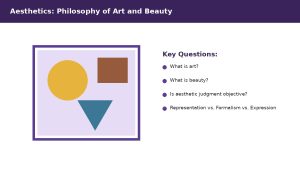
Existentialism draws heavily on debates about free will and determinism (freedom as the defining human condition) and directly engages aesthetics, since existentialist writers like Camus and Sartre treated the novel and the essay as philosophical tools in their own right, not just illustrations of ideas argued elsewhere. Practice explaining each thinker’s key concept using their own signature thought experiment (Abraham’s leap, eternal recurrence, the café waiter, Sisyphus, “the Other”) — this is the clearest way to demonstrate real comprehension rather than surface-level name-dropping.
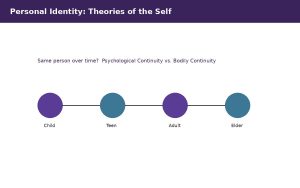
Kierkegaard’s claim that “truth is subjectivity” directly challenges the objective, justification-based picture of knowledge developed in Epistemology and Theories of Knowledge. Sartre’s account of radical freedom is best understood alongside the ethical implications explored in Normative Ethical Theories. The bad-faith waiter example in Section 4.3 raises questions about consciousness and self-deception that are examined more closely in Philosophy of Mind and the Mind-Body Problem. Camus’ rejection of “philosophical suicide” is itself an argument that can be reconstructed and evaluated using the tools in Logic: Deductive and Inductive Reasoning. De Beauvoir’s account of authentic freedom as inherently relational connects to the same questions of legitimate authority explored in Social Contract Theory. And the waiter’s shifting social role over a lifetime touches the same puzzle of what makes someone the same person over time, developed fully in Personal Identity and Theories of the Self.
For students developing a comparative philosophy essay, existentialism assignment assistance can be useful for structuring arguments, comparing thinkers, and connecting abstract concepts to specific examples.
Frequently Asked Questions
What does “existence precedes essence” mean? It is Sartre’s claim that human beings have no fixed, pre-given nature or purpose (essence) prior to existing; instead, we exist first and then define who we are through our free choices and actions over the course of our lives.
Is existentialism the same as nihilism? No, and this is a common misconception. Existentialists like Camus and Sartre explicitly reject the nihilistic conclusion that life is meaningless and not worth living; instead, they argue that meaning must be actively created or faced through freedom, rather than being ready-made.
What is “bad faith” in Sartre’s philosophy? Bad faith is the act of denying or fleeing from one’s own radical freedom and responsibility, often by pretending one’s identity or circumstances are more fixed and unchangeable than they actually are.
What is Camus’ answer to the absurd? Camus argues we should neither escape the absurd through suicide nor through unjustified metaphysical or religious consolation (“philosophical suicide”), but instead live in lucid, defiant acceptance of it — summarized in his claim that “one must imagine Sisyphus happy.”
Was Simone de Beauvoir just a follower of Sartre? No — she made substantial independent contributions, particularly her ethics of ambiguity (arguing authentic freedom requires willing the freedom of others) and her landmark analysis of gender construction in “The Second Sex.”