
Table of Contents
ToggleIntroduction
A building’s construction cost — the figure most clients focus on — typically represents only a fraction of its total cost over its useful life. Energy consumption, maintenance, repairs, cleaning, and eventual disposal or refurbishment can, over several decades, significantly exceed the original capital cost. Life cycle costing (LCC), also called whole life costing, is the methodology quantity surveyors use to evaluate and compare the total cost of a building or building component across its entire life, not just its initial construction cost. This article explains the LCC framework, the mathematics behind discounting future costs, and how to apply it through worked examples.
Why Life Cycle Costing Matters
Two design options might have very different capital costs but similar (or inverted) long-term costs. Without LCC analysis, decision-makers risk choosing the cheaper upfront option while unknowingly committing to significantly higher costs over the building’s life — a problem particularly relevant to clients who will own and operate the building long-term (as opposed to developers building purely for short-term sale, whose incentives may differ).
The Components of Life Cycle Cost
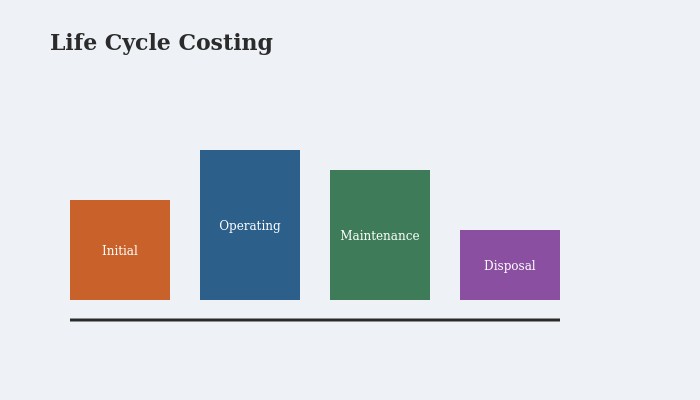
A complete life cycle cost analysis typically includes:
| Cost Category | Includes |
|---|---|
| Capital/Initial Cost | Construction cost, design fees, land acquisition |
| Operating Cost | Energy, water, cleaning, insurance, rates/taxes |
| Maintenance Cost | Planned/preventive maintenance, reactive repairs |
| Replacement Cost | Periodic replacement of components with shorter lifespans than the building itself (e.g., roof coverings, mechanical plant) |
| End-of-Life Cost | Demolition, disposal, or refurbishment cost, net of any residual/salvage value |
The Time Value of Money: Why Discounting Matters
A core principle of life cycle costing is that money spent in the future is not directly comparable to money spent today — a dollar spent in 20 years is worth less in present terms than a dollar spent today, due to the time value of money. LCC analysis therefore converts all future costs into their present value (PV) using a discount rate, allowing costs occurring at different points in time to be meaningfully compared and summed.
The Present Value Formula
The standard formula for converting a future cost to present value is:
PV = FV ÷ (1 + r)ⁿ
Where:
- PV = Present Value
- FV = Future Value (the cost expected to occur)
- r = discount rate (expressed as a decimal)
- n = number of years until the cost occurs
Worked Example: Comparing Two Roofing Options
Consider a client comparing two roofing systems for a commercial building, using a discount rate of 5% over a 30-year evaluation period.
Option A: Standard membrane roof
- Initial cost: $180,000
- Requires full replacement at year 20: estimated $190,000 (future cost)
- Annual maintenance: $2,000/year
Option B: Premium membrane roof
- Initial cost: $240,000
- No full replacement needed within 30 years
- Annual maintenance: $1,000/year
Step 1: Calculate present value of Option A’s year-20 replacement cost
PV = $190,000 ÷ (1.05)²⁰ PV = $190,000 ÷ 2.653 PV ≈ $71,600
Step 2: Calculate present value of annual maintenance costs (simplified using a present value annuity factor)
Using a present value annuity factor for 5% over 30 years (approximately 15.37):
- Option A: $2,000 × 15.37 ≈ $30,740
- Option B: $1,000 × 15.37 ≈ $15,370
Step 3: Total life cycle cost comparison
| Cost Component | Option A | Option B |
|---|---|---|
| Initial cost | $180,000 | $240,000 |
| PV of replacement | $71,600 | $0 |
| PV of maintenance | $30,740 | $15,370 |
| Total LCC | $282,340 | $255,370 |
Conclusion: Despite Option B’s higher initial cost, its total life cycle cost is approximately $27,000 lower over the 30-year period — a conclusion that would be entirely invisible if the client compared only initial capital costs.
For students studying quantity surveying, life cycle costing is also an important area of coursework, particularly when assignments require cost comparisons, present-value calculations, and evaluation of alternative building systems. If you need further guidance with quantity surveying coursework, see our Quantity Surveying Assignment Help guide.
Choosing an Appropriate Discount Rate
The discount rate used significantly affects LCC outcomes, and selecting it appropriately is a critical (and sometimes contested) part of the analysis. Considerations include:
- Public sector projects often use a standardized social discount rate set by government treasury guidance, reflecting broader social time preference.
- Private sector clients may use a rate reflecting their own cost of capital or required rate of return on investment.
- Sensitivity analysis is considered good practice — testing how conclusions change under different discount rate assumptions, since a relatively small change in discount rate can significantly shift which option appears more favorable over long time horizons.
Life Cycle Costing and Sustainability
LCC has become increasingly central to sustainability-focused design decisions, since many sustainable design choices—such as higher-performance insulation, energy-efficient mechanical systems, and durable, low-maintenance materials—involve higher capital costs but lower long-term operating and maintenance costs. This trade-off is closely related to value engineering. LCC provides the quantitative framework needed to justify these choices to clients focused on total cost of ownership rather than capital cost alone, and it is increasingly incorporated into green building certification frameworks and public procurement requirements.
Limitations and Challenges of Life Cycle Costing
- Forecasting uncertainty: Predicting energy prices, maintenance costs, or component lifespans decades into the future involves significant uncertainty — the same kind of forecasting uncertainty addressed through structured risk management and contingency — which is why sensitivity analysis and scenario testing are important complements to a single-point LCC calculation.
- Data availability: Reliable long-term cost and performance data for newer building technologies or materials may be limited, making comparisons less robust than for well-established systems.
- Split incentives: In some procurement arrangements (for example, a developer who will sell the building shortly after completion), the party making capital cost decisions may not be the party who bears the long-term operating costs, weakening the practical incentive to apply LCC rigorously.
Frequently Asked Questions
Q: What is the difference between life cycle costing and whole life costing? A: The terms are often used interchangeably, though “whole life costing” is sometimes used to indicate an even broader scope, including non-construction costs such as income generation or externalities, while “life cycle costing” more narrowly focuses on the cost side across a building’s physical life.
Q: Why does the discount rate matter so much in life cycle costing? A: The discount rate determines how heavily future costs are weighted relative to present costs; a higher discount rate reduces the present value of far-future costs, which can significantly change which design option appears most cost-effective overall.
Q: Can life cycle costing be applied to individual building components, not just whole buildings? A: Yes — LCC is commonly applied to compare specific components or systems (such as roofing, HVAC systems, or flooring finishes), which is often more practical and data-reliable than attempting a full whole-building LCC analysis.
Q: How is life cycle costing different from value engineering? A: Value engineering focuses on optimizing the function-to-cost ratio of a design, often considering capital cost primarily, while life cycle costing specifically evaluates total cost across a building’s entire life; the two are often used together, since a value engineering decision should ideally be checked against its life cycle cost implications.
Q: What data sources do quantity surveyors typically use for life cycle cost forecasting? A: Common sources include historical maintenance and operating cost data from comparable buildings, manufacturer data on component lifespans and performance, published industry cost indices, and, increasingly, building performance data gathered through post-occupancy evaluation studies.