

Once a firm has analyzed its industry Five Forces and its internal resources VRIO, it still faces a fundamental strategic choice: how will it actually compete? Porter’s Generic Strategies framework, introduced alongside Five Forces, argues that sustainable competitive positioning ultimately comes down to a small number of basic strategic postures — and crucially, that firms attempting to blend them without commitment tend to underperform both specialized competitors, a trap Porter called being “stuck in the middle.”
The Two Dimensions: Competitive Scope and Competitive Advantage
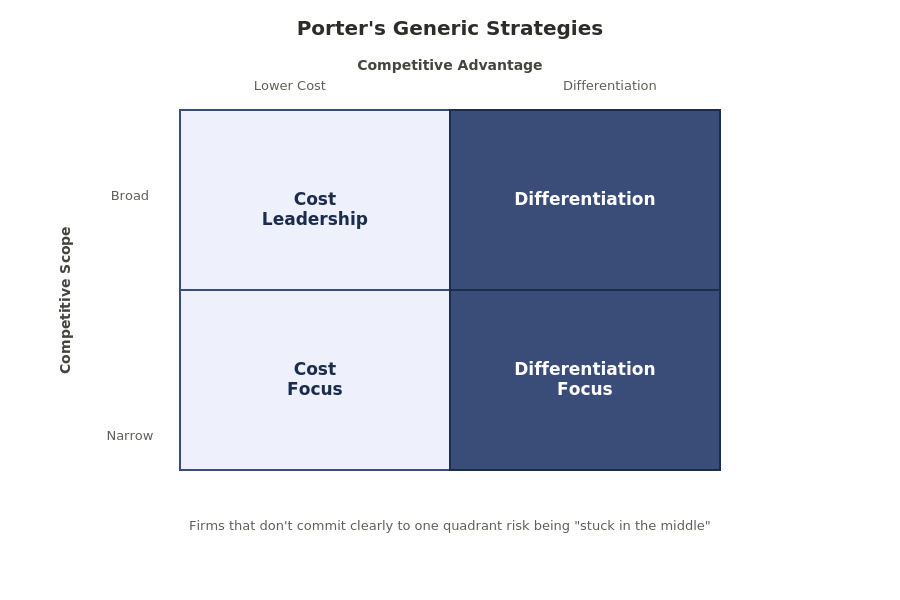
Porter’s framework is built from two intersecting dimensions:
- Competitive advantage type: does the firm compete primarily on lower cost, or on differentiation (offering something customers perceive as meaningfully unique or superior)?
- Competitive scope: does the firm target the broad market, or a narrow, focused segment?
Combining these two dimensions produces four generic strategies:
Cost Leadership: Competing on Being the Lowest-Cost Producer
A cost leadership strategy targets the broad market while competing primarily on being the industry’s lowest-cost producer — critically, this doesn’t necessarily mean the lowest price (though it often enables competitive pricing); it means the lowest underlying cost structure, which can be used either for aggressive pricing or for maintaining healthy margins at average market prices.
Worked example: Ryanair (budget airline sector). Ryanair pursues cost leadership through multiple reinforcing operational choices: a single aircraft type (reducing maintenance and training complexity), high aircraft utilization rates, secondary airports with lower fees, minimal in-flight service (converted into ancillary revenue opportunities rather than included cost), and a lean organizational structure. Each individual choice contributes modestly, but the combination of consistently cost-focused decisions across the entire operating model is what produces genuine, hard-to-replicate cost leadership — a single low-cost initiative alone rarely constitutes a full cost leadership strategy.
Key requirement for successful cost leadership: the cost advantage must be sustainable, not just a temporary price cut — this connects directly to VRIO logic, since a cost advantage that’s easily imitated (a temporary promotional discount, for instance) doesn’t constitute genuine strategic cost leadership.
Differentiation: Competing on Being Meaningfully Unique
A differentiation strategy also targets the broad market, but competes by offering products or services customers perceive as sufficiently unique to justify a premium price — the differentiation can be based on product features, brand image, customer service, innovation, or quality.
Worked example: Apple (consumer technology). Apple competes on differentiation through integrated hardware-software design, brand positioning, retail experience, and ecosystem lock-in (the interconnection between iPhone, Mac, and other devices creating switching costs) — none of which is primarily about being the lowest-cost producer. Apple’s manufacturing costs aren’t necessarily industry-lowest, but customers pay a premium because they perceive meaningfully differentiated value.
A critical distinction students often miss: differentiation must be based on attributes customers genuinely value and are willing to pay for — a feature that’s technically unique but doesn’t meaningfully influence customer purchasing decisions doesn’t constitute strategically useful differentiation, regardless of how novel it is from an engineering standpoint.
Focus Strategies: Narrowing Competitive Scope
Both cost leadership and differentiation can also be pursued within a narrow market segment rather than the broad market, producing two additional variants:
Cost Focus: competing on low cost within a specific narrow segment.
Worked example: A regional budget airline serving a specific underserved route network (rather than competing broadly like Ryanair) pursuing minimal-cost operations specifically tailored to that narrow geographic niche.
Differentiation Focus: competing on differentiation within a specific narrow segment.
Worked example: A luxury boutique hotel chain focused specifically on high-end business travelers in a small number of major financial districts, differentiating through hyper-tailored service and location rather than competing broadly across the entire hospitality market.
The strategic logic behind focus strategies: a firm may lack the scale to compete cost-effectively across an entire broad market, but can still achieve either cost or differentiation advantage by concentrating resources on serving a specific segment’s needs more precisely than broad-market competitors can.
The “Stuck in the Middle” Trap
Porter’s central warning: firms that fail to commit clearly to one of these strategic postures — attempting to be simultaneously somewhat cost-competitive and somewhat differentiated, without genuine commitment to either — tend to underperform firms that commit fully to a single clear strategy.
Worked example illustrating the trap: A mid-market department store chain attempts to compete on both price (offering some discount pricing) and differentiation (some premium/exclusive product lines) without fully committing to either. The result: it’s undercut on price by genuine discount retailers with truly optimized low-cost operating models, while simultaneously failing to match the brand prestige and curated experience of genuinely differentiated premium retailers. Customers seeking the lowest price go elsewhere; customers seeking a premium experience go elsewhere; the stuck-in-the-middle firm captures neither customer segment effectively.
Why this happens structurally, not just as a matter of poor execution: cost leadership and differentiation often require genuinely conflicting organizational priorities — cost leadership typically demands standardization, operational efficiency, and cost discipline throughout the organization, while differentiation typically demands investment in unique features, brand-building, and often higher-cost inputs. Attempting both simultaneously, without a focus strategy to narrow scope, often means neither priority receives the organizational commitment needed to execute it fully.
Are Hybrid Strategies Ever Viable?
This is a frequent and legitimate point of debate in more advanced strategic management coursework: some scholars and real-world examples (Toyota’s lean manufacturing achieving both efficiency and quality differentiation, for instance) suggest that hybrid “best-value” strategies can succeed under specific conditions — typically requiring genuinely superior operational capabilities that most competitors can’t replicate, rather than a half-committed blend of the two generic approaches. For MBA-level analysis, acknowledging this nuance (rather than treating Porter’s framework as an absolute, universally rigid rule) often strengthens an assignment’s critical engagement with the theory, provided the analysis explains specifically why a given hybrid case succeeds, rather than simply asserting hybrids are viable as a blanket exception.
Common Student Mistakes
- Confusing cost leadership with simply having low prices — cost leadership is about the underlying cost structure, which may or may not be reflected in low prices depending on the firm’s margin strategy
- Treating any product feature as differentiation — genuine differentiation requires the point of difference to be something customers actually value enough to pay a premium for, not just any technical distinction
- Missing the “stuck in the middle” analysis entirely — a strong strategic analysis explicitly evaluates whether a firm has committed clearly to one strategic posture, or risks the underperformance associated with an uncommitted hybrid approach
- Applying generic strategies without connecting to VRIO or Five Forces analysis — a strong MBA strategic assessment typically integrates multiple frameworks; the “sustainable” element of a cost or differentiation advantage connects directly back to VRIO’s rarity and imitability questions
- Assuming focus strategies are inherently “smaller” or less ambitious — focus strategies can be highly profitable and strategically sophisticated; the narrower scope is a deliberate strategic choice, not a lesser one
For readers developing strategic analysis for coursework, resources on strategic management coursework support can also be useful when combining frameworks such as VRIO, Five Forces, and Generic Strategies into a coherent assessment. See Strategic Management Assignment Guidance for additional material on approaching strategic management assignments.
Frequently Asked Questions
Can a large multinational firm operate different generic strategies in different business units or markets? Yes — a diversified corporation might pursue cost leadership in one business unit and differentiation in another, provided each unit maintains internal strategic clarity and consistency; the “stuck in the middle” risk applies primarily within a single competitive positioning, not necessarily across an entire diversified portfolio.
How does Porter’s Generic Strategies framework relate to Five Forces analysis? Five Forces analysis of industry structure often informs which generic strategy is more viable — an industry with intense price-based rivalry and low differentiation potential may favor cost leadership approaches, while an industry with strong brand loyalty potential and buyers willing to pay premiums may favor differentiation.
Is “stuck in the middle” always a strategic failure? Not universally and unconditionally — as the Toyota-style hybrid discussion illustrates, some firms achieve genuine dual advantage through superior capabilities rather than half-hearted commitment to both, though Porter’s original framework treats this as a rare exception requiring specific conditions, not the norm.
What’s the difference between differentiation and differentiation focus? Differentiation targets the broad market with a uniqueness-based competitive advantage; differentiation focus applies the same uniqueness-based logic but within a deliberately narrow market segment, allowing more precisely tailored differentiation than a broad-market approach could achieve.