

Porter’s Five Forces, developed by Michael Porter in 1979, is a framework for analyzing the competitive intensity and profitability potential of an industry — not a single company. This distinction trips up many students immediately: Five Forces analyzes the structure of an industry (why some industries are consistently more profitable than others, regardless of which specific firms compete in them), not a specific company’s internal strengths or weaknesses, which is exactly why it’s frequently taught alongside, but never confused with, internally-focused tools.
The Five Forces, Defined
- Competitive rivalry — the intensity of competition among existing firms in the industry
- Threat of new entrants — how easily new competitors can enter the industry
- Bargaining power of suppliers — how much leverage suppliers have to raise prices or reduce quality
- Bargaining power of buyers — how much leverage customers have to demand lower prices or better terms
- Threat of substitute products or services — the risk that customers switch to a fundamentally different solution to the same underlying need
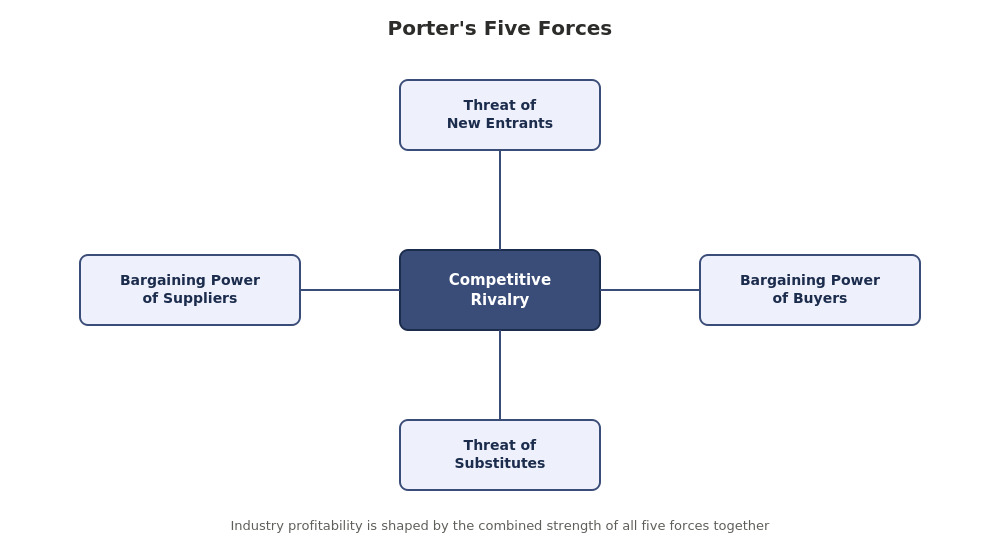
The central insight of the framework: an industry’s average profitability is shaped by the combined strength of all five forces, not any single one in isolation — a full analysis requires assessing each force individually and then synthesizing what they mean together.
A Full Worked Example: The UK Coffee Shop Industry
1. Competitive Rivalry: High
The UK coffee shop market includes large chains (Costa, Starbucks, Caffè Nero), a substantial number of independent cafes, and increasing competition from fast-food chains adding premium coffee offerings. Rivalry is intensified by relatively low product differentiation (coffee is a broadly similar core product across competitors), price competition, and low switching costs for customers between nearby outlets.
2. Threat of New Entrants: Moderate
Barriers to entry are moderate — starting a single independent coffee shop requires relatively modest capital compared to many industries, but building a scaled, branded competitor to established chains requires substantial capital, supply chain relationships, and brand recognition. This creates a two-tier reality: low barriers for small independent entrants, but high barriers for entrants aiming to compete at the scale of major chains.
3. Bargaining Power of Suppliers: Low to Moderate
Coffee bean suppliers are numerous globally, and most coffee shop chains can source from multiple suppliers, limiting any single supplier’s leverage. However, this shifts for specialty/premium bean suppliers with unique, sought-after sourcing relationships (e.g., specific single-origin or fair-trade certified suppliers), where supplier power increases somewhat due to differentiation and limited alternative sources.
4. Bargaining Power of Buyers: Moderate to High
Individual consumers have relatively low bargaining power individually (a single customer can’t negotiate prices), but collective buyer power is significant because switching costs are low — a customer can easily choose a different coffee shop with minimal inconvenience, and widespread price transparency (visible menu pricing) makes comparison easy. This is a useful distinction for students: buyer power isn’t only about negotiating leverage, it’s also meaningfully driven by ease of switching.
5. Threat of Substitutes: Moderate
Substitutes include home coffee brewing (increasingly sophisticated with quality home espresso machines), tea, energy drinks, and other beverage categories. This threat has grown with the rise of high-quality home brewing equipment, though the coffee shop experience itself (space, social context, convenience) provides some differentiation against a purely beverage-based substitute comparison.
Overall Assessment
Combining all five forces suggests a moderately challenging industry structure for sustained high profitability — strong rivalry and meaningful buyer power (through easy switching) create consistent pricing pressure, partially offset by low supplier power. This explains why coffee shop chains typically compete not purely on price, but on differentiation strategies (brand experience, loyalty programs, location convenience, specialty offerings) — a direct example of how Five Forces analysis informs actual strategic choice, not just academic description.
A Second Worked Example: The Commercial Aircraft Manufacturing Industry
To illustrate how dramatically the framework’s conclusions shift across industries, briefly consider commercial aircraft manufacturing:
- Competitive rivalry: Low to moderate — the market is effectively a duopoly (Boeing and Airbus) for large commercial aircraft, limiting the intensity of price-based rivalry compared to a fragmented industry
- Threat of new entrants: Very low — the capital investment, regulatory certification requirements, and technological expertise required represent enormous barriers
- Supplier power: Moderate to high — specialized component suppliers (engines, avionics) often have significant leverage due to limited alternative sources for highly specialized parts
- Buyer power: Moderate to high — airlines are large, sophisticated buyers purchasing in bulk, with real negotiating leverage, though limited to choosing between essentially two viable suppliers
- Threat of substitutes: Low for the core large-aircraft segment — no broadly viable alternative currently exists for long-haul mass passenger transport
This industry shows a fundamentally different profile — very low rivalry and very low threat of new entrants (due to enormous barriers) support higher sustained profitability potential than the coffee shop example, even though buyer and supplier power are both significant. Comparing these two examples side by side is exactly the kind of application markers look for: not just correctly labeling each force, but explaining why the combination produces a meaningfully different overall industry structure.
For students exploring the practical application of strategic management frameworks, additional resources on Strategic Management Assignment Help can provide further guidance on structuring analyses, applying strategic models, and developing evidence-based arguments.
Common Misapplications of the Framework
- Analyzing a company instead of an industry — Five Forces assesses industry structure; company-specific strengths and weaknesses belong in tools like VRIO or SWOT, not this framework
- Treating each force as independently determining profitability — the forces interact; a full analysis synthesizes the combined picture, not five separate isolated conclusions
- Ignoring that force strength varies by market segment — as shown in the coffee example, supplier power differs meaningfully between commodity and specialty bean suppliers; a single blanket rating for “supplier power” across an entire industry can oversimplify real variation
- Using the framework only descriptively rather than strategically — strong analysis explicitly connects the Five Forces findings to strategic implications (as in “this explains why firms compete on differentiation rather than price”), not just a static five-part description
Frequently Asked Questions
Is Five Forces analysis static, or does industry structure change over time? Industry structure can and does shift — technological change, regulatory change, and evolving buyer behavior can meaningfully alter force strength over time (the rise of home coffee brewing technology affecting substitute threat, for example), which is why Five Forces analysis is often revisited periodically rather than treated as a one-time, permanently fixed assessment.
How is Five Forces different from SWOT analysis? Five Forces is specifically an external, industry-structure framework. SWOT analysis combines both internal factors (Strengths, Weaknesses) and external factors (Opportunities, Threats) for a specific company — Five Forces can inform the “Threats” and some “Opportunities” elements of a SWOT analysis, but doesn’t address a company’s internal strengths and weaknesses at all.
Can Five Forces analysis be applied to a very narrow market segment rather than a whole industry? Yes, and this is often more useful in practice — analyzing “specialty independent coffee shops in London” produces a more precise, actionable analysis than analyzing “the global coffee industry” broadly, since force strength can vary significantly across different market segments within a broader industry category.
Does a “low threat” rating on every force guarantee high profitability? Not automatically — Five Forces indicates the structural potential for profitability within an industry, but individual company execution, cost structure, and strategic positioning still determine whether any specific firm actually captures that potential profitability.