
While chemical thermodynamics tells you whether a reaction is favorable, chemical kinetics tells you how fast it happens and by what pathway. This is one of the most calculation-heavy topics in university chemistry, and assignments typically test your ability to determine rate laws from data, use integrated rate equations, and apply the Arrhenius equation. This guide walks through each skill with detailed examples.
Table of Contents
Toggle1. What Is Reaction Rate?
The rate of reaction is the change in concentration of a reactant or product per unit time:
Rate = −Δ[A]/Δt = Δ[Product]/Δt
For a general reaction aA + bB → cC + dD, the rate must be expressed consistently:
Rate = −(1/a)Δ[A]/Δt = −(1/b)Δ[B]/Δt = (1/c)Δ[C]/Δt = (1/d)Δ[D]/Δt
Worked Example: For 2N₂O₅ → 4NO₂ + O₂, if O₂ forms at 4.5 × 10⁻⁶ mol/(L·s), what is the rate of disappearance of N₂O₅?
Rate (in terms of reaction) = (1/1)(4.5×10⁻⁶) = 4.5×10⁻⁶ mol/(L·s) Rate of N₂O₅ disappearance = 2 × (rate) = 9.0 × 10⁻⁶ mol/(L·s)
2. The Rate Law and Reaction Order
The rate law expresses reaction rate as a function of reactant concentrations:
Rate = k[A]^m[B]^n
Here, k is the rate constant, and m and n are the orders with respect to A and B, determined experimentally — they are NOT necessarily equal to the stoichiometric coefficients (a common assignment mistake). The overall order is m + n.
2.1 Determining Rate Law from Experimental Data (Method of Initial Rates)
Worked Example: Given the following data for A + B → C:
| Trial | [A] (M) | [B] (M) | Initial Rate (M/s) |
|---|---|---|---|
| 1 | 0.10 | 0.10 | 2.0 × 10⁻³ |
| 2 | 0.20 | 0.10 | 8.0 × 10⁻³ |
| 3 | 0.20 | 0.20 | 1.6 × 10⁻² |
Step 1 — Find order with respect to A (compare trials 1 and 2, where [B] is constant): (0.20/0.10)^m = 8.0×10⁻³/2.0×10⁻³ → 2^m = 4 → m = 2
Step 2 — Find order with respect to B (compare trials 2 and 3, where [A] is constant): (0.20/0.10)^n = 1.6×10⁻²/8.0×10⁻³ → 2^n = 2 → n = 1
Step 3 — Write the rate law: Rate = k[A]²[B]¹ (third order overall)
Step 4 — Solve for k using trial 1: 2.0×10⁻³ = k(0.10)²(0.10) → k = 2.0 M⁻²s⁻¹
3. Integrated Rate Laws
Integrated rate laws relate concentration directly to time, allowing you to predict concentration at any point or calculate half-life.
3.1 Zero-Order Reactions
Rate = k (independent of concentration). Integrated form: [A] = [A]₀ − kt A plot of [A] vs. t is linear with slope −k. Half-life: t½ = [A]₀ / (2k) (depends on initial concentration)
3.2 First-Order Reactions
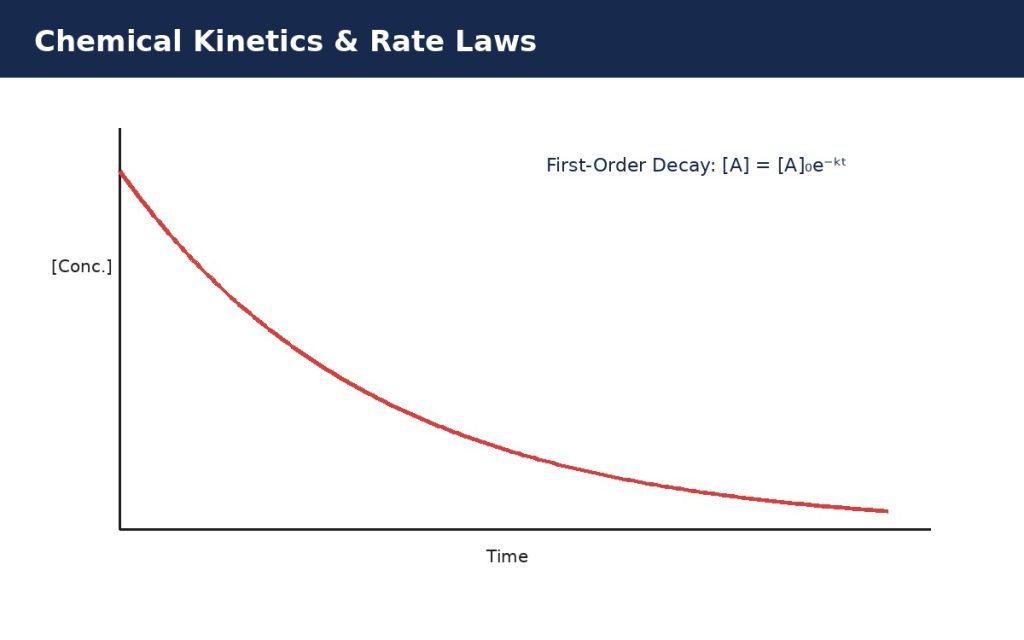
Rate = k[A]. Integrated form: ln[A] = ln[A]₀ − kt A plot of ln[A] vs. t is linear with slope −k. Half-life: t½ = 0.693 / k (constant, independent of concentration — a hallmark of first-order kinetics, also seen in radioactive decay)
Worked Example: A first-order reaction has k = 0.025 s⁻¹. If [A]₀ = 0.80 M, what is [A] after 60 seconds?
ln[A] = ln(0.80) − (0.025)(60) = −0.223 − 1.5 = −1.723 [A] = e^(−1.723) = 0.178 M
Worked Example — Half-life: t½ = 0.693/0.025 = 27.7 s. After 4 half-lives (110.8 s), the concentration drops to (1/2)⁴ = 1/16 of the original.
3.3 Second-Order Reactions
Rate = k[A]². Integrated form: 1/[A] = 1/[A]₀ + kt A plot of 1/[A] vs. t is linear with slope +k. Half-life: t½ = 1/(k[A]₀) (depends on initial concentration, increases as reaction proceeds)
3.4 Identifying Reaction Order from a Graph
| Order | Linear Plot | Slope |
|---|---|---|
| Zero | [A] vs. t | −k |
| First | ln[A] vs. t | −k |
| Second | 1/[A] vs. t | +k |
If a data set is given, the fastest way to determine order is to test which plot gives a straight line (highest R² value) — a technique frequently required in kinetics lab reports.
4. Rate Constant and Temperature: The Arrhenius Equation
Reaction rates increase with temperature because more molecules possess enough energy to overcome the activation energy (Ea) barrier, as illustrated in the reaction energy diagram covered under chemical thermodynamics. The Arrhenius equation quantifies this relationship:
k = A·e^(−Ea/RT)
Taking the natural log gives the linear form: ln k = −Ea/R (1/T) + ln A
A plot of ln k vs. 1/T is linear with slope = −Ea/R, allowing Ea to be determined graphically from experimental rate constants at different temperatures.
4.1 Two-Point Form
When k is known at two temperatures, use:
ln(k₂/k₁) = −Ea/R (1/T₂ − 1/T₁)
Worked Example: A reaction has k₁ = 3.0 × 10⁻⁴ s⁻¹ at 300 K and k₂ = 1.5 × 10⁻³ s⁻¹ at 320 K. Find Ea.
ln(1.5×10⁻³ / 3.0×10⁻⁴) = −Ea/8.314 × (1/320 − 1/300) ln(5.0) = −Ea/8.314 × (0.003125 − 0.003333) 1.609 = −Ea/8.314 × (−0.000208) 1.609 = Ea × 0.0000250 Ea = 1.609 / 0.0000250 = 64,360 J/mol ≈ 64.4 kJ/mol
5. Reaction Mechanisms and the Rate-Determining Step
Most reactions occur through a series of elementary steps that together make up the overall mechanism. Unlike the overall reaction, for an elementary step, the rate law can be written directly from its molecularity (stoichiometry):
- Unimolecular step (A → products): Rate = k[A]
- Bimolecular step (A + B → products): Rate = k[A][B]
The rate-determining step (RDS) is the slowest step in the mechanism, and it determines the overall rate law.
Worked Example: Consider the mechanism: Step 1 (slow): NO₂ + NO₂ → NO₃ + NO Step 2 (fast): NO₃ + CO → NO₂ + CO₂ Overall: NO₂ + CO → NO + CO₂
Since Step 1 is the rate-determining step, the rate law is determined by its stoichiometry: Rate = k[NO₂]². Note this does NOT include [CO], even though CO appears in the overall balanced equation — another classic point tested in assignments.
5.1 Mechanisms with a Fast Pre-Equilibrium
When the first step is a fast, reversible equilibrium followed by a slow step, the intermediate’s concentration must be expressed in terms of reactants using the equilibrium constant of the first step before it can appear in the final rate law — a technique that bridges kinetics and chemical equilibrium.
6. Catalysts
A catalyst speeds up a reaction by providing an alternative pathway with a lower activation energy, without being consumed in the overall reaction. Catalysts affect the rate constant k (by lowering Ea) but do not affect the equilibrium constant K or the value of ΔG for the reaction — they speed up the approach to equilibrium without shifting its position. This distinction is a very common misconception addressed in kinetics assignments and connects directly to chemical equilibrium.
7. Collision Theory
For a reaction to occur, molecules must collide with:
- Sufficient energy (≥ activation energy, Ea)
- Correct orientation (proper geometric alignment for bond-breaking/forming)
This explains why increasing temperature, concentration, or surface area (for solids) generally increases reaction rate — each factor increases the frequency and/or energy of effective collisions.
8. Common Assignment Pitfalls
Chemical kinetics assignments often combine experimental data, calculations, graphs, and reaction mechanisms, making small mistakes in order determination or equation selection particularly costly. Students working through broader chemistry coursework can also use our Chemistry Assignment Help service for academic assistance with kinetics assignments and related chemistry topics.
- Assuming reaction order matches stoichiometric coefficients — order must be determined experimentally (except for elementary steps).
- Forgetting units of the rate constant k change with overall reaction order: M⁻¹s⁻¹ (zero order: M/s… actually zero order is M·s⁻¹, first order is s⁻¹, second order is M⁻¹s⁻¹).
- Mixing up which integrated rate law/graph to use — always check the linearity of the plot before assuming an order.
- Forgetting that half-life for first-order reactions is constant, but for zero- and second-order reactions it depends on initial concentration.
- Including intermediates (not present in the overall reaction) in a final rate law expression without substituting them out.
9. Full Worked Problem
Question: The decomposition of a substance is first order with k = 0.0198 min⁻¹ at 25°C. How long will it take for the concentration to drop to 25% of its initial value?
Solution: 25% remaining means [A]/[A]₀ = 0.25. ln(0.25) = −kt −1.386 = −0.0198t t = 1.386/0.0198 = 70.0 minutes
(Alternatively: 25% remaining = 2 half-lives; t½ = 0.693/0.0198 = 35.0 min; 2 × 35.0 = 70.0 min — same answer, confirming the calculation.)
Chemical kinetics ties together concepts from chemical thermodynamics (activation energy, reaction energy diagrams) and previews the dynamic nature of chemical equilibrium, where forward and reverse rates become equal. Practice identifying reaction order from both tabulated data and graphs, since this is the single most frequently tested skill in kinetics assignments.