
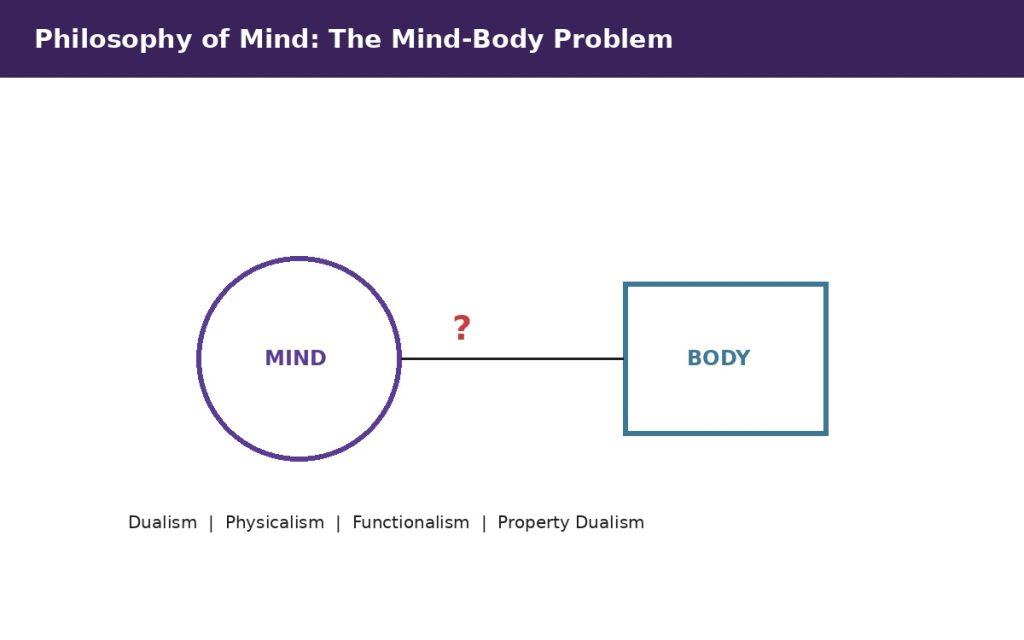
How can subjective, conscious experience arise from purely physical matter like neurons and electrochemical signals? This is the mind-body problem, one of the most enduring puzzles in philosophy. This guide covers dualism, physicalism, functionalism, and the “hard problem of consciousness,” with detailed worked examples to help you construct strong assignment answers. This topic builds naturally on personal identity (what makes a mind the same mind over time?) and epistemology (can we ever really know another mind exists?).
Table of Contents
Toggle1. Framing the Mind-Body Problem
The mind-body problem asks: what is the relationship between mental states (thoughts, feelings, sensations, beliefs) and physical states (brain activity, neurons firing)? Are minds a separate kind of substance from bodies, or are mental states ultimately nothing more than physical states, described differently?
2. Substance Dualism
Substance dualism, most famously defended by René Descartes, holds that mind and body are two fundamentally different kinds of substance: the body is physical (extended in space, subject to mechanical laws), while the mind is non-physical (a “thinking thing,” res cogitans, not extended in space).
2.1 Descartes’ Arguments for Dualism
Worked Example — The Conceivability Argument: Descartes argued that he could clearly and distinctly conceive of his mind existing without his body (e.g., in his dream/evil demon thought experiments, he could doubt he had a body at all, but could not doubt he was thinking). Since whatever is clearly and distinctly conceivable is metaphysically possible, and since mind and body can be conceived apart, mind and body must be genuinely distinct substances — not merely different descriptions of the same thing.
Worked Example — The Divisibility Argument: Descartes also argued that physical bodies are always divisible into parts (you can imagine cutting an arm in half), but the mind seems to be a single, indivisible unity — you cannot cut a thought or a belief in half in the same way. Since bodies are divisible and minds are not, they cannot be identical.
2.2 The Interaction Problem
The most serious objection to substance dualism is the interaction problem: if the mind is truly non-physical, how does it causally interact with the physical body (e.g., how does a non-physical decision to raise your arm cause physical neurons and muscles to move)? Princess Elisabeth of Bohemia famously pressed Descartes on exactly this point in their correspondence, and Descartes’ own answer (an interaction point in the pineal gland) is widely regarded as unsatisfying, since it doesn’t actually explain the mechanism of interaction between two categorically different kinds of substance.
3. Physicalism (Materialism)
Physicalism holds that everything that exists — including mental states — is ultimately physical, or wholly dependent on and determined by physical facts. There is no separate non-physical mental substance.
3.1 Behaviorism
Logical/analytic behaviorism held that statements about mental states are actually just statements (or can be translated into statements) about behavioral dispositions — “being in pain” just means “being disposed to wince, cry out, withdraw from the stimulus,” and so on, with no separate inner mental fact required.
Worked Example — Objection: Imagine a “perfect actor” who behaves exactly as though they are in pain (wincing, crying out) but feels nothing internally, or conversely a “super-Spartan” who feels intense pain but through immense discipline shows no behavioral signs whatsoever. Both cases seem conceivable, which suggests behavior and mental states can come apart — a serious problem for behaviorism, since it implies mental states cannot simply be behavioral dispositions.
3.2 Mind-Brain Identity Theory (Type Identity Theory)
Identity theory holds that mental state types are literally identical to physical brain state types — e.g., “pain” just is the firing of C-fibers (a classic textbook simplification of a real neural process).
Worked Example — Objection (Multiple Realizability): Hilary Putnam raised a powerful objection: if pain is identical to a specific type of physical brain state (like C-fiber firing), then any being lacking C-fibers (an octopus, a Martian, or an artificial intelligence with a silicon-based “brain”) could never be in pain — but this seems clearly wrong. Different physical systems seem capable of realizing the same type of mental state, which suggests mental states cannot be strictly identical to one specific type of physical state. This objection was hugely influential and helped motivate functionalism.
4. Functionalism
Functionalism holds that mental states are defined not by what they are made of (their physical substrate) but by their functional role — the causal relationships between sensory inputs, other mental states, and behavioral outputs.
4.1 The Core Idea
Worked Example: On a functionalist account, “pain” is defined as whatever internal state is typically caused by tissue damage, tends to produce the desire to avoid the damaging stimulus, and tends to cause winces, cries, and avoidance behavior. Crucially, this functional definition can be satisfied by biological neurons, by an octopus’s very different nervous system, or in principle by silicon-based computer hardware — this directly solves Putnam’s multiple realizability objection to identity theory, since the same functional role can be “played” by different physical substrates, much like software can run on different hardware.
4.2 Objections to Functionalism
Worked Example — The Chinese Room Argument (Searle): John Searle imagined a person locked in a room, manually following an English rulebook to manipulate Chinese symbols in response to Chinese questions slipped under the door, producing perfectly appropriate Chinese answers — without understanding a word of Chinese. Searle argues this shows that correctly manipulating symbols according to functional/computational rules (input-output mapping) is not sufficient for genuine understanding or consciousness — a direct challenge to functionalist (and computational) theories of mind.
Worked Example — Absent/Inverted Qualia: Critics argue we can conceive of a “zombie” functionally identical to a normal human — producing all the same behavior and internal functional states — but with no inner subjective experience at all (absent qualia), or with systematically inverted subjective experience (e.g., their experience of “red” is what we call “green,” yet their behavior and functional states remain identical because the labels are just swapped). If these scenarios are genuinely conceivable, functionalism seems to miss something essential about consciousness — namely, the subjective, qualitative character of experience.
5. The Hard Problem of Consciousness
Philosopher David Chalmers distinguished the “easy problems” of consciousness (explaining cognitive functions like attention, memory integration, and behavioral control — difficult in a technical sense, but tractable in principle through standard neuroscience) from the “hard problem”: explaining why and how physical processes give rise to subjective experience — qualia — at all.
5.1 The Explanatory Gap
Worked Example: Even a complete neuroscientific account of exactly which neurons fire when you see the color red would not, by itself, seem to explain why there is “something it is like” to see red — the subjective, felt quality of the redness itself. This gap between physical explanation and subjective experience is what makes the hard problem genuinely hard, according to Chalmers, distinguishing it from merely difficult but ultimately tractable “easy” problems.
5.2 Mary’s Room (The Knowledge Argument)
Worked Example: Frank Jackson’s famous thought experiment imagines Mary, a brilliant neuroscientist who has lived her entire life in a black-and-white room, but who has learned every physical fact there is to know about color vision and the brain. When Mary is finally released and sees a red tomato for the first time, does she learn something new — namely, what it’s actually like to see red? If so, this suggests that complete physical knowledge does not capture all the facts about consciousness, since Mary already had all the physical facts yet still learned something new upon her first color experience — an argument against pure physicalism.
5.3 Property Dualism
Many philosophers who reject substance dualism (Section 2) but find the hard problem persuasive adopt property dualism: there is only one kind of substance (physical), but it has two fundamentally distinct kinds of properties — physical properties and irreducible mental (phenomenal) properties that cannot be fully explained in purely physical terms.
6. Common Assignment Pitfalls
- Confusing substance dualism (two kinds of stuff) with property dualism (one kind of stuff, two kinds of properties) — these are importantly different positions with different commitments.
- Assuming functionalism automatically solves the mind-body problem — always address the Chinese Room and qualia objections when presenting functionalism as a solution.
- Treating the “hard problem” as simply a difficult neuroscience question rather than Chalmers’ specific philosophical claim that subjective experience may be irreducible to any amount of physical/functional explanation.
- Forgetting that behaviorism, identity theory, and functionalism are historically sequential responses to earlier objections — presenting them out of this dialectical order can make an essay harder to follow.
7. Applying These Concepts: A Sample Assignment Response
Question: “Does the Chinese Room argument successfully refute functionalism/strong AI?”
Sample structured answer: Explain the Chinese Room thought experiment and Searle’s conclusion that syntax (symbol manipulation) is not sufficient for semantics (genuine understanding). Present the “Systems Reply” (perhaps the room as a whole system, not just the person inside, understands Chinese, even if no individual part does) and explain Searle’s response to it (even if the person memorizes the entire rulebook and internalizes the whole system, they still wouldn’t understand Chinese). Evaluate whether the thought experiment successfully targets all functionalist theories, or only a narrow “symbol manipulation” (classical computational) version of functionalism, leaving room for functionalist theories built on different foundations (e.g., connectionist or embodied cognition models) to potentially escape the objection.
The philosophy of mind connects closely to personal identity (is the self identical to the mind, the brain, or something else?), free will and determinism (can a physical mind still make free choices?), and epistemology (the “problem of other minds” — how can I know that other people are conscious, rather than philosophical zombies?). Practice explaining each position’s core thought experiment in your own words — that is the clearest sign of genuine understanding rather than memorization. If you need additional guidance developing arguments or evaluating competing theories, philosophy assignment help can provide subject-specific academic support.
8. Panpsychism: A Radical Alternative
A growing minority position in contemporary philosophy of mind, panpsychism, offers a very different response to the hard problem (Section 5) than either dualism or standard physicalism.
Worked Example: Rather than treating consciousness as something that mysteriously emerges only in sufficiently complex physical systems (like brains), panpsychists propose that some extremely minimal form of experience is a fundamental, ubiquitous feature of physical reality itself — present in some rudimentary form even in basic physical entities like electrons, and combining into the rich, unified consciousness we experience as the brain’s complexity increases. Proponents argue this avoids the hard problem’s central puzzle (how does experience arise from wholly non-experiential matter?) by denying that matter is ever wholly non-experiential to begin with. Critics raise the combination problem: it remains deeply unclear how countless simple, separate micro-experiences (in individual particles) could combine into the single, unified macro-experience of a conscious subject, rather than remaining a mere aggregate of disconnected micro-experiences — arguably just as puzzling as the original hard problem it was meant to solve.
Worked Example — The Explanatory Gap in Everyday Terms: Consider trying to explain the taste of chocolate to someone who has never tasted anything, using only a complete physical description of sugar molecules, taste receptors, and neural firing patterns. No matter how detailed and accurate this physical description becomes, it seems to leave out the actual felt quality of the experience itself — which is precisely the intuition Nagel captured in his influential essay “What Is It Like to Be a Bat?”, arguing that even a complete physical understanding of bat echolocation would not tell us what it is subjectively like to experience the world as a bat does.
Whether a purely physical being can bear genuine moral responsibility connects directly to the ethical theories surveyed in Normative Ethical Theories. The Chinese Room argument in Section 4.2 turns on a careful distinction between valid inference and genuine understanding, a distinction sharpened in Logic: Deductive and Inductive Reasoning. Locke’s memory-based theory of personal identity, discussed in Social Contract Theory, was originally developed alongside his account of consciousness and the self. Sartre’s claim that consciousness is defined by radical freedom offers a phenomenological alternative to the functionalist picture, explored in Existentialism. Whether aesthetic experience (the felt quality of appreciating beauty) is itself a distinctive kind of mental state is a question explored in Aesthetics: Philosophy of Art and Beauty. And whether consciousness can ever be studied by the methods of natural science is a demarcation question addressed in Philosophy of Science and the Scientific Method.
Frequently Asked Questions
What is the mind-body problem in one sentence? It is the question of how mental states (thoughts, feelings, consciousness) relate to physical states (the brain and body), and specifically how something immaterial-seeming like subjective experience arises from purely physical matter.
What is the difference between substance dualism and property dualism? Substance dualism holds that mind and body are two entirely different kinds of substance. Property dualism holds there is only one substance (physical), but it has two fundamentally different kinds of properties — physical and irreducibly mental.
What is the hard problem of consciousness? Coined by David Chalmers, it refers specifically to the difficulty of explaining why physical processes are accompanied by subjective experience at all, as opposed to the “easy problems” of explaining cognitive functions like memory or attention.
Does functionalism solve the mind-body problem? Functionalism solves some problems (like multiple realizability) but faces serious objections of its own, particularly Searle’s Chinese Room argument and the possibility of “zombies” — beings functionally identical to us but lacking subjective experience.
Why does the mind-body problem matter for AI? If mental states are defined by functional role rather than physical substrate, it becomes conceivable that a sufficiently sophisticated computer could have genuine mental states — a claim functionalism supports but critics like Searle strongly dispute.