
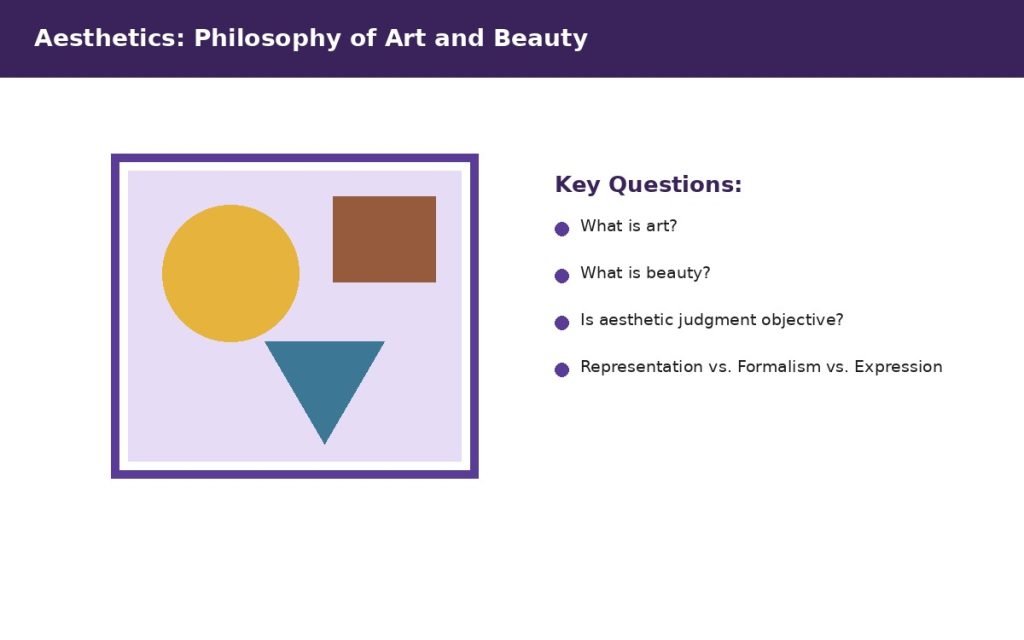
What makes something a work of art? Can beauty be judged objectively, or is it always “in the eye of the beholder”? Aesthetics — the branch of philosophy concerned with art, beauty, and taste — takes these seemingly casual questions and subjects them to rigorous philosophical analysis. This guide covers the major theories of art (representation, formalism, expression, and institutional theory), the debate over objective versus subjective beauty, and Kant’s influential account of aesthetic judgment, with detailed worked examples for assignments. This topic connects to normative ethical theories (can art be morally evaluated the way actions are?) and to epistemology (can aesthetic judgments be objectively justified?).
Table of Contents
Toggle1. What Is Aesthetics?
Aesthetics is the philosophical study of beauty, art, and taste, addressing questions such as: What is art? What makes something beautiful? Are aesthetic judgments (“this painting is beautiful”) objective facts, subjective preferences, or something in between? Is there a meaningful distinction between “high art” and popular or decorative art?
2. Theories of Art: What Makes Something Art?
2.1 The Representational (Mimetic) Theory
Whether an artist freely chooses their style or is largely shaped by training, tradition, and unconscious habit connects to the debate over agency covered in Free Will and Determinism.
The oldest theory of art, tracing back to Plato and Aristotle, holds that art is fundamentally imitation (mimesis) — the representation of reality, whether physical appearances, human action, or emotional truth.
Worked Example: A realistic portrait painting or a novel depicting a believable family drama fits comfortably within the representational theory: their value lies substantially in how accurately or insightfully they depict their subject. Aristotle, in his Poetics, actually praised mimesis positively (unlike Plato, who was suspicious of art as a mere “copy of a copy” removed from true reality), arguing that tragic drama’s imitation of action produces valuable emotional catharsis in the audience.
Worked Example — Objection: Representational theory struggles badly with abstract art. A Jackson Pollock drip painting or a Kandinsky composition of shapes and colors represents nothing recognizable at all, yet is widely accepted as genuine, significant art — suggesting representation cannot be a necessary condition for something to count as art.
2.2 Formalism
Formalism, associated with critics like Clive Bell and Clement Greenberg, holds that what makes something art (and what makes it good art) is its formal properties — line, color, shape, composition, balance — considered independently of subject matter, representational accuracy, or the artist’s intentions and emotions.
Worked Example: Bell’s concept of “significant form” holds that certain combinations of formal elements evoke a distinctive aesthetic emotion in viewers, regardless of what (if anything) the artwork depicts. This is precisely why abstract art, which formalism handles well, was such an important test case for early twentieth-century aesthetic theory — a Mondrian grid of colored rectangles can be appreciated purely for its balance and composition, with no representational content at all.
Worked Example — Objection: Formalism struggles to account for art that seems to derive much of its value from context, narrative, or conceptual content rather than pure form — a photorealistic painting of a historical atrocity, or a piece of conceptual art whose entire point is an idea rather than any visually pleasing arrangement, seems to have artistic value formalism cannot easily explain.
2.3 Expression Theory
Expression theory, associated with Leo Tolstoy and R.G. Collingwood, holds that art is fundamentally the expression and communication of emotion from artist to audience.
Worked Example: Tolstoy argued that a folk song sung with genuine feeling that successfully transmits that feeling to listeners is a more successful work of art, by this theory’s standard, than a technically skilled but emotionally hollow painting — value lies in successful emotional communication, not technical representation or formal composition. Collingwood further distinguished genuine “expression” (a creative, exploratory process by which the artist comes to understand their own emotion through the act of making the work) from mere “arousal” (deliberately manipulating an audience’s emotions, as an advertisement or propaganda poster might do) — only the former counts as true art on his view.
Worked Example — Objection: Expression theory struggles to explain highly intellectual or purely decorative art that doesn’t seem centrally about emotional expression at all — a mathematically precise Escher tessellation, or a minimalist Donald Judd sculpture, seems to be valuable art without primarily expressing or communicating any particular emotion.
2.4 The Institutional Theory of Art
Evaluating whether the institutional theory is genuinely circular, as critics allege, requires the same standards of logical argument analysis covered in Logic: Deductive and Inductive Reasoning.
Developed by George Dickie in response to the difficulty of defining art by any single intrinsic property, the institutional theory holds that something is art if it is created with the intention of being presented to an “artworld” public, and is accepted as a candidate for appreciation by the relevant institutions and practices of the art world (galleries, critics, museums, artists).
Worked Example — Duchamp’s “Fountain”: Marcel Duchamp’s famous 1917 work Fountain was simply a manufactured urinal, signed with a pseudonym and submitted to an exhibition. It has no representational content in any traditional sense, no significant formal composition beyond an ordinary industrial object, and expresses no obvious emotion — yet it is now considered one of the most influential artworks of the twentieth century. The institutional theory explains this by pointing to the act of presenting the object to the art world as a candidate for aesthetic status, radically shifting focus away from any intrinsic property of the object itself and toward the surrounding social and institutional context.
Worked Example — Objection: Critics argue the institutional theory is circular or unhelpfully deflationary — it seems to say “art is whatever the art world calls art,” without explaining why the art world confers that status on some objects and not others, or what justifies its authority to do so in the first place.
3. Is Beauty Objective or Subjective?
3.1 The Subjectivist View
The question of whether cultural institutions and shared practices, rather than individual judgment, ultimately determine aesthetic standards echoes debates about collective authority explored in Social Contract Theory.
The common saying “beauty is in the eye of the beholder” captures aesthetic subjectivism: beauty is not a property of objects themselves, but a response or reaction in the mind of the perceiver, varying with individual taste, culture, and historical period.
Worked Example: Standards of physical beauty have shifted dramatically across historical periods and cultures (compare the body types idealized in Renaissance paintings to contemporary fashion imagery), which subjectivists cite as evidence that beauty tracks contingent cultural preference rather than any objective, mind-independent property of the objects themselves.
3.2 Hume’s Moderate Subjectivism and the “Ideal Critic”
David Hume, in his essay “Of the Standard of Taste,” acknowledged that beauty is fundamentally a matter of subjective sentiment, yet argued that not all aesthetic judgments are equally valid. He proposed that the judgments of an “ideal critic” — someone with strong sensitivity, extensive practice, freedom from prejudice, and comparative experience across many works — provide a genuine standard by which to evaluate competing aesthetic judgments, even without positing beauty as a fully mind-independent property.
Worked Example: Hume argues that a novice who has read little literature and a widely-read, experienced literary critic may disagree about whether a particular novel is well-crafted, but we should generally give more weight to the critic’s judgment, since their extensive comparative experience makes their sentiment a more reliable guide — even though, strictly, both judgments remain sentiments rather than perceptions of an objective, mind-independent fact.
3.3 Kant’s Account: Subjective Universality
Immanuel Kant offered an especially influential middle position in his Critique of Judgment. He argued that a genuine aesthetic judgment (a “judgment of taste”) is subjective (grounded in a feeling of pleasure in the observer, not a conceptual fact about the object) yet claims universal validity — when you judge something beautiful, you are not merely reporting a private preference (like preferring chocolate to vanilla) but implicitly claiming that everyone else ought to agree, even though this claim cannot be proven through concepts or argument.
Worked Example: Kant distinguishes “this is beautiful” from “this is agreeable” (merely pleasant to me personally, like a favorite food). If you say a sunset is beautiful, you are implicitly inviting others to share your judgment and would be genuinely puzzled, not merely indifferent, if someone denied it — unlike a mere preference for a particular flavor, where disagreement doesn’t produce the same sense that the other person is somehow missing something real. This distinctive combination of subjectivity (grounded in feeling) and claimed universality (implicitly demanding others’ agreement) is what Kant considered the defining, puzzling feature of aesthetic judgment.
3.4 Disinterested Pleasure
Central to Kant’s account is the idea that genuine aesthetic appreciation involves disinterested pleasure — pleasure taken in an object’s mere representation or form, entirely apart from any desire to possess, consume, or use it.
Worked Example: Admiring the beauty of a piece of fruit in a still-life painting is, for Kant, a purely aesthetic (disinterested) pleasure, distinct from the practical desire to actually eat the fruit if it were real and in front of you. If your interest in an object is bound up with wanting to possess or use it, Kant argues your response is not a pure judgment of taste but is contaminated by practical interest.
4. Art and Morality
A long-running debate in aesthetics concerns whether an artwork’s moral content or effects are relevant to its artistic value.
4.1 Moralism, Autonomism, and Moderate Positions
- Ethicism/Moderate Moralism holds that the moral qualities of a work can genuinely enhance or diminish its aesthetic value — a work that manipulates viewers into endorsing a morally repugnant perspective may thereby be aesthetically worse, not merely morally objectionable.
- Radical Autonomism holds that aesthetic and moral value are entirely independent — a technically brilliant but morally repugnant work (propaganda films are the classic contested case) should be judged purely on artistic merit, with moral evaluation treated as a wholly separate question.
Worked Example: Leni Riefenstahl’s Triumph of the Will, a technically innovative propaganda film glorifying the Nazi regime, is the textbook case debated in this literature — a moderate moralist would argue its moral content actually undermines its aesthetic success (since it demands the viewer adopt a morally distorted perspective to fully appreciate its intended effect), while a strict autonomist would insist its technical and formal brilliance as filmmaking can and should be evaluated entirely apart from its abhorrent political content. This debate connects directly to the frameworks compared in normative ethical theories, since resolving it requires a view about how moral and aesthetic value relate to each other in the first place.
5. The Paradox of Fiction and Emotional Response
Existentialist writers took fiction especially seriously as a philosophical medium in its own right, a theme developed further in Existentialism.
A distinctive puzzle in aesthetics, the paradox of fiction, asks how we can have genuine emotional responses (fear, grief, sympathy) to characters and events we know to be fictional.
Worked Example: Why do audiences genuinely feel sad at a fictional character’s death in a novel, even though they know, with full rational certainty, that the character never existed and nothing bad has actually happened? This seems to violate the ordinary principle that emotions require belief in the reality of their object (you don’t typically fear a monster you know for certain isn’t real). Proposed solutions include the idea that fiction engages a kind of “make-believe” quasi-emotion distinct from ordinary belief-based emotion, or that readers form genuine beliefs about the fictional world “within the story” that are sufficient to trigger real emotional responses even while full awareness of the fiction’s unreality persists alongside them.
6. Common Assignment Pitfalls
Questions about whether an artist’s body of work remains recognizably “the same” across a career of stylistic change connect to the puzzles of persistence over time examined in Personal Identity and Theories of the Self. And whether aesthetic judgments can ever be tested and refined the way scientific hypotheses are is a demarcation question explored in Philosophy of Science and the Scientific Method.
- Treating “beauty” and “art” as interchangeable — something can be art without being conventionally beautiful (grotesque or disturbing works), and something can be beautiful without being art (a sunset, a mathematical proof).
- Assuming formalism and representational theory are mutually exclusive in every case — many works can be analyzed through multiple theoretical lenses simultaneously, and a strong essay often uses several theories to illuminate different aspects of the same work.
- Dismissing the institutional theory as simply “unhelpful” without engaging with the genuine problem it responds to — namely, that no purely intrinsic-property theory (representation, form, expression) has successfully accounted for cases like Duchamp’s Fountain.
- Conflating Kant’s “subjective universality” with simple subjectivism — Kant’s account is specifically designed to explain why aesthetic disagreement feels different from disagreement about mere personal taste, a nuance worth highlighting for a stronger essay.
7. Applying These Concepts: A Sample Assignment Response
Question: “Can Duchamp’s Fountain be considered art? Evaluate using at least two theories of art.”
Sample structured answer: Apply the representational theory first, noting that Fountain represents nothing and would likely fail this test as art. Apply formalism next, noting that a manufactured urinal has little in the way of deliberately composed formal qualities, so this theory also struggles to classify it as art (or would need to stretch its criteria considerably). Apply the institutional theory, explaining how Fountain‘s presentation to a gallery exhibition and its subsequent acceptance by art-world institutions and critics satisfies this theory’s criteria straightforwardly. Conclude by evaluating which theory offers the most satisfying account of this specific case, and whether the case reveals a genuine weakness in the representational and formalist theories or simply shows their limited scope for classifying conceptual art specifically.
Aesthetics draws on the same evaluative tools used in normative ethical theories (how do we justify value judgments?) and raises justification questions closely related to epistemology (can aesthetic judgments be objectively true?). It also intersects with philosophy of mind, since the paradox of fiction in Section 5 raises deep questions about the nature of emotion and belief. Practice applying at least two competing theories of art to the same specific example — as demonstrated in Section 7 — since this comparative approach is exactly what strong aesthetics essays require.
If you’re struggling to turn these theories into a structured university essay, philosophy assignment writing support can help you develop the argument, compare competing theories, and present the analysis clearly.
Frequently Asked Questions
What is the difference between formalism and expression theory in art? Formalism holds that artistic value lies in an artwork’s formal properties (line, color, composition), independent of what it represents or expresses. Expression theory holds that artistic value lies in the successful communication of genuine emotion from artist to audience. A work can score differently under each theory.
Why is Duchamp’s “Fountain” important in philosophy of art? It is the classic test case that most intrinsic-property theories of art (representation, formalism, expression) struggle to classify as art, motivating the development of the institutional theory, which locates artistic status in the surrounding social and institutional context rather than any property of the object itself.
Is beauty objective or subjective according to philosophers? There is no single accepted answer. Subjectivists hold beauty is purely a response in the observer’s mind; Hume proposed a moderate position using the standard of an “ideal critic”; Kant argued aesthetic judgments are subjective in origin but claim universal validity, a distinctive middle position most philosophy of art courses treat as especially influential.
Should art be judged separately from its moral content? Philosophers disagree. Moderate moralists argue a work’s moral content can genuinely affect its aesthetic value; radical autonomists argue aesthetic and moral value should be evaluated as entirely separate questions, regardless of how morally troubling the content is.
What is the paradox of fiction? It is the puzzle of how audiences can have genuine emotional responses to characters and events they know to be fictional, apparently violating the usual assumption that emotions require believing their object is real.