
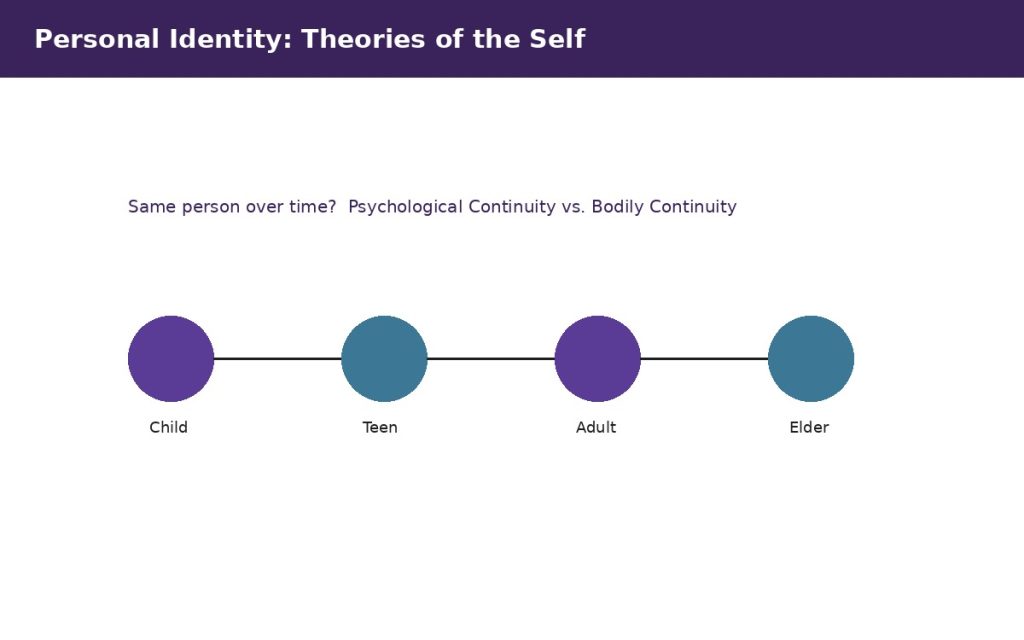
What makes you the same person you were ten years ago, despite the fact that nearly every cell in your body has been replaced and your personality, memories, and beliefs have changed substantially? This is the problem of personal identity, one of the most puzzling topics in metaphysics. This guide covers the major theories — psychological continuity, bodily/biological continuity, and the bundle theory — along with the classic thought experiments used to test them, with detailed examples for assignments. This topic connects directly to philosophy of mind (is the self identical to the mind or brain?) and free will and determinism (can a continuously changing self be the “same” agent responsible for past choices?).
Table of Contents
Toggle1. Framing the Problem
The methods philosophers use to test rival theories of personal identity — constructing precise thought experiments and checking their logical consequences — closely mirror the hypothesis-testing approach discussed in Philosophy of Science and the Scientific Method.
The problem of personal identity asks: what are the necessary and sufficient conditions for a person existing at one time (say, you at age 10) to be numerically identical — literally one and the same entity, not merely similar — to a person existing at another time (you right now)? This is a metaphysical question distinct from questions about what makes someone the “same kind of person” in a looser, qualitative sense (having a similar personality).
2. The Psychological Continuity Theory
The dominant contemporary approach, tracing back to John Locke, holds that personal identity over time consists in psychological continuity — an overlapping chain of connected mental states (memories, beliefs, desires, personality traits, intentions).
2.1 Locke’s Memory Criterion
Worked Example: Locke proposed that personal identity is grounded specifically in memory: person A at time 1 is the same person as person B at time 2 if and only if B can remember (from a first-person, experiential perspective) the experiences of A. Locke’s famous illustration involves a prince and a cobbler: if the prince’s consciousness (including all his memories) were somehow transferred into the cobbler’s body, Locke argues we should say the prince now inhabits the cobbler’s body — personal identity follows consciousness/memory, not the physical body.
2.2 The Circularity/Transitivity Objection
Worked Example — The Brave Officer Case: Thomas Reid raised a classic objection: suppose an elderly general remembers being a brave young officer, and the brave young officer remembered (much earlier in his life) being a mischievous schoolboy — but the elderly general has entirely forgotten his schoolboy days. According to Locke’s strict memory criterion, the general is identical to the officer (memory connection holds), and the officer is identical to the schoolboy (memory connection holds), yet the general is not identical to the schoolboy (no memory connection). This violates the logical requirement that identity must be transitive (if A=B and B=C, then A=C must hold) — a serious problem for Locke’s simple memory criterion.
2.3 Parfit’s Refinement: Overlapping Chains of Psychological Connectedness
Derek Parfit refined the theory to solve the Brave Officer problem by defining personal identity in terms of overlapping chains of psychological connectedness (direct memory links, or continuity of intentions, beliefs, and personality traits) rather than requiring a single, direct memory link between every pair of time-slices. On this revised view, the general is continuous with the schoolboy through an unbroken chain of overlapping psychological links (general-to-officer, officer-to-schoolboy), even without any single direct memory connecting the endpoints.
2.4 The Teletransportation Thought Experiment
Worked Example: Imagine a teletransporter that scans your body and brain in complete detail, destroys the original, and instantly creates a perfect physical and psychological replica on Mars — with all your memories, personality, and beliefs intact. Is the person who steps out on Mars really you, or merely a psychological duplicate who mistakenly believes they are you? Psychological continuity theorists argue this is (or is enough like) survival, since all the relevant psychological connections are preserved. Critics worry this seems to overlook something important about physical, spatiotemporal continuity that our ordinary concept of personal identity seems to require.
2.5 The Branching Problem
Worked Example: Now imagine the teletransporter malfunctions and creates two perfect replicas — one on Mars and one on Venus — both with identical claims to psychological continuity with the original. Since numerical identity is a strict one-to-one relationship (you cannot be identical to two distinct people at once, since if both Mars-you and Venus-you were identical to original-you, they would have to be identical to each other, yet they are clearly two distinct, separately existing people), this branching case seems to show that psychological continuity alone cannot be sufficient for strict numerical identity — a serious challenge that has led some, like Parfit, to conclude that identity itself may not be what ultimately matters for survival.
3. The Bodily (Biological) Continuity Theory
An alternative approach locates personal identity in the continued existence of the same physical organism (typically the brain, or the whole biological body) rather than in psychological connections.
3.1 The Basic View
On this animalist view, you are fundamentally a biological organism (a human animal), and you persist over time in whatever way any living organism persists — through continuous biological/organic function, regardless of psychological changes, memory loss, or even complete personality transformation.
Worked Example: Consider a patient with severe amnesia or advanced dementia who has lost all their memories and can no longer recognize loved ones. Psychological continuity theories struggle here, since the psychological connections that supposedly ground identity have been severely disrupted or destroyed. Animalists argue this case is actually straightforward: the patient is still the very same biological organism that existed before the memory loss, so personal identity is clearly preserved — accounting for the strong, widely shared intuition that this patient is still “the same person” (in the numerical identity sense) despite the profound psychological discontinuity.
3.2 The Ship of Theseus Problem Applied to Bodies
Worked Example: Just as the classic Ship of Theseus puzzle asks whether a ship remains “the same ship” after all its planks have gradually been replaced over time, human bodies undergo constant cellular turnover — most of your body’s cells are replaced over a period of years. If bodily continuity requires literal persistence of physical matter, this raises the puzzle of how you can be bodily identical to your childhood self when almost none of the original physical matter remains — animalists typically respond by emphasizing continuous biological organization and function (the persisting form and life-process of the organism) rather than the persistence of any specific physical matter, similar to how a river remains “the same river” despite the water constantly flowing through and changing.
3.3 Objections to Bodily/Animalist Theories
Critics raise the “transplant intuition”: if your brain (with all its memories and psychological traits) were transplanted into an entirely different body, most people’s strong intuition is that “you” would go wherever your brain (and its associated psychology) goes, not that “you” would remain behind in your original body while a psychologically alien stranger now occupies it — this intuition favors a psychological (or at least brain-based) account over the broader whole-body animalist view, and it’s precisely this intuition that motivated Locke’s original prince-and-cobbler thought experiment in Section 2.1.
4. The Bundle Theory / No-Self View
A more radical position, associated with David Hume and (in a very different tradition) Buddhist philosophy, denies that there is any persisting, unified “self” underlying our experiences at all.
4.1 Hume’s Bundle Theory
Worked Example: Hume famously reported that whenever he introspected — looked inward at his own mind — he never encountered a persisting “self” as a distinct entity, but only a constantly shifting bundle of particular perceptions, sensations, memories, and emotions, one following another, with no additional unifying “self” standing behind or beyond this bundle to observe them. On Hume’s view, the sense of a unified, continuous self is something the mind constructs (through the natural relations of resemblance and causation among our perceptions), rather than something we directly perceive as an independently existing metaphysical entity.
4.2 The Buddhist Doctrine of Anatta (No-Self)
Buddhist philosophy independently arrives at a related conclusion through the doctrine of anatta (non-self): what we conventionally call a “person” is actually a constantly changing bundle of five aggregates (physical form, sensations, perceptions, mental formations, and consciousness), with no fixed, permanent, independently existing self underlying them — clinging to a false belief in a fixed self is, in this tradition, considered a primary source of suffering.
4.3 Objections to the Bundle/No-Self View
Critics argue that a mere “bundle” of disconnected perceptions cannot adequately explain unified conscious experience (why do all these particular perceptions feel like they belong to a single subject, rather than being scattered, disconnected experiences with no owner?), nor can it easily account for the strong practical and moral significance we place on personal identity — such as holding someone responsible today for a promise or crime committed by “the same person” years earlier, a concept that seems to require more than a merely conventional, constructed bundle.
5. Why Does Personal Identity Matter? Parfit’s Radical Conclusion
Derek Parfit, after extensively analyzing puzzle cases like teletransportation and branching (Section 2.4–2.5), controversially argued that strict numerical identity may not actually be what matters for the things we typically care about (survival, prudential concern for our future, moral responsibility).
Worked Example: Parfit argues that what we truly care about in survival is really the holding of strong psychological continuity and connectedness — and this can come in degrees, and can even branch (as in the Mars/Venus case), without requiring strict, all-or-nothing numerical identity. If this is right, questions like “will I survive this teletransportation?” may be based on a confused presupposition (that survival requires strict identity), and the more precise, philosophically correct question is simply “will there be a psychologically continuous successor, or several?” — a genuinely radical reconceptualization of what matters in personal survival.
6. Common Assignment Pitfalls
- Confusing numerical identity (being one and the same entity) with qualitative identity (being similar or alike in characteristics) — personal identity theories are specifically about the former.
- Assuming psychological continuity theories require that all memories persist perfectly — Parfit’s refined version (Section 2.3) only requires overlapping chains of connectedness, not universal, direct memory links.
- Treating the teletransportation and branching thought experiments as merely fanciful science fiction irrelevant to “real” philosophy — these thought experiments are specifically designed to isolate and test our underlying intuitions and theoretical commitments in ways ordinary cases cannot.
- Forgetting that Parfit’s conclusion is not simply “psychological continuity theory is true,” but the more radical claim that identity itself may not be what fundamentally matters — a distinction worth highlighting for a stronger, more nuanced essay.
7. Applying These Concepts: A Sample Assignment Response
Question: “Does the branching (fission) case show that psychological continuity cannot be a sufficient condition for personal identity?”
Sample structured answer: Present the psychological continuity theory (Section 2) and the branching thought experiment (Section 2.5), explaining why the case creates a genuine logical problem for treating psychological continuity as sufficient for strict numerical identity (since identity cannot logically hold between one person and two distinct successors simultaneously). Present Parfit’s response (Section 5) — that this problem actually reveals identity was never truly what mattered in the first place, and that we should instead focus on psychological continuity/connectedness directly, accepting that it can branch even though strict identity cannot. Evaluate whether this response adequately resolves the puzzle, or merely redefines the question to avoid it, noting objections from those (like animalists) who maintain that ordinary identity claims (as opposed to Parfit’s revisionary “what matters” framework) remain philosophically indispensable for practices like promising, moral responsibility, and prudential planning.
Personal identity theory intersects deeply with philosophy of mind (is the self identical with the mind, brain, or something else entirely?) and free will and determinism (moral responsibility presupposes that the agent who acted and the agent being held responsible are the same person). Practice applying each theory (psychological, bodily, bundle) to the same thought experiment (teletransportation is especially useful) — comparing all three side by side is the most effective way to demonstrate command of this topic in an exam.
Locke’s memory criterion, discussed in Section 2.1, was developed as part of his broader empiricist theory of knowledge, covered in Epistemology and Theories of Knowledge. Whether responsibility for a past action requires strict identity with one’s past self connects directly to the ethical theories surveyed in Normative Ethical Theories. Evaluating the logical consistency of the Brave Officer case and the branching thought experiment relies on the standards of valid inference covered in Logic: Deductive and Inductive Reasoning. Locke’s account of the self as continuous consciousness also underwrites his theory of political consent, examined in Social Contract Theory. Sartre’s claim that the self is nothing but its freely chosen actions offers an existentialist alternative to both the psychological and bodily continuity theories, explored in Existentialism. And an artist’s body of work is often treated as an extension of their identity across time, raising the question of what continuity of style or vision actually requires — a puzzle explored in Aesthetics: Philosophy of Art and Beauty.
If you need support developing a personal identity essay, comparing competing theories, or turning thought experiments into a well-structured philosophical argument, personal identity philosophy assignment support can help you approach the assignment systematically.
Frequently Asked Questions
What is the difference between numerical and qualitative identity? Numerical identity means being one and the same entity (not merely similar). Qualitative identity means being alike or similar in characteristics. Personal identity theories are specifically about numerical identity over time.
What is Locke’s memory theory of personal identity? Locke argued that personal identity consists in psychological continuity grounded in memory: you are the same person as someone at an earlier time if you can remember their experiences from a first-person perspective.
Why is the teletransportation thought experiment important? It tests whether personal identity requires physical continuity or only psychological continuity, and the related “branching” version (where two replicas are created) reveals a serious logical problem for treating psychological continuity as sufficient for strict identity.
What is the bundle theory of the self? Associated with Hume, it is the view that there is no persisting, unified “self” beyond a constantly changing bundle of perceptions, memories, and sensations — a position echoed independently in Buddhist philosophy’s doctrine of anatta (non-self).
Does personal identity theory have any practical importance? Yes — it underlies practices like moral responsibility (punishing someone today for a crime committed years ago), promising, and prudential planning for one’s own future, all of which assume some meaningful continuity of the self over time.