
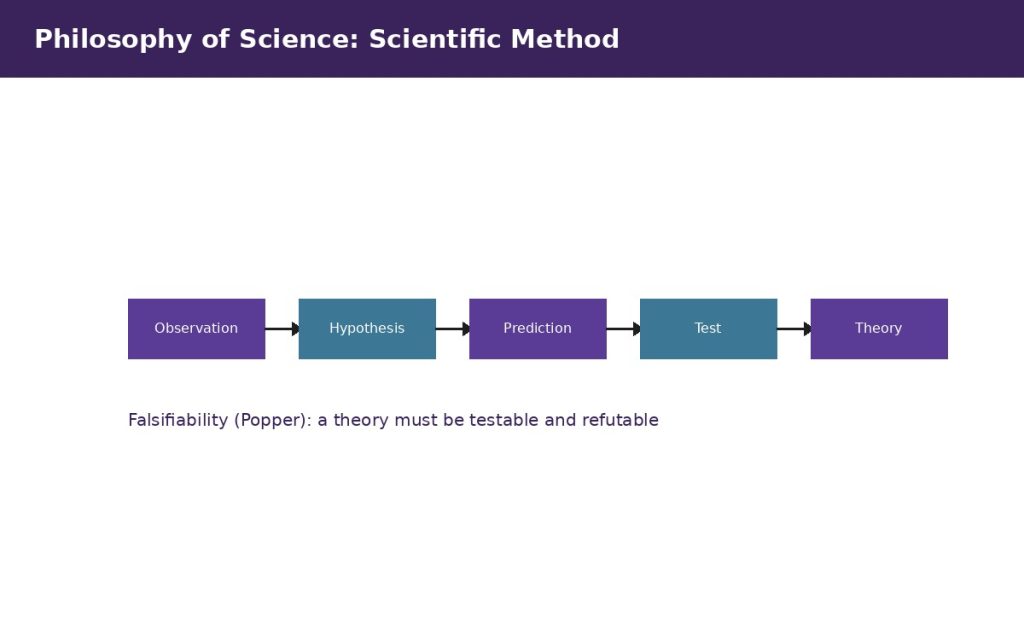
What makes science different from pseudoscience? How do scientific theories actually get justified, and can we ever be certain a scientific theory is true? This guide covers falsifiability, the demarcation problem, Kuhn’s theory of paradigm shifts, and the underdetermination of theory by evidence, with detailed worked examples for assignments. This topic builds directly on epistemology (how is scientific knowledge justified?) and logic (the problem of induction underlying scientific generalization).
Table of Contents
Toggle1. The Problem of Induction Revisited
Scientific theories about human cognition and development also raise the question of whether the reasoning subject remains the same entity across the course of an experiment or a lifetime of observation, a puzzle taken up in Personal Identity and Theories of the Self.
As discussed in logic, David Hume pointed out that inductive generalization (inferring general laws from finite observed instances) can never be strictly justified without circularity — no matter how many white swans we observe, we cannot logically guarantee the next swan won’t be black. Since science relies heavily on generalizing from observed instances to universal laws, this poses a foundational challenge: how can scientific theories, built on induction, ever be genuinely justified rather than merely convenient habits of thought?
2. Karl Popper and Falsifiability
Karl Popper’s response to the problem of induction was radical: he argued that science does not, and should not, proceed by verifying theories through accumulating confirming evidence at all. Instead, genuine science proceeds by attempting to falsify theories through rigorous testing.
2.1 The Asymmetry Between Verification and Falsification
Worked Example: No finite number of observations of white swans can logically prove the universal claim “all swans are white” (since some unobserved swan might be black) — but a single observation of one genuinely black swan can logically disprove it, with the certainty of deductive logic (modus tollens: if all swans are white, and this swan is not white, then not all swans are white). Popper argued this fundamental logical asymmetry between verification (impossible with certainty) and falsification (possible with certainty) should reshape our understanding of scientific method: good scientific theories are ones that make bold, specific, falsifiable predictions, and survive repeated, genuine attempts to falsify them — rather than theories that are merely compatible with existing evidence.
2.2 Falsifiability as the Demarcation Criterion
Popper proposed falsifiability as his solution to the demarcation problem — the challenge of specifying exactly what distinguishes genuine science from non-science or pseudoscience.
Worked Example — Astrology vs. Astronomy: Popper argued that astrology typically fails the falsifiability test because its predictions (“you will face challenges but also opportunities this week”) are vague and flexible enough to be interpreted as confirmed by almost any actual outcome — no possible observation could count as clearly refuting it. Astronomy, by contrast, makes precise, falsifiable predictions (e.g., the exact time and location a solar eclipse will be visible) that could, in principle, be shown false by a failed observation — this sharp contrast is exactly what Popper’s criterion is designed to capture.
Worked Example — Freud and Adler vs. Einstein: Popper famously contrasted Freudian and Adlerian psychoanalytic theories, which he argued could accommodate virtually any human behavior after the fact (a man who abandons his child could be explained by either theory as easily as a man who rescues a drowning child from the same river, since both theories are flexible enough to retroactively “explain” opposite behaviors), with Einstein’s general relativity, which made a precise, risky, falsifiable prediction (the bending of starlight around the sun, measurable during a solar eclipse) that could have straightforwardly failed the 1919 Eddington expedition’s test — but did not, providing genuine, high-stakes corroboration precisely because failure was a real possibility.
2.3 Objections to Falsificationism
Critics point out that in actual scientific practice, a single anomalous or seemingly falsifying observation rarely leads scientists to immediately abandon a well-established theory — instead, they often (reasonably) question the auxiliary assumptions, instruments, or background conditions of the observation itself. This connects to the Duhem-Quine thesis discussed below, which poses a serious challenge to simple falsificationism.
3. The Duhem-Quine Thesis and Underdetermination
3.1 No Theory Is Tested in Isolation
Worked Example: Suppose astronomers predict, based on Newtonian mechanics, exactly where a planet should appear in the sky at a given time — but the planet is observed at a different location. Pierre Duhem and later W.V.O. Quine pointed out that this apparent falsification doesn’t cleanly refute Newtonian mechanics alone, because the prediction actually depended on a whole web of auxiliary assumptions (the accuracy of the telescope, the absence of other unknown gravitational influences, the correctness of background astronomical data, etc.). Historically, exactly this kind of anomaly (in the observed orbit of Uranus) led not to abandoning Newtonian mechanics, but to hypothesizing a new, previously unobserved planet — which led to the successful prediction and discovery of Neptune. A single falsifying observation, therefore, never uniquely identifies which specific piece of a broader theoretical web is actually at fault — a serious complication for Popper’s simple falsificationist picture.
3.2 Underdetermination of Theory by Evidence
The underdetermination thesis generalizes this point: for any given body of evidence, there may exist multiple, genuinely incompatible theories that are equally well supported by that evidence, meaning the evidence alone cannot logically determine a single uniquely correct theory — additional considerations (simplicity, explanatory scope, coherence with other accepted theories) must play a role in theory choice, beyond pure logical inference from the data.
4. Thomas Kuhn and Paradigm Shifts
Thomas Kuhn’s The Structure of Scientific Revolutions (1962) offered an influential alternative picture, based on the actual history of science rather than an idealized logical reconstruction of scientific method.
4.1 Normal Science and Paradigms
Kuhn argued that mature scientific fields operate within a paradigm — a shared framework of theories, methods, standards, and exemplary problem-solutions that structures the field’s practice. Most scientific activity, which Kuhn called “normal science,” consists of solving specific puzzles within the accepted paradigm, rather than fundamentally questioning the paradigm itself.
4.2 Anomalies and Crisis
Worked Example: Over time, a paradigm accumulates unresolved anomalies — observations or results that resist explanation within the existing framework. Initially, scientists tend to treat these as puzzles to be solved later, or attribute them to experimental error, rather than treating them as genuine threats to the paradigm (consistent with the Duhem-Quine point above). If anomalies accumulate and resist resolution, the field can enter a state of crisis, opening the door to genuinely revolutionary alternative theories.
4.3 Scientific Revolutions and Incommensurability
Worked Example: Kuhn’s paradigm case is the shift from Ptolemaic (Earth-centered) to Copernican (Sun-centered) astronomy, and later, the shift from Newtonian mechanics to Einsteinian relativity. Kuhn controversially argued that paradigm shifts are not simply a matter of rationally, straightforwardly replacing a false theory with a better-confirmed true one — rather, competing paradigms can be “incommensurable,” meaning they involve such fundamentally different concepts, standards, and even ways of perceiving evidence that scientists working within different paradigms may, in a sense, be “seeing” a different world and even struggle to fully understand or fairly compare each other’s positions — a claim that has drawn accusations of promoting relativism about scientific truth, which Kuhn spent much of his later career trying to clarify and soften.
4.4 Objections to Kuhn
Critics (including Popper’s student Imre Lakatos) worry that Kuhn’s picture makes scientific progress seem less rational and more like a matter of sociological fashion or persuasion among competing scientific communities than a matter of evidence and logic — though defenders argue Kuhn was describing the actual sociological and historical process of science, not necessarily denying that later paradigms are, by ordinary standards like predictive accuracy and problem-solving power, genuinely better than earlier ones.
5. Lakatos’s Research Programmes: A Middle Path
Imre Lakatos attempted to combine insights from both Popper and Kuhn, proposing that science should be understood in terms of research programmes with a protected “hard core” of central assumptions surrounded by a flexible “protective belt” of auxiliary hypotheses that can be revised in response to anomalies (addressing the Duhem-Quine problem), while still offering an account of rational theory-choice: a progressive research programme is one that continues to generate genuinely novel, successful predictions, while a degenerating programme merely adds ad hoc patches to accommodate anomalies without making new, successful predictions.
6. Common Assignment Pitfalls
- Treating Popper’s falsifiability criterion as though it straightforwardly and uncontroversially solves the demarcation problem — always mention the Duhem-Quine challenge and the historical difficulty of applying strict falsificationism to real scientific practice.
- Assuming Kuhn’s theory implies that scientific theory choice is entirely irrational or arbitrary — Kuhn’s actual, more nuanced position (especially in his later work) allows for reasoned, if not strictly algorithmic, theory comparison based on shared values like accuracy, simplicity, and fruitfulness.
- Confusing the demarcation problem (what makes something science vs. pseudoscience) with the problem of induction (how is inductive reasoning justified) — these are related but distinct problems in philosophy of science.
- Forgetting to note that historical case studies (Neptune’s discovery, the Eddington eclipse expedition) are exactly the kind of concrete evidence that strengthens a philosophy of science essay far more than purely abstract argument.
7. Applying These Concepts: A Sample Assignment Response
Question: “Does Popper’s falsifiability criterion successfully solve the demarcation problem?”
Sample structured answer: Present Popper’s falsifiability criterion and its motivating logical asymmetry between verification and falsification (Section 2.1), with the astrology/astronomy and Freud/Einstein examples (Section 2.2). Present the Duhem-Quine challenge (Section 3.1), explaining how it complicates simple falsificationism, since no single observation can cleanly falsify an isolated theory apart from its auxiliary assumptions. Introduce Kuhn’s alternative, more historically grounded picture (Section 4) as a further complication, noting that actual scientific practice does not always immediately abandon theories after apparently falsifying results. Conclude with a reasoned judgment: perhaps falsifiability remains a useful rough guide to distinguishing genuine science from pseudoscience (astrology genuinely does seem unfalsifiable in a way physics does not), even if it fails as a strict, fully precise logical criterion once the complications from Duhem-Quine and Kuhn are taken fully into account.
Philosophy of science depends heavily on the reasoning tools developed in logic (deductive validity, the problem of induction) and connects to broader epistemology debates about justification and the sources of knowledge. Practice applying the demarcation criteria (falsifiability, and Lakatos’s progressive/degenerating distinction) to real historical case studies from your own science coursework — this concrete application is what separates a strong philosophy of science essay from a merely abstract, definitional one.
If you’re working on a philosophy of science essay and need help developing the argument, comparing philosophers, or structuring your analysis, philosophy of science assignment help can provide additional academic support.
8. Feyerabend and Epistemological Anarchism
Paul Feyerabend pushed the historical, sociological critique of scientific method even further than Kuhn, arguing in Against Method that there is no single, universal scientific method at all that has actually produced scientific progress across history.
Worked Example: Feyerabend famously argued that Galileo’s own defense of heliocentrism against the dominant Aristotelian/Ptolemaic paradigm did not proceed through strict, disciplined adherence to a fixed methodological rulebook, but often involved rhetorical persuasion, ad hoc auxiliary hypotheses, and willingness to violate then-standard empirical and methodological norms (for instance, defending observations made through the newly invented and still somewhat unreliable telescope against reasonable contemporary skepticism about the instrument’s accuracy). Feyerabend’s provocative slogan, “anything goes,” was meant to capture his view that rigid methodological rules, if strictly enforced, would have blocked many of history’s most important scientific breakthroughs, and that scientific progress instead requires a flexible, pluralistic willingness to break with established method when creative theoretical progress demands it. Critics worry this position risks collapsing the distinction between science and pseudoscience entirely (undermining even Popper’s demarcation project from Section 2), while defenders argue Feyerabend was specifically targeting rigid, prescriptive philosophical accounts of method, not denying that science has rational, evidence-based standards of evaluation after the fact.
Popper’s falsifiability criterion was developed partly in response to deterministic-sounding psychoanalytic theories, a contrast that connects to the causal picture of action examined in Free Will and Determinism. Whether scientific consensus alone should guide moral or policy decisions is a question taken up in Normative Ethical Theories. Kuhn’s claim that scientists working in different paradigms may perceive evidence differently echoes debates about the mind’s role in shaping experience, discussed in Philosophy of Mind and the Mind-Body Problem. Scientific institutions themselves rest on collectively agreed norms and authority structures not unlike those examined in Social Contract Theory. Kuhn’s picture of incommensurable paradigms has also been compared to the existentialist idea that individuals inhabit fundamentally different, freely chosen worldviews, a theme explored in Existentialism. And whether aesthetic judgments about elegance and simplicity in a scientific theory are themselves evidence of truth, or merely a matter of taste, is a question examined in Aesthetics: Philosophy of Art and Beauty.
Frequently Asked Questions
What is falsifiability, and why did Popper propose it? Falsifiability is the idea that a genuinely scientific theory must make predictions that could, in principle, be shown false by observation. Popper proposed it because he argued theories can never be conclusively verified by evidence, but they can be conclusively falsified by a single contrary observation.
What is the demarcation problem? It is the challenge of specifying exactly what distinguishes genuine science from non-science or pseudoscience. Popper’s falsifiability criterion is the most famous proposed solution, though it faces significant objections.
What is the Duhem-Quine thesis? It is the observation that no scientific theory is ever tested in complete isolation — predictions always depend on auxiliary assumptions (instruments, background theories) — so a failed prediction never uniquely identifies which specific part of a theoretical web is at fault.
What did Thomas Kuhn mean by a “paradigm shift”? Kuhn argued that scientific revolutions involve replacing one overarching theoretical framework (paradigm) with another, often in ways that are not purely a matter of straightforward logical evidence-weighing, since competing paradigms can involve fundamentally different concepts and standards.
Is falsifiability still accepted today as the correct demarcation criterion? Not without qualification. Most philosophers of science regard it as a useful rough guide, but acknowledge that the Duhem-Quine problem and Kuhn’s historical analysis show it cannot function as a strict, fully precise logical test.