
The VRIO framework, developed by Jay Barney as part of the resource-based view of strategy, answers a question external frameworks like Five Forces can’t: not “is this industry attractive?” but “does this specific firm possess resources or capabilities capable of producing sustainable competitive advantage?” Where Five Forces looks outward at industry structure, VRIO looks inward at a firm’s own resources — and for MBA students, correctly distinguishing between these two directions of analysis is often the difference between a strong strategic analysis and a muddled one that conflates internal and external factors.
The Four VRIO Questions
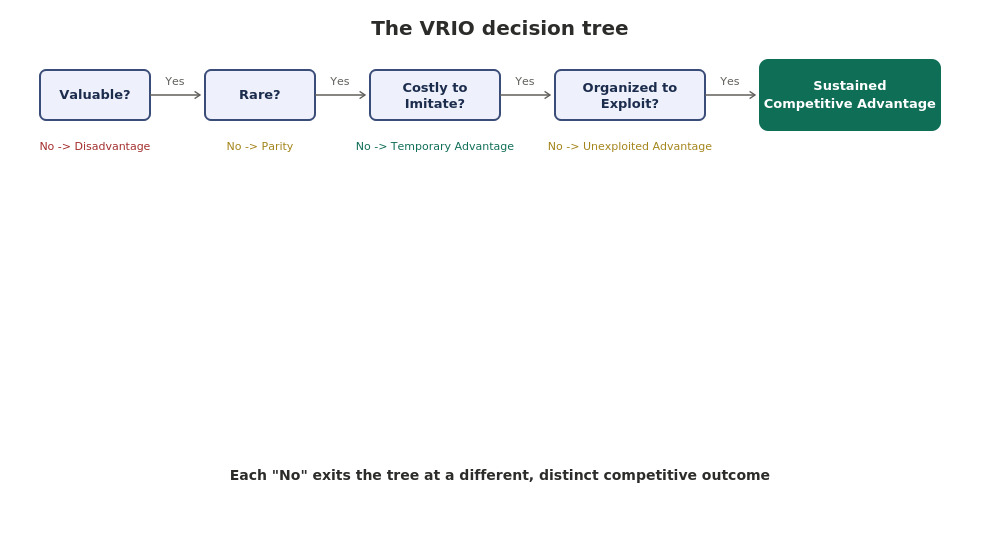
VRIO evaluates a resource or capability against four sequential questions, each one a gate the resource must pass through to reach the next:
- Value: Does the resource enable the firm to exploit an opportunity or neutralize a threat?
- Rarity: Is the resource currently controlled by only a small number of competing firms?
- Imitability: Is the resource costly or difficult for other firms to imitate or substitute?
- Organization: Is the firm organized (through structure, systems, and processes) to actually exploit the resource’s full potential?
Why the Framework Is Sequential, Not a Simple Checklist
This is the single most commonly misunderstood aspect of VRIO for MBA students: a resource must pass through the questions in order, and failing any question at any stage stops the analysis at that point — a resource that fails “Value” is automatically a competitive disadvantage, regardless of how rare or hard to imitate it might be. This sequential structure produces four distinct possible outcomes:
| Value? | Rare? | Costly to Imitate? | Organized to Exploit? | Competitive Implication |
|---|---|---|---|---|
| No | — | — | — | Competitive disadvantage |
| Yes | No | — | — | Competitive parity |
| Yes | Yes | No | — | Temporary competitive advantage |
| Yes | Yes | Yes | Yes | Sustained competitive advantage |
| Yes | Yes | Yes | No | Unexploited competitive advantage |
That last row is worth pausing on: a resource can be valuable, rare, and hard to imitate, yet still fail to produce sustained advantage if the firm’s organizational structure doesn’t actually let it be exploited effectively — a genuinely common real-world scenario MBA case studies frequently test students on.
A Full Worked Example: Analyzing a Firm’s Proprietary Technology
Scenario: A mid-sized logistics firm has developed a proprietary route-optimization algorithm that reduces fuel costs by 12% compared to industry-standard routing software.
Applying VRIO:
Value: Yes — the algorithm directly reduces a major operating cost (fuel), improving margins and allowing more competitive pricing. This clearly exploits a value-creating opportunity.
Rarity: Yes, currently — competitors are using industry-standard routing software without this specific optimization capability, making the resource genuinely rare within the competitive set at this point in time.
Imitability: This is where deeper analysis is required, not just a yes/no guess. Consider the actual sources of imitation difficulty:
- Patents: Is the algorithm protected by intellectual property that legally prevents direct copying?
- Causal ambiguity: Even without formal IP protection, is it unclear to competitors exactly which combination of data, algorithm design choices, and tuning produces the 12% improvement, making reverse-engineering difficult?
- Path dependency: Was the algorithm built on years of accumulated proprietary route and delivery data that a competitor couldn’t quickly replicate even with equivalent technical talent?
Suppose analysis confirms the algorithm relies on several years of accumulated proprietary delivery data alongside the algorithm itself — this makes imitation costly (a competitor would need years to accumulate comparable data, not just hire equivalent engineers), so the answer is yes, costly to imitate.
Organization: Does the firm have the internal systems to actually exploit this? Suppose the firm has integrated the algorithm directly into live dispatch operations, trained staff to work with its outputs, and built ongoing data collection into standard operating procedure — yes, organized to exploit.
Conclusion: All four conditions met — this resource represents a source of sustained competitive advantage, not just a temporary edge, precisely because the combination of rarity, costly imitability (via accumulated data, not just the algorithm itself), and organizational integration creates a durable barrier competitors cannot quickly close.
A Contrasting Example: When Organization Is the Failure Point
Scenario: A retail bank has invested heavily in an advanced customer data analytics platform capable of highly personalized product recommendations — valuable, genuinely rare in this specific regional market, and technically difficult for smaller competitors to replicate due to the data science expertise and infrastructure investment required.
On the first three questions, this resource looks like a strong candidate for sustained advantage. But suppose further analysis reveals the bank’s branch staff have no training on how to use the platform’s outputs, the recommendations aren’t integrated into actual customer-facing systems, and organizational silos mean the data science team’s outputs rarely reach frontline staff in a usable form.
Conclusion: This is a case of unexploited competitive advantage — the resource itself qualifies as valuable, rare, and costly to imitate, but the firm’s organizational structure fails to convert that potential into actual competitive advantage. For an MBA strategic analysis, identifying this specific failure point (organization, not the underlying resource) directly implies a different strategic recommendation than if the resource itself were the problem — the fix here is organizational integration and change management, not further investment in the technology itself.
VRIO vs SWOT: A Common Point of Confusion
Both frameworks address internal factors, which leads some students to treat them as interchangeable — they’re not. SWOT’s “Strengths” category is often populated somewhat impressionistically (a broad, unranked list of things the firm does well), while VRIO applies a structured, rigorous test specifically to determine whether a given strength actually produces sustainable advantage, or merely competitive parity.
Practical implication for coursework: a strong strategic analysis often uses VRIO to critically interrogate items initially identified in a SWOT “Strengths” list — not every genuine strength survives VRIO’s four-question test as a source of sustained advantage, and demonstrating this critical distinction (rather than treating every SWOT strength as automatically strategically significant) is exactly the kind of analytical rigor that distinguishes strong MBA strategic analysis from a surface-level listing exercise.
For students applying VRIO to coursework or case-based analysis, further guidance on MBA strategic management assignments can be useful when developing a structured evaluation of resources and capabilities. A relevant reference is Strategic Management Assignment Support, which discusses approaches to strategic management assignments and analysis.
Common Student Mistakes
- Treating VRIO as four independent, unordered questions — the sequential, gated structure is central to the framework; a resource failing an earlier question doesn’t need further evaluation on later questions
- Confusing “valuable” with “sustainable advantage” — many resources are valuable without being rare or hard to imitate, producing only competitive parity, not genuine advantage
- Underdeveloping the imitability analysis — a strong answer explains why imitation is costly (patents, causal ambiguity, path dependency, social complexity), not just asserts that it is
- Overlooking the Organization question entirely — as the retail bank example shows, this is a frequently decisive factor that separates theoretical resource potential from actual realized competitive advantage
- Applying VRIO to an entire company rather than specific resources or capabilities — the framework is meant to evaluate individual resources or capabilities one at a time, not render a single verdict about a whole organization
Frequently Asked Questions
What’s the difference between a resource and a capability in VRIO analysis? A resource is typically a tangible or intangible asset the firm owns (proprietary technology, brand reputation, patents, data), while a capability is the firm’s ability to deploy and coordinate resources effectively (a well-developed process, organizational skill, or way of combining resources) — VRIO can be applied to either.
Can a competitive advantage identified through VRIO become obsolete over time? Yes — “sustained” competitive advantage means durable relative to current competitive conditions, not permanent regardless of any future change; technological shifts, competitor innovation, or changing customer needs can erode even a currently well-protected advantage over time.
How many resources should a VRIO analysis in an MBA assignment typically evaluate? This varies by assignment brief, but a focused analysis of 2-4 genuinely significant resources or capabilities, each analyzed thoroughly through all four questions, generally demonstrates stronger analytical depth than a superficial pass through a longer list.
Is VRIO only used in for-profit business contexts? While most commonly applied to commercial firms, the underlying logic (do we have resources that are valuable, rare, hard to imitate, and are we organized to exploit them) can be adapted to non-profit and public sector strategic analysis as well, though the “value” question shifts toward mission achievement rather than purely financial competitive advantage.