
Table of Contents
ToggleAtomic Structure and Quantum Numbers: A Complete University Guide
Atomic structure is the foundation on which almost every other topic in chemistry is built — from chemical bonding and molecular geometry to coordination chemistry and even electrochemistry. Yet it is also one of the topics students find most confusing in their first university assignments, mainly because it asks you to think about electrons not as tiny balls orbiting a nucleus, but as probability clouds described by quantum numbers. This guide breaks the topic down step by step, with plenty of worked examples, so you can confidently tackle any assignment on atomic structure.
1. From Bohr’s Model to the Quantum Mechanical Model
Early models of the atom, such as Bohr’s model, pictured electrons moving in fixed circular orbits around the nucleus, similar to planets orbiting the sun. This model explained the hydrogen spectrum reasonably well but failed for multi-electron atoms. The modern quantum mechanical model, developed from Schrödinger’s wave equation, describes electrons in terms of orbitals — three-dimensional regions of space where there is a high probability (usually 90–95%) of finding an electron.
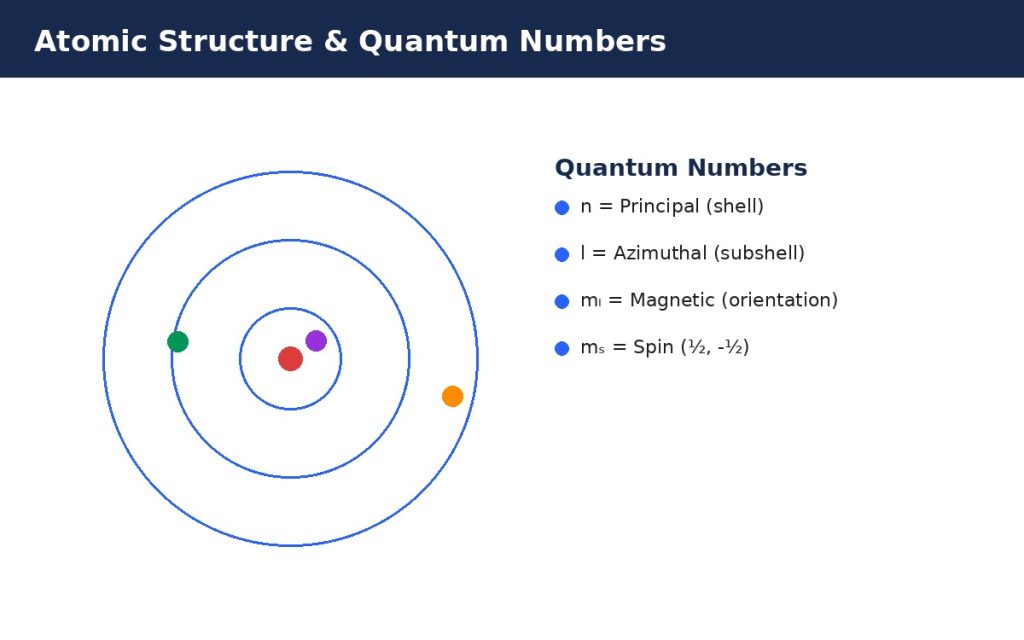
Instead of a definite path, each electron is described by a wavefunction (ψ), and the square of the wavefunction (ψ²) gives the probability density of finding the electron at a given point. Solving the Schrödinger equation for the hydrogen atom produces a set of four quantum numbers that together give a complete “address” for every electron in an atom.
2. The Four Quantum Numbers
2.1 Principal Quantum Number (n)
The principal quantum number, n, describes the main energy level or shell of an electron. It can take positive integer values: n = 1, 2, 3, 4, and so on. Larger values of n correspond to shells that are farther from the nucleus and have higher energy.
Example: An electron with n = 2 is in the second shell, which is higher in energy than n = 1 but lower than n = 3. In a hydrogen atom, the energy of an electron depends only on n, according to the formula E = −13.6/n² eV.
2.2 Azimuthal (Angular Momentum) Quantum Number (l)
The azimuthal quantum number, l, describes the shape of the subshell (orbital type) within a given shell. It can take integer values from 0 to (n − 1).
- l = 0 → s subshell (spherical shape)
- l = 1 → p subshell (dumbbell shape)
- l = 2 → d subshell (cloverleaf shape)
- l = 3 → f subshell (complex multi-lobed shape)
Example: For n = 3, the possible values of l are 0, 1, and 2, giving rise to the 3s, 3p, and 3d subshells. Notice that a given shell can only contain subshells up to l = n − 1; there is no 1p or 2d subshell.
2.3 Magnetic Quantum Number (mₗ)
The magnetic quantum number, mₗ, describes the orientation of an orbital in space relative to the other orbitals. It ranges from −l to +l, including zero.
Example: For l = 1 (a p subshell), mₗ can be −1, 0, or +1, which correspond to the three p orbitals: pₓ, p_y, and p_z. For l = 2 (a d subshell), mₗ can be −2, −1, 0, +1, +2 — five values, giving five d orbitals.
2.4 Spin Quantum Number (mₛ)
The spin quantum number, mₛ, describes the intrinsic angular momentum (“spin”) of the electron. It can only take two values: +½ or −½, often visualized as “spin up” and “spin down.” No two electrons in the same atom can have the exact same set of all four quantum numbers — this is the basis of the Pauli exclusion principle, discussed below.
Worked Example: Write a complete set of four quantum numbers for the last electron added to a nitrogen atom (Z = 7). Nitrogen’s configuration is 1s² 2s² 2p³. The third electron added to the 2p subshell would occupy the third p orbital singly (by Hund’s rule): n = 2, l = 1, mₗ = +1, mₛ = +½ (or −½, depending on convention).
3. Rules Governing Electron Configuration
Filling electrons into orbitals correctly is one of the most heavily tested skills in introductory and intermediate chemistry courses. Three rules govern this process.
3.1 The Aufbau Principle
“Aufbau” is German for “building up.” This principle states that electrons occupy the lowest-energy orbitals available before filling higher-energy ones. The general filling order follows the diagonal (n + l) rule:
1s → 2s → 2p → 3s → 3p → 4s → 3d → 4p → 5s → 4d → 5p → 6s → 4f → 5d → 6p → 7s → 5f → 6d
Example: Potassium (Z = 19) fills 4s before 3d, giving the configuration 1s² 2s² 2p⁶ 3s² 3p⁶ 4s¹, not …3p⁶3d¹, because the 4s orbital has a slightly lower energy than 3d at this point in the periodic table.
3.2 The Pauli Exclusion Principle
No two electrons in the same atom can have identical values for all four quantum numbers. Practically, this means each orbital can hold a maximum of two electrons, and those two electrons must have opposite spins.
Example: The 2s orbital in beryllium (Z = 4) holds two electrons: one with mₛ = +½ and one with mₛ = −½. It cannot hold a third electron because there would be no unique quantum number combination left.
3.3 Hund’s Rule of Maximum Multiplicity
When electrons fill a set of orbitals of equal energy (degenerate orbitals, such as the three p orbitals or five d orbitals), they occupy separate orbitals singly, with parallel spins, before any orbital receives a second electron. This minimizes electron-electron repulsion.
Example: Carbon (Z = 6) has the configuration 1s² 2s² 2p². The two 2p electrons go into two different p orbitals (say pₓ¹ and p_y¹) with parallel spins, rather than pairing up in a single pₓ² orbital.
4. Writing Electron Configurations: Step-by-Step Examples
Example 1 — Chlorine (Z = 17): Fill orbitals in Aufbau order until 17 electrons are placed: 1s² 2s² 2p⁶ 3s² 3p⁵
Example 2 — Iron (Z = 26): 1s² 2s² 2p⁶ 3s² 3p⁶ 4s² 3d⁶
Note that when writing configurations in order of increasing shell number for clarity, 3d is often listed before 4s even though 4s filled first: [Ar] 3d⁶ 4s².
Example 3 — Ion formation, Fe³⁺: To form Fe³⁺ from iron, remove three electrons. Importantly, electrons are removed from the 4s orbital first, then from 3d, because once occupied, 4s electrons become higher in energy than 3d electrons. Fe: [Ar] 3d⁶ 4s² → Fe³⁺: [Ar] 3d⁵
This is a classic assignment trap — many students incorrectly remove electrons from 3d first.
Example 4 — Noble gas (shorthand) notation for bromine (Z = 35): [Ar] 3d¹⁰ 4s² 4p⁵
5. Exceptions to the Aufbau Principle
A handful of elements do not follow the standard filling order because half-filled and fully-filled d subshells are unusually stable.
- Chromium (Z = 24): Expected [Ar] 3d⁴ 4s², but actual is [Ar] 3d⁵ 4s¹ (half-filled d subshell is more stable).
- Copper (Z = 29): Expected [Ar] 3d⁹ 4s², but actual is [Ar] 3d¹⁰ 4s¹ (fully-filled d subshell is more stable).
Assignments frequently ask students to identify or explain these exceptions, so it is worth memorizing this pair as the most common examples, along with their heavier analogues molybdenum and silver.
6. Orbital Shapes and Nodes
Understanding orbital shapes helps connect atomic structure to bonding theory, which becomes essential in chemical bonding and molecular geometry.
- s orbitals are spherical and have no angular nodes. The number of radial nodes equals (n − 1).
- p orbitals are dumbbell-shaped with one angular node (a nodal plane through the nucleus).
- d orbitals mostly have a cloverleaf shape with two angular nodes; the d_z² orbital is a notable exception with a different shape.
Example: The 2p orbital has one angular node and zero radial nodes. The 3p orbital has one angular node and one radial node (total nodes = n − 1 = 2).
7. Quantum Numbers and the Periodic Table
The structure of the periodic table is a direct visual representation of electron configuration:
- s-block (Groups 1–2): outermost electrons fill s orbitals.
- p-block (Groups 13–18): outermost electrons fill p orbitals.
- d-block (transition metals): electrons fill d orbitals.
- f-block (lanthanides/actinides): electrons fill f orbitals.
Example: Sulfur is in Group 16, Period 3, so its valence configuration is 3s² 3p⁴ — four electrons in the p subshell, consistent with being the fourth element of the p-block in period 3.
8. Common Assignment Questions and How to Approach Them
Questions on atomic structure, electron configurations, quantum numbers, and periodic trends are common in university chemistry coursework. Students working through broader chemistry coursework can also explore Chemistry Assignment Help for academic assistance with chemistry assignments and related topics.
- “Give the four quantum numbers for the 5th electron in oxygen.” Write out oxygen’s configuration (1s² 2s² 2p⁴), identify which orbital the 5th electron enters based on Hund’s rule, and assign n, l, mₗ, mₛ accordingly.
- “Explain why chromium does not follow the Aufbau principle.” Discuss the extra stability of a half-filled 3d⁵ subshell due to symmetric electron distribution and exchange energy.
- “How many unpaired electrons does a given ion have?” Write the configuration, apply Hund’s rule to the outer subshell, and count singly occupied orbitals — this connects directly to concepts used later in coordination chemistry and crystal field theory.
- “Calculate the energy change when an electron moves from n = 3 to n = 1 in hydrogen.” Use E = −13.6(1/n²) eV for each level and subtract; this same energy framework underlies discussions of chemical thermodynamics.
9. Quick Reference Summary Table
| Quantum Number | Symbol | Range of Values | Describes |
|---|---|---|---|
| Principal | n | 1, 2, 3, … | Shell / energy level |
| Azimuthal | l | 0 to (n−1) | Subshell shape |
| Magnetic | mₗ | −l to +l | Orbital orientation |
| Spin | mₛ | +½ or −½ | Electron spin direction |
10. Final Tips for Assignments
- Always double-check the maximum electron capacity of a subshell: s = 2, p = 6, d = 10, f = 14.
- Remember that when writing configurations for transition metal cations, remove 4s electrons before 3d electrons.
- Use Hund’s rule diagrams (orbital box notation) whenever a question asks about unpaired electrons or magnetic properties, since unpaired electrons make a substance paramagnetic.
- Practice converting between full and noble-gas shorthand notation, since both formats appear frequently on exams.
Mastering atomic structure and quantum numbers gives you the vocabulary and logic needed for nearly every later topic in general and inorganic chemistry, particularly chemical bonding and coordination chemistry. Take time to practice writing configurations for at least twenty different elements and ions — repetition is what makes this topic feel automatic rather than overwhelming.
Related Articles
Continue building your chemistry foundation with these related guides:
- Chemical Bonding and Molecular Geometry
- Chemical Thermodynamics
- Chemical Kinetics and Rate Laws
- Chemical Equilibrium and Le Chatelier’s Principle
- Acids, Bases and pH Calculations
- Electrochemistry and Redox Reactions
- Organic Reaction Mechanisms (SN1, SN2, E1, E2)
- Coordination Chemistry and Bonding Theories
- Gas Laws and States of Matter