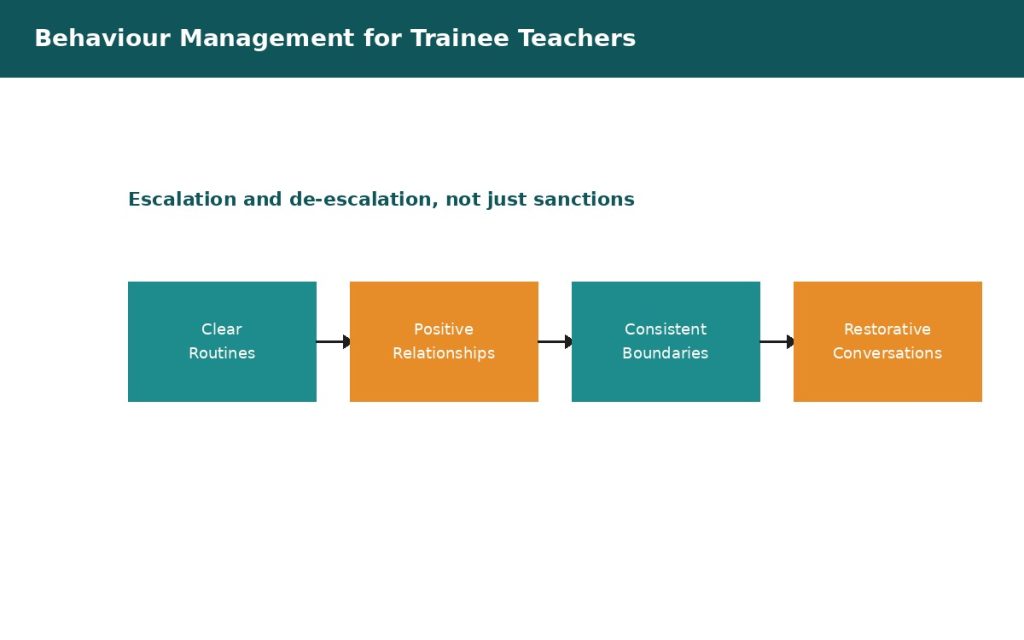
Behaviour management is consistently rated by PGCE trainees as the most anxiety-inducing area of practice — and it’s also one of the areas assignments most often mark down for being generic (“I was firm but fair”) rather than specific and evidence-based. This guide covers the major theoretical approaches to behaviour management, practical classroom strategies for building routines and relationships, and restorative approaches to managing incidents, with detailed worked examples for your placement files and written assignments. Behaviour management connects directly to the assessment and differentiation practices covered in Assessment for Learning and Differentiation and Inclusive Teaching, since much disruptive behaviour stems from pupils being insufficiently challenged, insufficiently supported, or both.
Table of Contents
Toggle1. Why “Being Strict” Isn’t a Strategy
A common weakness in PGCE behaviour management assignments is describing your approach in vague, personality-based terms (“I have a strong presence,” “I’m naturally firm”). Markers are looking for specific, nameable, evidence-based strategies you deliberately planned and applied — behaviour management should be treated as a professional skill set, not an innate personal trait some trainees simply “have” and others don’t.
2. Theoretical Approaches to Behaviour Management
2.1 Behaviourist Approaches
Rooted in the work of B.F. Skinner, behaviourist approaches focus on reinforcement — rewarding desired behaviour to increase its frequency, and applying consequences to reduce undesired behaviour.
Worked Example: A trainee running a Year 3 classroom uses a simple, consistently-applied house-points system, awarding points immediately and specifically (“that’s a house point for lining up so sensibly”) rather than vaguely or after a delay. Behaviourist theory predicts that immediate, specific, consistent reinforcement is far more effective at shaping behaviour than delayed or vague praise — a point worth making explicitly in an assignment discussing your reward system’s design.
Worked Example — Objection: Critics of purely behaviourist approaches argue that over-reliance on extrinsic rewards can undermine pupils’ intrinsic motivation over time (pupils may stop behaving well once the rewards stop), and that a rewards-and-sanctions system alone doesn’t address the underlying causes of persistent misbehaviour — a nuance PGCE assignments should acknowledge rather than presenting behaviourist strategies as a complete solution on their own.
2.2 Assertive Discipline (Canter)
Lee and Marlene Canter’s Assertive Discipline model emphasises that teachers have the right to determine what is best for pupils and to expect appropriate behaviour, communicated through clear, calm, consistent expectations backed by a known system of positive and negative consequences.
Worked Example: A trainee establishes and explicitly teaches (not just displays) three clear classroom rules at the start of the year, alongside a visible, predictable consequence ladder (verbal reminder, name noted, brief time-out, contact home), applying it calmly and consistently rather than emotionally or unpredictably. The key research-backed principle here is predictability: pupils, particularly those with anxiety or attachment needs, respond far better to consistently-applied, known consequences than to a system that varies with the teacher’s mood.
2.3 Restorative Approaches
Restorative practice, increasingly emphasised in UK behaviour policy and PGCE training, shifts focus from punishment alone toward repairing harm and rebuilding relationships, asking questions like “what happened?”, “who was affected?”, and “what needs to happen to put things right?” rather than simply “what rule was broken, and what’s the punishment?”
Worked Example: After a disruptive incident between two Year 9 pupils, rather than only issuing a sanction, a trainee holds a brief restorative conversation once things have calmed down, asking each pupil what happened, how it affected the other person, and what they think needs to happen next. This doesn’t replace the school’s formal sanction (which may still apply), but it explicitly addresses the relational harm and models a constructive way of resolving conflict — a strategy well worth describing in an assignment on behaviour management, since it demonstrates a more sophisticated understanding of behaviour than a punitive report focused purely on sanctions would.
2.4 Understanding Behaviour as Communication
A significant strand of current thinking, particularly relevant to pupils with SEND or social, emotional and mental health needs (see Differentiation and Inclusive Teaching), treats persistently disruptive behaviour as a form of communication — often signalling an unmet need (anxiety, lack of understanding of the task, sensory overload, a need for attention or control) rather than simple wilful defiance.
Worked Example: A trainee notices that a particular Year 7 pupil consistently becomes disruptive specifically during independent writing tasks. Rather than assuming simple non-compliance, the trainee investigates further and discovers the pupil finds unstructured writing tasks genuinely difficult to start (a possible undiagnosed processing or organisational difficulty) and is using disruption to avoid the task and the associated feeling of failure. Providing a structured writing frame largely resolves the behaviour — demonstrating that effective behaviour management sometimes requires addressing an underlying academic or emotional need rather than simply escalating sanctions, a genuinely analytical point that strengthens an assignment considerably.
3. Building Routines: The Foundation of Good Behaviour
3.1 Why Routines Matter
Well-established routines reduce the number of moments where behaviour decisions need to be made or negotiated, lowering overall classroom friction and freeing up teacher attention for teaching itself.
Worked Example: A trainee explicitly teaches and rehearses a specific entry routine in the first week with a new class — pupils enter silently, collect equipment from a designated point, and begin a “do now” task displayed on the board, every single lesson, without exception. Explicitly teaching this routine (not just expecting pupils to infer it) and then reinforcing it consistently over the first few weeks produces a far smoother, lower-friction start to lessons than announcing expectations once and hoping they stick — worth describing with specific before/after detail in an assignment on establishing routines.
3.2 Transitions
Worked Example: Transitions between activities (e.g., moving from carpet time to independent seated work in a primary classroom) are a common flashpoint for low-level disruption. A trainee uses a specific, consistent signal (a countdown, a chime, a call-and-response phrase) paired with clear, concise instructions given before pupils start moving, rather than shouting instructions over the noise of pupils already moving — a small but well-evidenced change that noticeably reduces transition-related disruption.
4. De-escalation Strategies
4.1 Take-Up Time
Worked Example: When asking a pupil to comply with an instruction (e.g., “please put your phone away”), a trainee gives the instruction calmly, states the expected outcome clearly, and then deliberately turns attention elsewhere for a few seconds (“take-up time”) rather than standing over the pupil waiting for immediate compliance. This avoids creating a public confrontation that can escalate quickly, giving the pupil a face-saving way to comply without an audience focused entirely on them.
4.2 The Broken Record Technique
Worked Example: If a pupil attempts to argue or deflect from a simple instruction (“why do I have to move seats, it’s not fair, [other pupil] started it”), a trainee calmly repeats the core instruction (“I hear you, and we can talk about that after the lesson — right now I need you to move seats”) without being drawn into an escalating debate about fairness or blame in front of the class — a specific, learnable technique worth naming explicitly in an assignment rather than describing vaguely as “staying calm.”
4.3 Choosing Your Battles: Low-Level vs. Serious Behaviour
Effective behaviour management requires distinguishing low-level, non-urgent behaviour (which can often be addressed with a quiet, non-confrontational tactic like proximity or a non-verbal cue) from more serious behaviour requiring immediate, direct intervention. Over-responding to every minor infraction with a full formal consequence can escalate unnecessary confrontations and disrupt lesson flow, while under-responding to serious behaviour can undermine classroom safety and authority — striking this balance thoughtfully, and explaining your reasoning for specific decisions, demonstrates the kind of professional judgement PGCE assignments reward.
5. Behaviour Management and Relationships
Research consistently shows that positive teacher-pupil relationships, built through consistent fairness, genuine interest in pupils as individuals, and non-confrontational correction, are one of the strongest predictors of good classroom behaviour — arguably more foundational than any specific sanction system.
Worked Example: A trainee makes a deliberate effort to learn about a particularly challenging Year 10 pupil’s interests (football, in this case) and uses brief, genuine check-ins (“how did the match go at the weekend?”) before addressing any behaviour concerns. Over several weeks, this investment in the relationship measurably reduces confrontational incidents with that pupil — a slower, relationship-based strategy that is harder to describe in a single lesson observation but extremely valuable to discuss in a longer placement reflection or reflective assignment using Gibbs’ Reflective Cycle.
6. Linking Behaviour Management to the Teachers’ Standards
Behaviour management maps most directly onto Standard 7 of the UK Teachers’ Standards (“manage behaviour effectively to ensure a good and safe learning environment”), and assignments discussing behaviour should reference this standard explicitly, along with the specific whole-school behaviour policy of your placement school, since Standard 7 specifically expects trainees to apply the school’s policy consistently and fairly.
7. Common Assignment Pitfalls
- Describing your approach to behaviour management vaguely (“I was firm but fair,” “I have good classroom presence”) rather than naming specific, evidence-based strategies.
- Presenting behaviour management as purely about sanctions, without discussing routines, relationships, or restorative approaches, all of which are increasingly emphasised in current UK practice.
- Failing to consider the underlying causes of persistent disruptive behaviour (unmet academic, emotional, or sensory needs) before assuming simple wilful defiance.
- Forgetting to reference your placement school’s specific behaviour policy, and Standard 7 of the Teachers’ Standards, when discussing behaviour management in assignments.
- Describing a single successful lesson in isolation, rather than showing how routines and relationships were built deliberately and consistently over time.
8. Applying These Concepts: A Sample Assignment Response
Question: “Reflect on a behaviour management strategy you developed and applied on placement, evaluating its effectiveness.”
Sample structured answer: Describe the specific context (e.g., a Year 8 class with a pattern of low-level disruption during transitions) and the specific strategy developed (a consistent transition routine with a clear countdown signal, as in Section 3.2). Reference relevant theory (Canter’s emphasis on predictability, or the behaviourist principle of consistent reinforcement) to justify the strategy’s design. Provide specific before/after evidence of impact (e.g., reduced number of behaviour points issued during transitions over a three-week period). Acknowledge limitations honestly (e.g., the strategy worked well for low-level disruption but did not address one particular pupil’s more persistent behaviour, which required a different, relationship-based approach as in Section 5). Conclude with a specific, evidence-based next step, referencing Standard 7 explicitly. Developing this kind of theory-informed reflection is also an important part of producing strong PGCE coursework.
Behaviour management is rarely separable from the quality of your lesson planning (well-paced, appropriately challenging lessons generate far less disruption than poorly-paced ones) and your use of assessment and differentiation to ensure pupils are neither bored nor overwhelmed. Practice naming specific, theory-linked strategies (assertive discipline, take-up time, restorative conversations) rather than describing your general classroom “manner” — this specificity is exactly what turns a generic reflection into a strong, evidence-based PGCE assignment.
Frequently Asked Questions
What is the difference between behaviourist and restorative approaches to behaviour management? Behaviourist approaches focus on reinforcement — rewarding desired behaviour and applying consequences to reduce undesired behaviour. Restorative approaches focus on repairing harm and rebuilding relationships after an incident, asking what happened and what needs to happen to put things right, rather than focusing solely on punishment.
What is “take-up time” in behaviour management? It is the practice of giving an instruction calmly, stating the expected outcome, and then deliberately withdrawing direct attention for a few seconds rather than waiting for immediate compliance in front of the class — this avoids creating a public confrontation and gives the pupil space to comply without an audience.
Why do routines matter so much for behaviour management? Well-established, explicitly taught routines reduce the number of moments requiring behaviour decisions or negotiation, lowering overall classroom friction and freeing up attention for teaching itself, particularly during common flashpoints like lesson entry and transitions between activities.
Should disruptive behaviour always be treated as deliberate defiance? No — a significant strand of current practice treats persistent disruptive behaviour as a possible form of communication, often signalling an unmet academic, emotional, or sensory need, particularly for pupils with SEND. Investigating underlying causes can be more effective than escalating sanctions alone.
Which Teachers’ Standard covers behaviour management? Standard 7 (“manage behaviour effectively to ensure a good and safe learning environment”) is the most directly relevant, and PGCE assignments discussing behaviour should reference it explicitly alongside the placement school’s specific behaviour policy.