
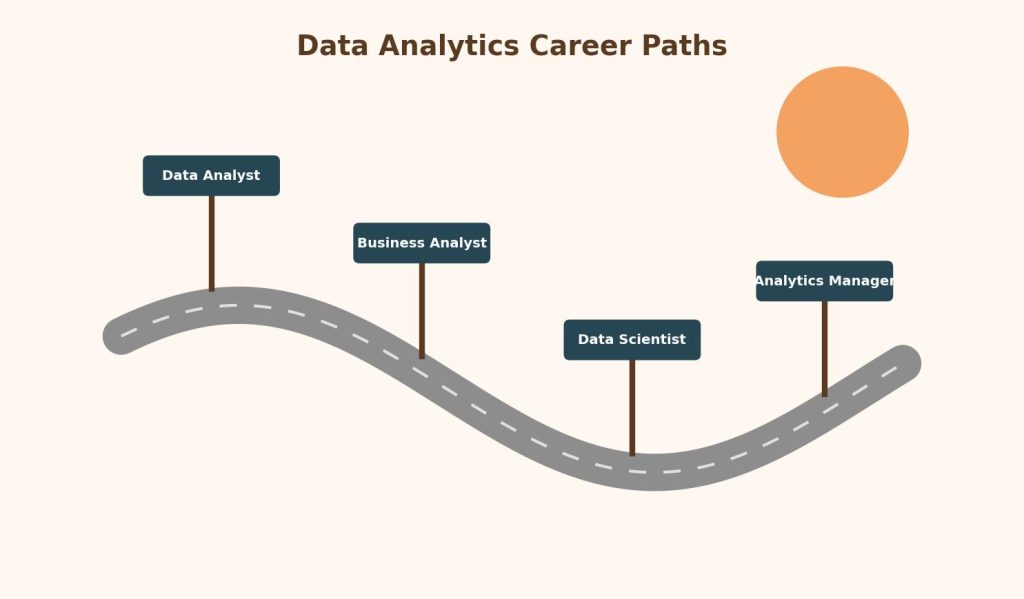
One of the most common questions students ask when entering a data analytics program is: “Where does this degree actually lead?” Unlike more narrowly defined fields, data analytics branches into a wide range of job titles and specializations — from entry-level business analyst roles to highly technical data science and analytics engineering positions. Understanding this landscape early helps students choose electives, projects, and certifications strategically.
This article maps out the major data analytics career paths, the skills and certifications associated with each, and a realistic view of career progression.
Table of Contents
ToggleCore Data Analytics Job Roles
1. Data Analyst
The most common entry point into the field. Data analysts collect, clean, and analyze data to answer specific business questions, typically presenting findings through reports and dashboards.
Typical responsibilities: Writing SQL queries, building dashboards in Tableau/Power BI, performing exploratory data analysis, and communicating findings to non-technical stakeholders.
Core skills: SQL, Excel, a BI tool (Tableau or Power BI), basic statistics, and increasingly, Python or R.
Worked example: A retail data analyst is asked, “Why did online sales dip in March?” They query the sales database, segment the drop by region and product category, discover a shipping delay disproportionately affected the West Coast, and present the finding with a simple dashboard and a one-paragraph explanation to the operations team.
2. Business Analyst
Closely related to data analysts but with a stronger focus on business process, strategy, and requirements gathering, often acting as a bridge between technical teams and business stakeholders.
Typical responsibilities: Gathering business requirements, process mapping, light data analysis, and translating business needs into specifications for technical teams.
Core skills: Excel, SQL (often lighter than a data analyst), stakeholder communication, process modeling, and familiarity with project management frameworks (e.g., Agile).
Distinction from data analyst: A data analyst tends to focus more on “what does the data say,” while a business analyst focuses more on “what should the business do, and what does the business need from its systems and processes” — though in smaller companies these roles frequently overlap or merge into one position.
3. Data Scientist
A more technically advanced role that builds on data analyst skills with a heavier emphasis on statistics, machine learning, and programming.
Typical responsibilities: Building predictive models, running experiments (A/B tests), developing machine learning pipelines, and often working closely with engineering teams to deploy models into production.
Core skills: Python or R (advanced), machine learning (scikit-learn, TensorFlow/PyTorch), statistics, SQL, and often some software engineering practices (version control, testing)
Worked example: A data scientist at a subscription service builds a churn prediction model using historical customer data, then works with the engineering team to deploy it so the model automatically flags at-risk customers for the retention team every week — a task requiring both statistical modeling skill and software deployment knowledge beyond what a typical data analyst role requires.
4. Data Engineer
Focuses on building and maintaining the data infrastructure and pipelines that analysts and data scientists depend on, rather than analyzing the data directly.
Typical responsibilities: Building ETL (Extract, Transform, Load) pipelines, managing databases and data warehouses, ensuring data quality and availability at scale.
Core skills: SQL (advanced), Python, cloud platforms (AWS, Azure, GCP), data warehousing tools (Snowflake, BigQuery), and big data tools (Spark, Airflow).
Distinction from data analyst: Where a data analyst asks questions of the data, a data engineer builds and maintains the systems that make the data reliably available for those questions to be asked in the first place.
5. Analytics Manager / Director of Analytics
A leadership role typically reached after several years of experience, overseeing a team of analysts and setting the strategic direction for how data is used across an organization.
Typical responsibilities: Managing analyst teams, prioritizing analytics projects, translating executive priorities into data initiatives, and presenting high-level findings to senior leadership.
Core skills: All the technical skills of a senior analyst, plus people management, project prioritization, and executive communication.
Career Progression: A Realistic Path
While paths vary significantly, a common progression looks like this:
- Entry-level: Junior Data Analyst or Business Analyst (0–2 years) — building core SQL, Excel, and dashboarding skills.
- Mid-level: Data Analyst or Analytics Associate (2–5 years) — taking ownership of full projects, mentoring junior analysts, possibly specializing in a domain (marketing analytics, financial analytics, product analytics).
- Senior/Specialized: Senior Data Analyst, Data Scientist, or Data Engineer (5+ years) — depending on whether the analyst leans toward advanced statistics/ML (data science), infrastructure (data engineering), or deep business domain expertise (senior analyst).
- Leadership: Analytics Manager, Director of Analytics, or Chief Data Officer (7–15+ years) — overseeing teams and organizational data strategy.
Worked example: A student graduates with a data analytics degree and starts as a Junior Data Analyst at a healthcare company, focusing on operational reporting. After two years, they specialize in patient outcomes analysis, developing strong SQL and Python skills. At year four, they begin building predictive models for readmission risk, gradually transitioning their title (and responsibilities) to Data Scientist. By year eight, they lead a small team combining analysts and data scientists, moving into an Analytics Manager role.
Popular Data Analytics Certifications
Certifications can help students and career-changers demonstrate practical skills, particularly when formal work experience is limited. Commonly recognized options include:
- Google Data Analytics Professional Certificate — a widely taken beginner-friendly program covering the full analytics process, including spreadsheets, SQL, Tableau, and R.
- Microsoft Certified: Power BI Data Analyst Associate — validates Power BI-specific skills, useful for roles in Microsoft-centric organizations.
- Tableau Desktop Specialist / Certified Data Analyst — validates Tableau-specific visualization and dashboarding skills.
- IBM Data Analyst Professional Certificate — covers Python, SQL, and data visualization, with a slightly more technical bent than the Google certificate.
- Microsoft Certified: Azure Data Scientist Associate — for students leaning toward data science/ML roles within the Azure ecosystem.
- AWS Certified Data Analytics — relevant for students interested in big data and cloud-based analytics infrastructure roles.
Certifications are generally most valuable when paired with a portfolio of real projects (e.g., a public GitHub repository or a Tableau Public dashboard) that demonstrate applied skill, rather than as a stand-alone credential.
Building a Portfolio as a Student
Because analytics is a highly practical field, employers often weight demonstrated project work heavily alongside coursework and certifications. Strong student portfolios typically include:
- A SQL-based project analyzing a public dataset (e.g., a city’s open crime or transit data)
- A Tableau Public or Power BI dashboard telling a clear data story
- A Python-based exploratory data analysis or machine learning project, documented on GitHub
- A written case study explaining the business question, methodology, and recommendation for at least one project — demonstrating communication skill, not just technical execution
These projects also give students an opportunity to apply concepts covered in their coursework to realistic datasets and business problems. For additional guidance with data analytics coursework, projects, and assignments, see our Data Analytics Assignment Help guide.
FAQs
Q1: What’s the difference between a data analyst and a data scientist? Data analysts typically focus on descriptive and diagnostic analysis using SQL, Excel, and BI tools to answer defined business questions, while data scientists more heavily emphasize predictive modeling, machine learning, and programming to build forecasting or automated decision systems. In many companies, especially smaller ones, these roles overlap significantly.
Q2: Do I need a master’s degree to become a data analyst? No. Most entry-level data analyst roles are accessible with a bachelor’s degree (in any field, though quantitative or business-related degrees are common) combined with demonstrated skills in SQL, Excel, and a BI tool. A master’s degree becomes more relevant for data scientist or specialized research-oriented roles.
Q3: Which certification should I get first? For students new to the field, the Google Data Analytics Professional Certificate or a similar broad introductory program is a common starting point, since it covers the full breadth of foundational tools (spreadsheets, SQL, visualization) before narrowing into a specialization like Power BI, Tableau, or Python-focused data science.
Q4: Is coding required for a data analytics career? SQL is essentially required across nearly all data analytics roles. Python or R proficiency is increasingly expected, especially for mid-level and senior positions, though some entry-level or Excel/BI-tool-focused roles can be entered with more limited coding knowledge.
Q5: How long does it typically take to move from data analyst to data scientist? This varies widely based on the individual’s prior technical background, but many analysts who deliberately build statistics, Python, and machine learning skills alongside their analyst work transition within two to four years, often by taking on progressively more predictive/modeling-focused projects within their current role before formally changing titles.
Q6: What soft skills matter most in data analytics careers? Beyond technical skills, the ability to translate technical findings into clear business language, ask well-scoped questions, and communicate effectively with non-technical stakeholders consistently ranks among the most valued skills in analytics roles, since the impact of any analysis depends on decision-makers understanding and trusting it.