

Every experiment or research study is built around a claimed relationship between variables, and correctly identifying which variable is independent and which is dependent is the foundation that everything else — hypothesis writing, experimental design, statistical analysis — is built on. Getting this distinction wrong doesn’t just cause minor confusion; it can invalidate an entire study’s design, since the independent/dependent structure determines what’s actually being manipulated versus what’s actually being measured.
Core Definitions
Independent variable (IV): the variable a researcher deliberately manipulates or changes, believed to cause an effect. It’s “independent” because its value doesn’t depend on anything else in the study — the researcher sets it directly.
Dependent variable (DV): the variable being measured, believed to respond to changes in the independent variable. It’s “dependent” because its value is hypothesized to depend on the independent variable.
A useful shorthand: the independent variable is the cause you’re testing; the dependent variable is the effect you’re measuring.
Worked Example 1: A Controlled Experiment
Research question: Does the amount of sunlight affect plant growth rate?
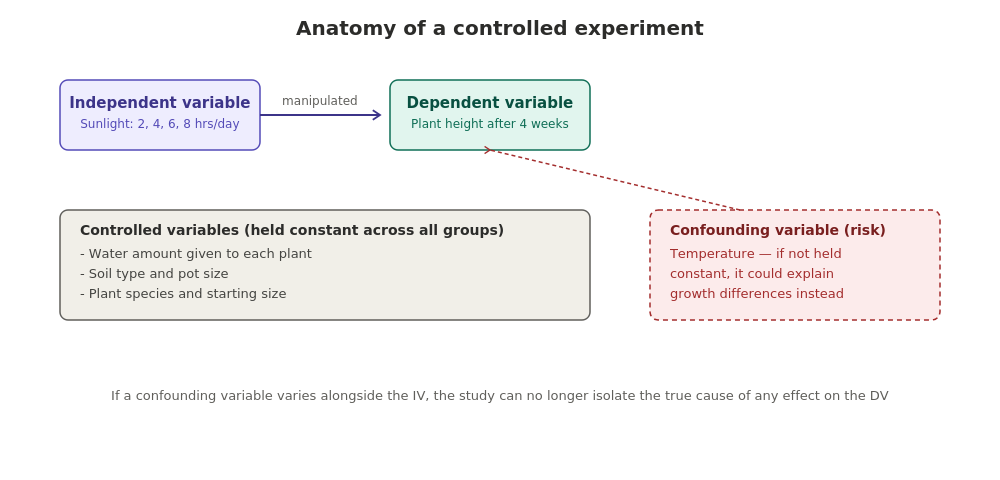
Independent variable: hours of sunlight exposure per day (researcher sets this: 2, 4, 6, or 8 hours)
Dependent variable: plant height after 4 weeks (measured outcome)
The researcher directly controls sunlight exposure (assigning different plants to different light conditions) and then measures the resulting growth — growth doesn’t get set directly; it’s observed as a response.
Worked Example 2: A Non-Experimental (Observational) Study
Research question: Is there a relationship between hours of sleep and academic performance among college students?
Independent variable: average hours of sleep per night (the presumed influencing factor)
Dependent variable: GPA (the presumed outcome)
This example is worth pausing on, because unlike Worked Example 1, the researcher isn’t actually manipulating sleep hours directly — students aren’t being assigned a sleep schedule. This is an observational study, not a controlled experiment, and the independent/dependent labels here reflect the hypothesized direction of influence, not direct experimental control. This distinction matters enormously for what conclusions the study can support (see the causation section below).
The Third Category: Controlled (Constant) Variables
Beyond independent and dependent variables, rigorous experimental design also requires identifying controlled variables — factors that must be held constant across all conditions specifically to isolate the independent variable’s actual effect.
Continuing the plant growth example: to ensure that sunlight exposure (and only sunlight exposure) is responsible for any observed difference in growth, the researcher must hold constant:
- Water amount given to each plant
- Soil type and pot size
- Ambient temperature
- Plant species and starting size
If any of these controlled variables is allowed to vary uncontrolled alongside sunlight exposure, the study can no longer confidently attribute differences in growth specifically to sunlight — a confounding variable may be responsible instead, undermining the entire causal claim.
Worked Example 3: Identifying a Confounding Variable
Scenario: A researcher compares plant growth between a group given more sunlight (assigned to an outdoor greenhouse) and a group given less sunlight (kept indoors near a window). The outdoor group grows significantly taller.
The flaw: the outdoor greenhouse is also warmer than the indoor location. Temperature was never controlled — it varied alongside sunlight exposure. The researcher cannot conclude sunlight caused the growth difference, because temperature is a confounding variable: it changed at the same time as the independent variable, and it’s also independently plausible as a cause of the growth difference.
The fix: hold temperature constant across both groups (e.g., using climate-controlled growing conditions for both), so that sunlight exposure is the only variable that differs between them.
Multiple Independent or Dependent Variables
Not every study has exactly one IV and one DV — more complex designs can include several of either.
Worked example — multiple independent variables: A study examining how both sunlight hours and fertilizer type affect plant growth has two independent variables (sunlight, fertilizer type) and one dependent variable (growth). This is sometimes called a factorial design, allowing researchers to examine not just each variable’s individual effect, but also whether they interact — for instance, whether fertilizer type only matters at high sunlight levels but not at low levels.
Worked example — multiple dependent variables: A study on a new teaching method might measure both exam scores and student engagement ratings as dependent variables, both potentially responding to the same independent variable (teaching method used).
Independent and Dependent Variables in Hypothesis Statements
This distinction also maps directly onto regression analysis, where the independent variable becomes the predictor and the dependent variable becomes the outcome being modeled — and onto how a testable hypothesis should be structured, since a well-formed hypothesis explicitly identifies both variables and the predicted relationship between them.
Weak hypothesis (variables not clearly identified): “Sunlight affects how plants grow.”
Strong hypothesis (variables and predicted relationship explicit): “Plants exposed to 8 hours of sunlight per day will grow taller over 4 weeks than plants exposed to 2 hours of sunlight per day, with all other growing conditions held constant.”
The strong version specifies exactly what’s being manipulated (sunlight hours, with specific levels), exactly what’s being measured (height after 4 weeks), and implicitly acknowledges the need for controlled variables — this is what makes a hypothesis genuinely testable rather than just a vague claim.
Why This Distinction Matters for Causal Claims
A critical point often glossed over: correctly labeling variables as independent and dependent does not, by itself, establish that the independent variable actually causes changes in the dependent variable. Whether a causal claim is justified depends on the study design, not the labeling:
| Study type | Can it support a causal claim? |
|---|---|
| True experiment (IV randomly assigned by researcher, other variables controlled) | Yes, with appropriate controls |
| Observational study (IV not manipulated, only observed) | No — only correlation, not causation, since confounding variables can’t be ruled out |
This is exactly why Worked Example 2 (sleep and GPA) can only support a correlational claim, not a causal one — students weren’t randomly assigned different sleep schedules, so any number of confounding variables (stress levels, time management skills, health conditions) could plausibly explain an observed relationship between sleep and GPA, independent of any direct causal link.
Common Student Mistakes
- Confusing which variable is independent vs dependent — a useful check: ask “which variable is the researcher manipulating or treating as the presumed cause?” (independent) versus “which variable is being measured as the presumed outcome?” (dependent)
- Assuming an independent/dependent relationship proves causation — as shown above, this depends entirely on whether the study is a true controlled experiment or merely observational
- Overlooking controlled variables entirely — a study can correctly identify its IV and DV but still produce invalid conclusions if other relevant factors aren’t held constant, allowing confounding variables to distort the results
- Failing to specify measurable levels for the independent variable — “different amounts of sunlight” is vaguer and harder to test than explicitly defined levels like “2, 4, 6, or 8 hours per day”
Frequently Asked Questions
Can a variable be independent in one study and dependent in another? Yes — the same variable’s role depends entirely on the specific research question. Sleep hours might be an independent variable in a study examining sleep’s effect on academic performance, but could be a dependent variable in a different study examining how caffeine intake affects sleep duration.
What’s the difference between a dependent variable and a confounding variable? The dependent variable is the outcome the study is specifically designed to measure. A confounding variable is an uncontrolled factor that varies alongside the independent variable and could independently explain changes in the dependent variable, threatening the validity of a causal conclusion.
Do observational studies ever use the terms independent and dependent variable? Yes, though some researchers prefer “predictor” and “outcome” variable in observational contexts specifically to avoid implying direct experimental manipulation — the underlying concept (presumed influencing factor vs presumed outcome) remains the same regardless of terminology.
How many independent variables can a single study have? There’s no fixed upper limit, though studies with many independent variables (and their potential interactions) require larger sample sizes and more complex statistical analysis to draw reliable conclusions — simpler designs with one or two independent variables remain far more common, especially in introductory research contexts.