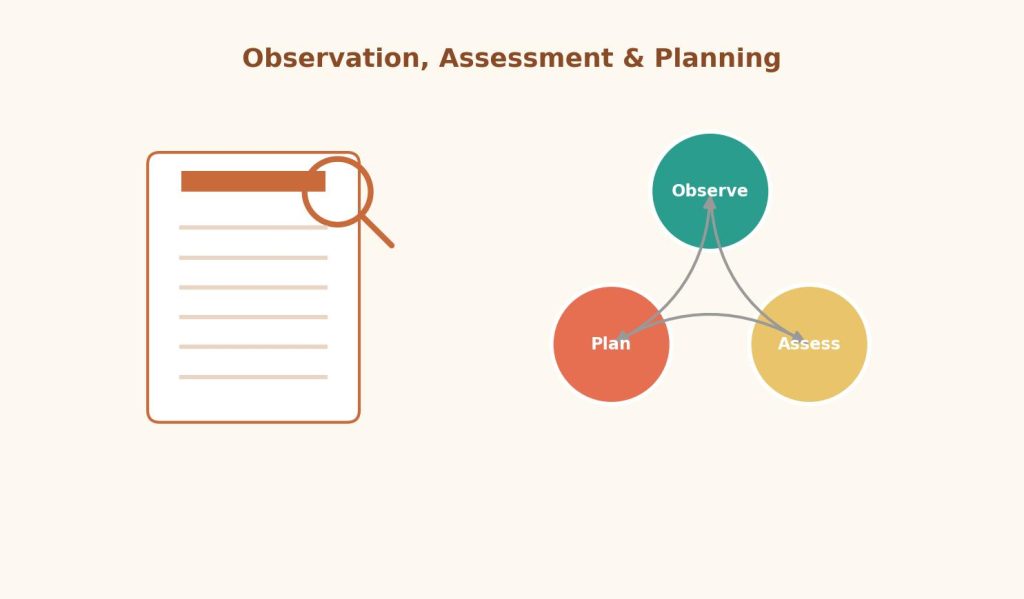
If there’s one skill that runs through nearly every CACHE Level 3 unit and placement requirement, it’s the observation-assessment-planning cycle. It sounds simple in theory — watch a child, work out what it tells you, plan what to do next — but students consistently lose marks because their written observations slip into opinion, their assessments don’t clearly connect back to the observation, or their “next steps” are too vague to actually implement. This article walks through each stage with concrete, gradeable examples.
Table of Contents
ToggleWhy This Cycle Matters So Much in CACHE Level 3
The observation-assessment-planning cycle is a competence-based skill — meaning it’s assessed through evidence of what you actually did in a real setting, not just what you know about child development theory. Assignments and portfolio evidence typically require you to submit:
- A written observation of a real child (with consent and anonymized appropriately)
- An assessment linking that observation to expected developmental milestones
- A “next steps” plan showing how you would support that child’s continued development
Weakness in any one stage breaks the whole chain, which is why assessors mark this cycle so strictly.
Stage 1: Observation Methods
There are several recognized observation methods used across CACHE Level 3 coursework, and choosing the right one for the situation is itself something assignments test.
Narrative (Free Description) Observation
A running, real-time written account of everything a child does during a set period, written in the present tense as it happens.
Worked example: “9:14am: Amir walks to the water tray and picks up a plastic jug. He fills it from the tap, pours the water into a smaller cup, and watches it overflow. He laughs and says ‘more, more!’ He repeats this action three times before moving to the sand tray.”
Best used for: Capturing a broad picture of a child’s behavior and interests over a short period, especially useful early in getting to know a child.
Time Sampling
Observing and recording a child’s behavior at set intervals (e.g., every five minutes) over a longer period, useful for spotting patterns like how often a child engages in solitary versus cooperative play.
Worked example: A time sample recorded every 10 minutes across a morning session might show: 9:00 — solitary play (building blocks); 9:10 — parallel play (sitting near another child, not interacting); 9:20 — cooperative play (sharing blocks with a peer); 9:30 — solitary play (moved to book corner). This pattern, tracked across a whole session, gives evidence for assessing a child’s typical balance of play types.
Event Sampling
Recording every instance a specific behavior occurs, useful for tracking a specific concern (e.g., biting incidents, or how often a child initiates speech).
Worked example: An event sample tracking a child’s spontaneous speech across a session might record: 9:05 “Look, big tower!”; 9:22 “My turn now”; 9:40 “That’s not fair” — giving a practitioner concrete evidence of vocabulary range and sentence complexity, rather than a vague impression of “talks quite a lot.”
Checklist Observation
A pre-prepared list of specific skills or milestones, ticked off as the child demonstrates them — quick to complete but less rich in descriptive detail.
Best used for: Efficiently tracking progress against specific developmental checkpoints (e.g., an EYFS-aligned checklist for fine motor skills), often used alongside a richer narrative observation rather than instead of one.
Stage 2: Writing Observations Objectively (Where Most Students Lose Marks)
The single most common feedback CACHE Level 3 students receive on observation assignments is: “This is not objective.” Objectivity means recording only what you directly saw or heard — not your interpretation, assumption, or judgment about why the child did something.
Example of a weak, subjective observation: “Freya was upset because she wanted attention. She cried and pushed the other child, showing she has trouble sharing.”
This sentence contains three unearned assumptions: that she was upset because she wanted attention, that pushing indicates a general sharing problem, and an implied character judgment.
Example of a strong, objective observation of the same event: “Freya reached for the red truck at the same time as another child. She said ‘mine’ and pulled the truck toward herself. The other child did not let go. Freya pushed the other child’s shoulder with an open hand. The other child let go of the truck and moved away. Freya then played with the truck alone for approximately two minutes.”
Notice the second version records only observable facts — actions, words spoken, sequence of events — with no inference about motivation. The interpretation (what this might indicate about Freya’s development) belongs in the separate assessment stage, not the observation itself.
A useful test for students: If you can’t point to exactly what you saw or heard that supports a sentence in your observation, it’s an assumption and needs to be removed or moved into the assessment section instead.
Stage 3: Assessment — Linking Observation to Development
The assessment stage is where you interpret the observation against expected developmental norms, typically referencing an age/stage framework (such as EYFS “Development Matters” bands) or a recognized theorist where relevant.
Worked example (continuing the Freya observation above): “This observation suggests Freya, aged 2 years 8 months, is functioning broadly within the expected range for her age in terms of social development. At this age, children are typically still developing an understanding of sharing and turn-taking, and instances of grabbing or pushing over a contested toy are common rather than concerning in isolation. However, the use of physical action to resolve the conflict, rather than a verbal strategy, indicates an area of social development (‘using words to solve problems with peers’) that could be specifically supported.”
Common assignment mistake: Writing an assessment that simply restates the observation in different words, without actually comparing it to a developmental expectation. A strong assessment always answers: “Is this what we’d expect for a child this age, and what does it tell us about this specific child’s development?”
Stage 4: Planning Next Steps
The final stage translates the assessment into a specific, actionable plan — and this is where vague answers cost the most marks. “Support Freya’s social skills” is not a next-steps plan; it’s a restated goal. A strong next-steps plan specifies an activity, a practitioner action, and how success will be recognized.
Worked example: “Over the next two weeks, I will introduce a simple turn-taking game during small-group time (e.g., rolling a ball back and forth, using a visual timer for sharing popular toys like the red truck). When Freya reaches for a toy another child is using, I will model the phrase ‘can I have a turn when you’re finished?’ and prompt her to use it. I will observe during the following two sessions whether Freya begins to use verbal requests instead of physical action in similar situations, and record this in a follow-up observation.”
This example works because it names a specific activity, describes the practitioner’s exact role in supporting it, and states how the plan’s success will be checked — which closes the loop back to a future observation, completing the cycle.
A Common Structural Mistake: Treating the Three Stages as One Paragraph
Many students write observation, assessment, and planning as one blended paragraph, which makes it hard for an assessor to see that you understand the stages are distinct skills. Structuring your assignment with clear subheadings — Observation, Assessment, Next Steps — makes the separation obvious and is usually rewarded, even where the content itself is similar to a blended version.
A Practical Checklist for Students Stuck on an Observation Assignment
- Choose an observation method appropriate to what you’re trying to find out (narrative for a general picture, event sampling for a specific behavior, time sampling for patterns across a session).
- Write the observation in the present tense, recording only observable actions, words, and sequence — no interpretation.
- Reread your observation and remove any word implying motive, emotion, or judgment unless the child stated it directly (e.g., only write “upset” if the child said “I’m upset” — otherwise describe the observable signs: “eyes filled with tears,” “voice raised”).
- In the assessment, explicitly compare the observed behavior to an age/stage expectation, and name the framework or theory you’re referencing.
- In the next steps, name a specific activity, your specific role in it, and how you’ll check whether it worked.
FAQs
Q1: How long should a CACHE Level 3 observation be? There’s no universal word count — it depends on your specific assignment brief and awarding body guidance — but narrative observations are typically a focused 5–15 minute window, long enough to capture a meaningful sequence of behavior without becoming an unfocused, all-day account.
Q2: Can I use a child’s real name in my written observation? No — CACHE Level 3 coursework requires anonymization to protect confidentiality, typically using a first initial or a pseudonym, in line with your setting’s confidentiality policy and safeguarding requirements.
Q3: What’s the difference between “assessment” in this context and a formal diagnostic assessment? In this context, “assessment” simply means interpreting your observation against expected developmental norms — it is not a formal diagnostic or clinical assessment, which would only be carried out by a qualified specialist (such as a speech and language therapist or educational psychologist) where a more significant concern is identified.
Q4: My placement setting doesn’t use time sampling — do I still need to know it for my assignment? Yes — CACHE Level 3 theory units typically expect you to understand and be able to describe multiple observation methods, even if your specific placement setting primarily uses only one or two in daily practice, since assignments may ask you to compare methods or justify why one is more suitable than another for a given situation.
Q5: How do I handle an observation where nothing developmentally significant seems to happen? Even seemingly ordinary observations usually contain useful evidence — the goal isn’t to catch a dramatic milestone, but to accurately document typical behavior and compare it to expected norms. If truly nothing observable occurred, that itself may be worth noting and repeating the observation at a different time or during a different activity.
Related Reading
Observations frequently surface safeguarding concerns — see CACHE Level 3 Safeguarding: Legislation, Policies, and Reporting Procedures Explained for what to do if that happens. For guidance on structuring the written assignment itself, including referencing and common formatting mistakes, see CACHE Level 3 Assignment Writing: Referencing, Structure, and Common Mistakes. Observation evidence is also a core part of your portfolio — see CACHE Level 3 Placement Hours and Portfolio Evidence: What You Need to Know.