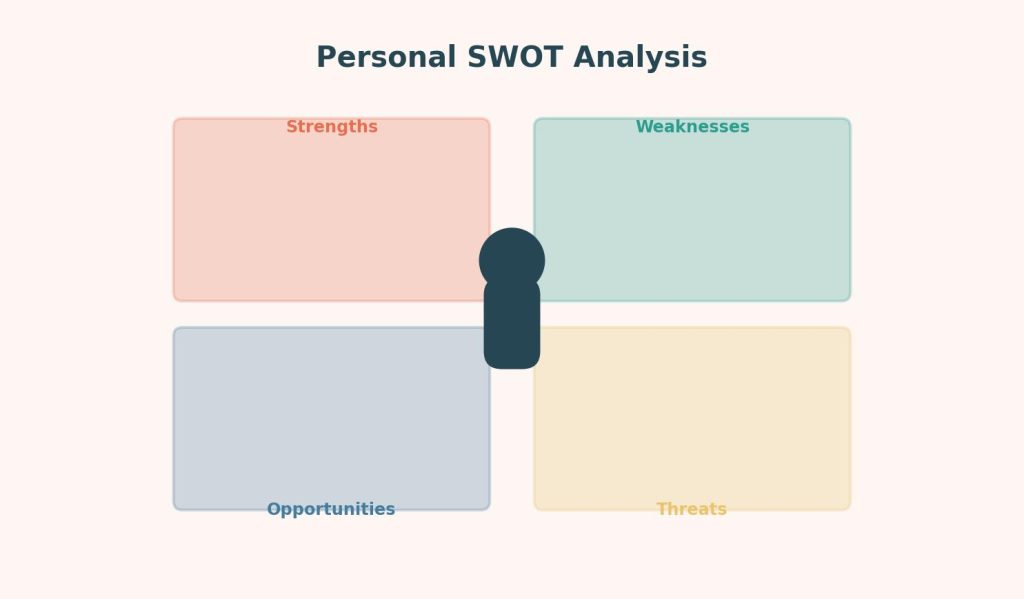
The standard SWOT framework was built for analyzing organizations, which is exactly why applying it to yourself feels so unfamiliar the first time an assignment asks for it — usually as part of a career planning module, a personal development portfolio, or a leadership course. The same four-box structure works, but the classification logic shifts in ways that trip students up: “internal” and “external” mean something different when the subject is a person rather than a company, and it’s genuinely harder to be honest and specific about your own weaknesses than about a business’s. This guide walks through how to adapt the SWOT framework correctly for a personal analysis, with a complete worked example.
Table of Contents
ToggleHow Internal vs. External Changes When the Subject Is You
In a standard business SWOT, internal means “within the organization’s control,” and external means “the broader market or environment.” For a personal SWOT, the same logic applies, but the boundary shifts:
- Internal (Strengths/Weaknesses): your own skills, traits, habits, knowledge, and personal characteristics — things that exist within you.
- External (Opportunities/Threats): factors in your environment, industry, or circumstances that you don’t personally control — job market conditions, industry trends, competition from other candidates, economic conditions.
Worked example clarifying a commonly confused point: “I don’t have much experience in data analysis” is internal (a personal characteristic — specifically a weakness), while “the job market for my field is highly competitive right now” is external (a market condition outside your control — a threat). Students sometimes list a lack of experience as a “threat,” reasoning that it threatens their job prospects — but the lack of experience itself is internal to the person; it’s a weakness. The resulting difficulty finding a job because of that weakness combined with a competitive market is where the weakness and the threat interact, which is worth explaining explicitly rather than blurring the two together into one miscategorized point.
Strengths: Going Beyond a Generic Skills List
A weak personal SWOT lists strengths like “hard worker” or “good communicator” without any supporting detail — exactly the kind of vague claim that a hiring manager, or an instructor grading a career-planning assignment, has seen a thousand times.
Worked example — weak vs. strong:
Weak: “I am a good communicator.”
Strong: “I have consistently strong written and verbal communication skills, demonstrated through leading weekly presentations in my part-time retail supervisor role and receiving positive feedback in three consecutive performance reviews specifically citing my ability to de-escalate customer complaints calmly and clearly.”
Categories worth considering when brainstorming personal strengths:
- Technical/hard skills — specific software, languages, certifications, technical knowledge
- Soft skills — communication, leadership, adaptability, time management (always paired with a specific example, as shown above)
- Experience — relevant work, internship, volunteer, or project experience
- Personal traits — traits like resilience or curiosity, again always tied to a specific demonstrated instance rather than stated as a bare claim
Weaknesses: The Section Students Struggle With Most (And How to Handle It Honestly)
Being asked to formally document your own weaknesses feels uncomfortable, and this discomfort often produces one of two unhelpful patterns: either disguising a strength as a fake weakness (“I work too hard” — a classic, and instructors recognize it instantly as evasive), or writing something so vague it says nothing useful (“I could improve in some areas”).
Worked example — the fake-weakness trap to avoid:
Avoid: “My biggest weakness is that I’m a perfectionist and care too much about my work.”
Instead, write something genuinely useful: “I have limited experience with public speaking to large groups, having only presented to audiences of fewer than 15 people, which may be a gap for roles that require frequent large-audience presentations.”
Why the second version is stronger for an assignment: it’s specific, honest, and — critically — sets up a natural connection to an actionable next step (which fits directly into a “next steps” or action-planning section many personal SWOT assignments require, similar to the strategic matching covered in TOWS Matrix: Turning Your SWOT Analysis Into Actionable Strategies, adapted here to a personal development plan rather than a business strategy).
A useful reframing technique: if you’re struggling to identify genuine weaknesses, think about specific feedback you’ve received (from a supervisor, professor, or peer), skills required in your target career path that you haven’t yet developed, or tasks you consistently avoid or find more difficult than your peers.
Opportunities: External Factors You Could Take Advantage Of
Worked example:
“The growing demand for data-literate professionals across nearly all industries — not just technical roles — represents a significant opportunity, since my current degree program includes an optional data analytics certificate that I could complete alongside my primary coursework to strengthen my competitiveness for a wider range of roles after graduation.”
Categories worth considering:
- Industry/market trends — growing demand in your target field, emerging specializations
- Educational opportunities — certificates, electives, exchange programs, or workshops available to you
- Networking opportunities — professional organizations, alumni networks, industry events
- Timing-based opportunities — a growing company hiring aggressively, a new program launching at your institution
Common assignment mistake: listing something you’re already doing as an “opportunity” (for example, “I am currently completing an internship” is really evidence supporting a strength or a strategy already being pursued, not a still-available external opportunity) rather than something available to be pursued or capitalized on going forward.
Threats: External Factors Working Against You
Worked example:
“Increasing automation of entry-level data entry and basic analysis tasks in my target industry represents a threat to the traditional entry points into this career path, meaning I may need to target roles requiring a slightly higher skill threshold than I might have originally planned, or actively build skills that are more resistant to near-term automation, such as stakeholder communication and complex problem-solving.”
Categories worth considering:
- Competitive pressure — a high volume of similarly qualified candidates in your target field
- Economic conditions — hiring freezes, industry contraction, broader economic uncertainty
- Technological change — automation or new tools changing the skills employers require
- Structural/systemic factors — geographic limitations, visa/work authorization constraints, industry-specific barriers to entry
A Full Worked Example: A Complete Personal SWOT for a Career Planning Assignment
Context: A third-year marketing student preparing for post-graduation job applications.
Strengths:
- Strong portfolio of real client work from a semester-long agency-style capstone project, including a documented 22% engagement increase for a local nonprofit’s social media campaign
- Proficient in three major design and analytics tools (Adobe Creative Suite, Google Analytics, Canva), evidenced by coursework and a completed Google Analytics certification
- Demonstrated leadership experience as social media coordinator for a 200-member student organization for two consecutive years
Weaknesses:
- No formal experience with paid advertising platforms (Google Ads, Meta Ads Manager), despite this being commonly listed as a requirement in target job postings
- Limited professional network outside of university connections, having not yet attended industry events or built LinkedIn connections beyond classmates and professors
- Public speaking experience limited to small class presentations, not larger professional or client-facing settings
Opportunities:
- University career center offers a free six-week paid advertising certification workshop next semester, directly addressing the identified weakness above
- Growing local business association actively seeking student interns for real marketing projects, offering a chance to build both experience and professional network simultaneously
- Industry-wide shift toward data-driven marketing roles plays directly to existing strength in analytics tools
Threats:
- Highly competitive entry-level marketing job market in the target city, with significantly more graduating marketing students than available entry-level roles
- Continued industry consolidation of marketing functions into fewer, more senior “growth marketer” hybrid roles, potentially raising the experience bar for entry-level candidates
- Economic uncertainty affecting marketing budgets industry-wide, which are often among the first departments to face cuts during downturns
A brief connecting strategy statement (often required as a concluding section): “Given the highly competitive local job market (Threat) and the current gap in paid advertising experience (Weakness), completing the university’s paid advertising certification workshop (Opportunity) directly strengthens my competitiveness by closing that specific skills gap, while my existing portfolio and analytics certification (Strengths) can be leveraged in networking conversations at local business association events (Opportunity) to build the professional connections I currently lack.”
A Step-by-Step Checklist for Students Writing a Personal SWOT Analysis
- Remember that internal (Strengths/Weaknesses) means characteristics of you, while external (Opportunities/Threats) means factors in your environment or industry you don’t personally control.
- For every strength, add a specific example or piece of evidence — avoid bare claims like “hard worker” with nothing behind them.
- Resist disguising a strength as a fake weakness; instead, identify a genuine, specific gap, ideally one connected to a concrete next step you could realistically take.
- Make sure opportunities describe something available to pursue going forward, not something you’re already doing.
- If your assignment allows it, close with a brief paragraph connecting specific points across quadrants into an actionable takeaway — this final step is often exactly what separates a basic self-assessment from a genuinely strategic personal development plan.
FAQs
Q1: Is it okay to be very honest about my weaknesses in a personal SWOT assignment? Yes — and it’s actually expected. Instructors grading these assignments are specifically looking for genuine self-reflection rather than disguised strengths or vague non-answers, and a well-chosen, specific, honest weakness paired with a realistic plan to address it typically earns stronger marks than an evasive answer.
Q2: How is a personal SWOT different from a business SWOT beyond just the subject matter? The core structure and internal/external logic are the same, but a personal SWOT often includes a stronger emphasis on actionable next steps for individual development (since the “strategy” that follows is about your own choices and actions, not organizational decisions), and tends to draw more heavily on personal experience and specific feedback rather than formal research reports.
Q3: Should I include personality traits or only skills in the strengths and weaknesses sections? Both are appropriate, as long as each point is specific and, ideally, tied to a concrete example — a personality trait like “adaptability” is a reasonable strength to include if you can point to a specific situation demonstrating it, rather than listing traits as bare, unsupported adjectives.
Q4: What if I genuinely can’t think of any weaknesses? This usually means you haven’t looked in the right places yet — review specific feedback you’ve received from supervisors, professors, or peers, compare your current skill set against the specific requirements listed in job postings for your target role, and consider tasks or situations you consistently find more difficult or tend to avoid.
Q5: Do I need to include a “next steps” or action plan section after my personal SWOT? Check your specific assignment brief, but many career-planning and personal development courses do expect this, since a personal SWOT without any resulting action plan misses the practical purpose of the exercise — the connecting strategy statement shown in the worked example above is a common, effective way to bridge from analysis into concrete next steps.
Applying the Same Framework at the Organizational Level
If you’re also working on an organizational (rather than personal) SWOT assignment in parallel, the underlying classification principles are covered in more depth in How to Write a SWOT Analysis for a Business Plan or Assignment, and What Is SWOT Analysis and How to Do It Right remains the best starting point if you need to revisit the foundational framework itself.