Business strategy courses love throwing three-letter and five-word acronyms at students in quick succession — SWOT, PESTLE, Porter’s Five Forces — often within the same module, sometimes within the same assignment. The result is a common and understandable confusion: students memorize each framework’s structure individually but struggle to explain why you’d choose one over another, or how they actually differ in what they analyze. This guide clarifies exactly what each framework does, where they overlap, where they genuinely differ, and how to combine them correctly in a single strategic analysis assignment.
Table of Contents
ToggleThe One-Sentence Distinction Worth Memorizing First
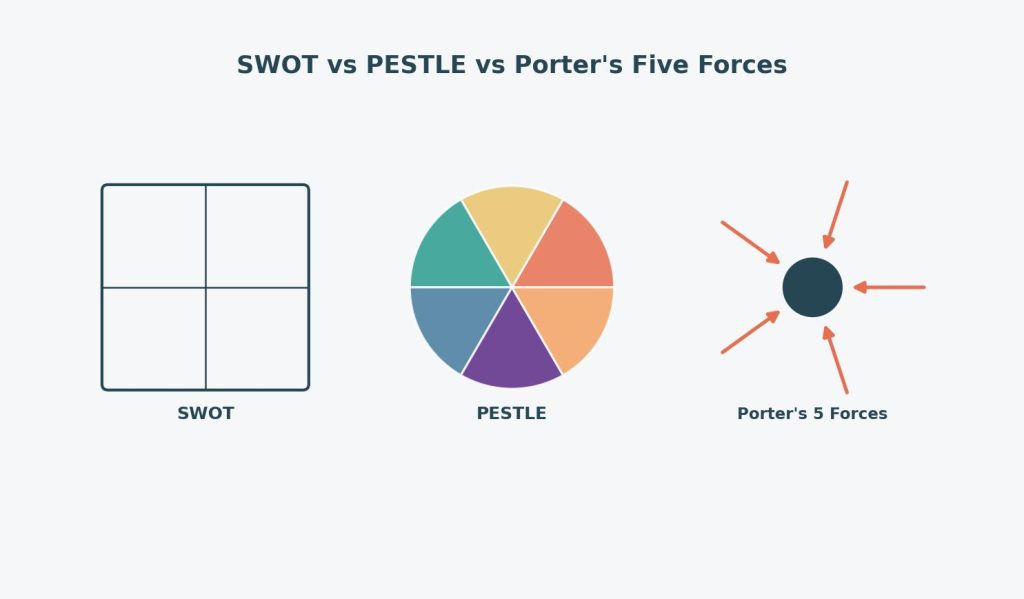
- SWOT analyzes a specific organization, combining its internal characteristics with its external environment.
- PESTLE analyzes the broader macro-environment only — it says nothing about any specific organization’s internal characteristics.
- Porter’s Five Forces analyzes the competitive structure of an industry — specifically, how much competitive pressure and profit potential exists within that industry.
If you remember only one thing from this article, remember that PESTLE and Porter’s Five Forces are both purely external, environment-focused tools, while SWOT is the only one of the three that also asks about the organization itself. This is exactly why SWOT is often used after PESTLE or Porter’s Five Forces in a well-structured assignment — the external analysis feeds directly into the Opportunities and Threats sections of the SWOT.
SWOT Analysis: A Quick Recap
As covered in depth in What Is SWOT Analysis and How to Do It Right, SWOT examines four categories: internal Strengths and Weaknesses, and external Opportunities and Threats, specific to one organization. It’s a synthesis tool — pulling together both internal self-assessment and external environmental awareness into a single, organization-specific picture.
What SWOT is good at: producing a clear, organization-specific summary that’s easy to communicate to stakeholders and directly supports strategic recommendations.
What SWOT is not designed to do: systematically and comprehensively scan every possible external factor. A SWOT’s Opportunities and Threats section can end up thin or incomplete if it isn’t informed by a more systematic external scan first — which is exactly the gap PESTLE and Porter’s Five Forces are built to fill.
PESTLE Analysis: Scanning the Macro-Environment
PESTLE (sometimes PEST, without the L and E) systematically examines six categories of external, macro-level factors affecting any organization operating in a given market — not specific to one company at all:
- Political — government policy, political stability, trade regulations, tax policy
- Economic — interest rates, inflation, exchange rates, economic growth or recession
- Social — demographic shifts, cultural trends, consumer attitudes and behaviors
- Technological — automation, innovation cycles, emerging technologies affecting the industry
- Legal — employment law, industry-specific regulation, intellectual property law, consumer protection law
- Environmental — climate change impacts, sustainability regulations, resource availability
Worked example — PESTLE applied to the electric vehicle industry (not any single company):
- Political: Government subsidies and tax incentives for EV purchases in many countries directly influence consumer demand.
- Economic: Rising interest rates increase the cost of auto financing, potentially slowing big-ticket purchases like vehicles across the board.
- Social: Growing consumer environmental consciousness, particularly among younger buyers, increases demand for lower-emission vehicles.
- Technological: Battery technology improvements are steadily increasing vehicle range while reducing production costs industry-wide.
- Legal: Increasingly strict emissions regulations in many major markets are accelerating the industry-wide shift away from internal combustion engines.
- Environmental: Growing scrutiny of the environmental impact of lithium and cobalt mining for batteries creates supply chain and reputational pressure across the entire industry.
The key distinguishing feature of this example, worth noting for assignments: none of these six points mention a specific company at all — they apply to every company operating in the EV industry equally. This is precisely what separates PESTLE from SWOT: PESTLE describes the shared environment; SWOT (specifically its Opportunities and Threats sections) describes how a specific company is positioned relative to that shared environment.
Common assignment mistake: writing PESTLE points that are actually specific to one company (e.g., “Company X’s new EV model has strong battery range”), which belongs in that company’s SWOT Strengths section, not in a PESTLE analysis, which should remain entirely industry- and market-level.
Porter’s Five Forces: Analyzing Industry Competitive Structure
Porter’s Five Forces, developed by Michael Porter, examines the competitive intensity and profit potential of an entire industry, through five specific forces:
- Threat of new entrants — how easily new competitors could enter the industry
- Bargaining power of suppliers — how much leverage suppliers have over pricing and terms
- Bargaining power of buyers — how much leverage customers have to demand lower prices or better terms
- Threat of substitute products or services — how easily customers could switch to an entirely different type of solution
- Competitive rivalry among existing competitors — how intensely existing companies in the industry compete with each other
Worked example — Porter’s Five Forces applied to the coffee shop industry (again, industry-level, not company-specific):
- Threat of new entrants: Moderate — relatively low startup capital is needed for a small independent coffee shop, but building brand recognition to compete with established chains is a real barrier.
- Bargaining power of suppliers: Moderate to high — coffee bean prices are subject to global commodity market fluctuations largely outside any individual coffee shop’s control.
- Bargaining power of buyers: High — customers face very low switching costs between coffee shops, and price/quality comparisons are easy to make.
- Threat of substitutes: Moderate — energy drinks, tea, and at-home coffee brewing all represent viable substitute options for caffeine consumption.
- Competitive rivalry: High — the coffee shop industry in most urban markets is saturated with both large chains and independent shops competing intensely on location, price, and experience.
What this tells you (industry-level insight, not company-specific): overall, this is a highly competitive industry with limited structural profit protection — useful context for any company considering entering or already operating in this space, but it doesn’t yet say anything about how well-positioned any specific company is within that competitive landscape. That’s exactly where a company-specific SWOT analysis picks up.
Common assignment mistake: confusing Porter’s Five Forces with PESTLE, since both are external analysis tools. The key difference: PESTLE examines broad macro-environmental trends (political, economic, social, etc.) that affect virtually every industry, while Porter’s Five Forces specifically examines the competitive dynamics within one particular industry — supplier power, buyer power, rivalry, and so on. A rising interest rate is a PESTLE (economic) factor; the ease with which a new coffee shop could open next door is a Porter’s Five Forces (threat of new entrants) factor.
How the Three Frameworks Fit Together in One Assignment
Many strategy assignments expect you to use these tools together, in a specific logical sequence, rather than as three disconnected exercises:
- Start with PESTLE to scan the broad macro-environment affecting the entire industry.
- Apply Porter’s Five Forces to understand the specific competitive structure and profit potential within that industry.
- Build the SWOT analysis last, using insights from both PESTLE and Porter’s Five Forces to inform the Opportunities and Threats sections, while drawing on internal company research for the Strengths and Weaknesses sections.
Worked example showing this flow explicitly:
“PESTLE analysis identified a Political trend toward stricter emissions regulation (macro-environmental). Porter’s Five Forces analysis showed high competitive rivalry within the EV industry generally (industry-level). Bringing both of these into Company X’s SWOT: the emissions regulation trend becomes an Opportunity specifically for Company X, given its existing Strength in advanced battery technology relative to competitors — while the high competitive rivalry identified through Porter’s Five Forces becomes a Threat, particularly given Company X’s specific Weakness in brand recognition compared to more established competitors.”
This worked example shows exactly how the three tools connect: PESTLE and Porter’s Five Forces provide the external raw material, and SWOT is where that external material gets connected to the specific organization’s internal position — a synthesis that a strong assignment makes explicit rather than leaving implicit.
A Comparison Table for Quick Reference
| Feature | SWOT | PESTLE | Porter’s Five Forces |
|---|---|---|---|
| Focus | Specific organization | Macro-environment (broad) | Industry competitive structure |
| Internal factors included? | Yes (Strengths/Weaknesses) | No | No |
| External factors included? | Yes (Opportunities/Threats) | Yes (all six categories) | Yes (all five forces) |
| Best used for | Organization-specific strategic summary | Broad environmental scanning | Assessing industry attractiveness/profitability |
| Typical assignment sequence | Usually last, synthesizing other analyses | Usually first | Usually second |
A Step-by-Step Checklist for Students Choosing Between These Frameworks
- Ask whether your assignment wants analysis of a specific company (SWOT) or the broader environment/industry (PESTLE or Porter’s Five Forces) — this alone often resolves which framework the question is actually asking for.
- If your assignment wants broad macro-environmental trends unrelated to any single company’s competitive position, use PESTLE.
- If your assignment wants an assessment of how competitive and structurally profitable an entire industry is, use Porter’s Five Forces.
- If your assignment asks you to combine tools, use PESTLE and/or Porter’s Five Forces first to gather external insight, then build the SWOT last, explicitly drawing specific points from the earlier analyses into the Opportunities and Threats sections.
- Double-check that any point you’ve placed in a PESTLE or Porter’s Five Forces analysis is genuinely industry-wide, not accidentally specific to one company — if it’s company-specific, it belongs in that company’s SWOT instead.
FAQs
Q1: Do I always need to use all three frameworks in one assignment? No — check your specific assignment brief. Many assignments ask for only one framework in isolation, while more advanced strategy courses may explicitly require combining two or three tools to demonstrate you understand how they complement each other, as shown in the worked example above.
Q2: What’s the main difference between PESTLE and Porter’s Five Forces if they’re both external tools? PESTLE covers broad macro-environmental categories (political, economic, social, technological, legal, environmental) that affect essentially every industry, while Porter’s Five Forces focuses specifically on the competitive dynamics within one particular industry — supplier power, buyer power, new entrant threat, substitutes, and rivalry intensity.
Q3: Can a factor identified in PESTLE also appear in a company’s SWOT? Yes, and this is actually the intended, correct use of these tools together — a macro-environmental trend identified in PESTLE (like stricter regulation) becomes company-specific once you ask how it affects one particular organization’s Opportunities or Threats, given that company’s specific internal Strengths and Weaknesses.
Q4: Which framework should I use first in a combined assignment? There’s no absolute rule, but a common and logical sequence is PESTLE first (broadest scope), Porter’s Five Forces second (narrower, industry-specific), and SWOT last (narrowest scope, specific to one organization), since this order moves from the widest environmental context down to the most specific, company-level synthesis.
Q5: Is Porter’s Five Forces the same as competitor analysis? Not quite — competitor analysis typically examines specific, named competitors in detail (their strategies, strengths, market share), while Porter’s Five Forces analyzes the structural competitive intensity of an entire industry more abstractly, including forces beyond direct competitors, such as supplier and buyer bargaining power and the threat of substitute products.
Putting These Frameworks Into a Complete SWOT Assignment
Once you’ve gathered PESTLE and Porter’s Five Forces insights, How to Write a SWOT Analysis for a Business Plan or Assignment shows exactly how to translate that external research into a properly structured, well-evidenced SWOT, and SWOT Analysis Examples: Real-World Case Studies for Business Students shows finished examples of what that synthesis looks like in practice.