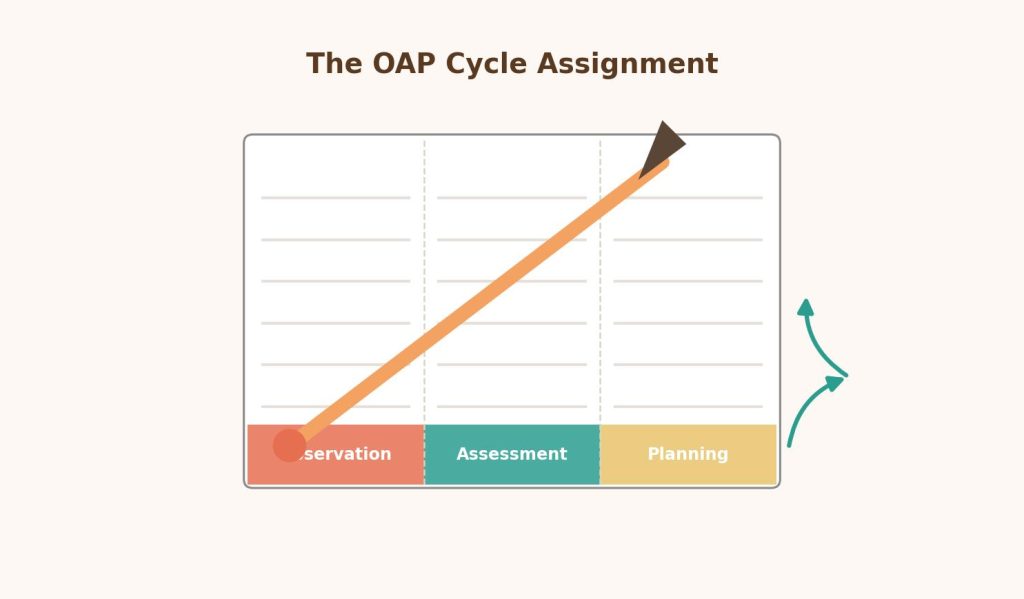
If you’ve searched for extra help on the Observation, Assessment, and Planning (OAP) cycle, chances are you already understand the theory but are staring at an assignment brief that says something like “carry out an observation of a child and complete the OAP cycle” — and you don’t know exactly how to turn that into a submittable piece of written work. This article is built specifically for that moment: it gives you a complete, start-to-finish worked example of an actual OAP cycle assignment, a reusable template you can adapt to your own placement child, and a breakdown of exactly what assessors are checking for at each stage.
This guide assumes you already understand the purpose of each stage (if you need that grounding first, see the Related Reading section at the end). Here, the focus is entirely on how to actually write the assignment — the structure, the language, and the level of detail that turns a pass-level answer into a strong one.
Table of Contents
ToggleBefore You Start: What Your Assignment Brief Is Really Asking For
Almost every CACHE Level 3 OAP assignment is checking for the same underlying skills, even when the wording of the brief varies:
- Can you carry out and record an observation objectively, using an appropriate method?
- Can you accurately interpret that observation against expected developmental norms for the child’s age?
- Can you translate that interpretation into a specific, actionable, and realistic plan?
- Can you reference relevant theory or frameworks to support your assessment and plan (rather than relying only on personal opinion)?
If your brief includes command words like “carry out,” “record,” “analyse,” or “plan,” treat each one as a checklist item your final submission must visibly demonstrate — assessors are usually marking against a criteria grid that maps directly onto these four skills.
Step 1: Preparing Before You Observe
A common reason students get stuck isn’t the writing — it’s not having planned the observation itself properly. Before you observe, decide:
- Which child, and with what consent? Confirm parental/setting consent is in place, and decide how you’ll anonymize the child in your written work (e.g., “Child A” or a single initial).
- Which observation method fits your purpose? A narrative observation is usually the safest default for a general OAP assignment, since it captures rich, sequential detail that supports a strong assessment stage afterward. Event or time sampling suits a more specific, targeted question (e.g., “how often does the child initiate speech?”).
- What time and setting will give you useful material? Choose a period where the child is likely to be actively engaged (free play, a focused activity) rather than a transition or waiting period, which tends to produce thin, low-detail observations.
Practical tip for struggling students: If you’re not sure what to focus on, observe during free-flow play for 10–15 minutes and write down everything the child does and says, in sequence — you can decide what’s developmentally significant afterward, during the assessment stage. Trying to decide what’s “important enough” to observe while you’re observing often leads to a thin, cherry-picked record that’s harder to assess properly.
Step 2: The Observation — Full Worked Example
Below is a complete, realistic example you can use as a model for structure, tone, and level of detail.
Child: Child A, aged 3 years 4 months Date/Time: [date], 9:05–9:18am Context: Free-flow play, indoor construction area Method: Narrative observation
9:05 — Child A walks to the construction area and selects the wooden block basket. She tips the basket over, spreading blocks across the mat. 9:06 — Child A begins stacking blocks vertically. She places four blocks before the tower topples. She says, “Oh no, fall down,” and laughs. 9:08 — Child A rebuilds the tower, this time selecting larger blocks for the base and smaller blocks toward the top. The tower reaches six blocks before it is stable. 9:11 — Child B approaches and reaches for a block near Child A’s tower. Child A says, “No, I’m using that,” and moves the block toward herself. 9:12 — Child A offers Child B a different block from the basket, saying, “You can have this one.” 9:13 — Both children begin building separate towers in parallel, occasionally glancing at each other’s structure. 9:16 — Child A’s tower reaches eight blocks. She calls to the practitioner, “Look how big!” 9:18 — Observation ends as children are called to tidy-up time.
Notice this observation contains no interpretation at all — only actions, direct speech (in quotation marks), and a clear time sequence. This is exactly the standard assessors are checking for, and it’s also what makes the next stage possible to write well.
Step 3: The Assessment — Full Worked Example
The assessment stage takes the raw observation and interprets it against expected developmental norms, ideally referencing a recognized framework (such as EYFS Development Matters bands) or theorist.
This observation of Child A, aged 3 years 4 months, provides evidence across several areas of development. In terms of physical development, Child A demonstrates competent fine motor control and hand-eye coordination, successfully building a stable eight-block tower — broadly consistent with expectations for her age band, where children typically manage towers of six or more blocks with increasing stability (Development Matters, 3–4 years).
In terms of cognitive development, Child A shows early problem-solving skills, adjusting her strategy after the tower’s initial collapse by selecting larger blocks for the base — evidence of trial-and-error reasoning and an emerging understanding of basic structural stability, rather than simply repeating the same unsuccessful approach.
In terms of social and emotional development, the interaction with Child B is particularly significant. Child A’s initial response (“No, I’m using that”) reflects a still-developing, though age-appropriate, sense of ownership over resources, which is typical at this age. However, her follow-up action — independently offering an alternative block rather than the practitioner needing to prompt a resolution — indicates an emerging ability to self-regulate and negotiate a shared-resource conflict, which is slightly more advanced than what would be expected as a baseline for many children at 3 years 4 months, where adult support to resolve such conflicts is still common.
In terms of language development, Child A’s spoken output (“Oh no, fall down,” “No, I’m using that,” “You can have this one,” “Look how big!”) shows use of short, functional sentences of three to five words, consistent with typical expectations for her age.
Why this example works: Each paragraph explicitly names a developmental area, references a specific moment from the observation as evidence, and compares it to an age-appropriate expectation — rather than simply re-describing what happened. Notice also that the assessment doesn’t just confirm “everything is normal” — it identifies one area (the independent conflict resolution) as a specific strength worth highlighting, which shows a more nuanced, individualized understanding of this particular child rather than a generic, one-size-fits-all assessment.
Step 4: The Plan — Full Worked Example
The final stage sets specific, actionable next steps, tied directly back to the assessment.
Based on this assessment, the following next steps are planned to build on Child A’s demonstrated strengths and support continued development:
Target 1 (Physical/Cognitive): Extend Child A’s construction play by introducing a wider range of materials (e.g., cardboard tubes, fabric, natural materials such as pinecones) alongside the wooden blocks over the next two weeks, to challenge her problem-solving with materials of varying weight and shape, rather than the uniform blocks she has already mastered.
Target 2 (Social/Emotional): Build on Child A’s emerging negotiation skills by planning a small-group construction activity (three to four children) later this week, deliberately providing a limited number of a popular resource (such as one set of “special” gold-colored blocks) to create a low-stakes opportunity for further sharing and negotiation practice, with the practitioner observing from a supportive distance rather than intervening immediately.
Target 3 (Language): During construction play, the key person will model slightly extended vocabulary related to size, shape, and stability (e.g., “that block is wider than this one,” “your tower is more stable now”) to gently extend Child A’s descriptive language beyond her current functional phrases.
Review point: These targets will be reviewed in three weeks through a follow-up observation during a similar construction-based activity, checking specifically whether Child A independently uses comparative language (Target 3) and whether she initiates sharing/negotiation without practitioner prompting in a group setting (Target 2).
Why this example works: Each target is directly traceable back to a specific point made in the assessment stage — nothing appears out of nowhere. Each target also names a specific activity, a specific practitioner action, and a specific timeframe, and the plan closes with a named review point specifying exactly what future evidence would confirm progress — completing the cycle rather than leaving it open-ended.
A Reusable Template You Can Adapt
Use this skeleton structure for your own OAP assignment, replacing the bracketed prompts with your own placement child’s details:
OBSERVATION
Child: [anonymized initial], aged [X years, X months]
Date/Time: [date], [start–end time]
Context: [activity/area, indoor or outdoor]
Method: [narrative / time sampling / event sampling]

[Time-stamped, objective, present-tense record of actions and direct speech only]

ASSESSMENT
This observation of [Child], aged [X], provides evidence across the following areas of development:

Physical development: [what was observed] compared to [age-appropriate expectation, with reference to EYFS/theory]
Cognitive development: [what was observed] compared to [age-appropriate expectation]
Social/emotional development: [what was observed] compared to [age-appropriate expectation]
Language/communication development: [what was observed] compared to [age-appropriate expectation]

[Identify at least one specific strength and, if relevant, one area to support further]

PLANNING NEXT STEPS
Target 1 ([development area]): [specific activity], [specific practitioner action], [timeframe]
Target 2 ([development area]): [specific activity], [specific practitioner action], [timeframe]
Target 3 ([development area], if relevant): [specific activity], [specific practitioner action], [timeframe]

Review point: [specific future date/activity], checking specifically for [specific, observable evidence of progress]
Common Mistakes That Cost Marks in OAP Assignments (Beyond What’s Covered Elsewhere)
- Assessment that doesn’t reference the observation directly — every claim in your assessment should be traceable to a specific line or moment in your observation. If you find yourself writing a general developmental fact without pointing back to “this was shown when the child did X,” the connection is too weak.
- Plans that don’t specify who does what — “encourage more sharing” is not a plan; “the practitioner will introduce a limited-resource small-group activity and observe from a supportive distance” is.
- No named review point — a plan without a specified way to check whether it worked reads as incomplete, since the whole point of the cycle is that it feeds back into a future observation.
- Only referencing one area of development — even if the assignment brief doesn’t explicitly ask for all areas, touching on physical, cognitive, social/emotional, and language development (where the observation supports it) generally demonstrates a more holistic, well-rounded understanding.
- Copying observation language directly into the assessment without adding interpretation — e.g., writing “Child A built an eight-block tower” again in the assessment section without explaining what that means developmentally repeats information rather than analyzing it.
A Step-by-Step Approach If You’re Stuck Right Now
- If you haven’t observed yet: pick a 10–15 minute window of engaged play, and write only what you see and hear, in sequence, present tense, no interpretation.
- If you have an observation but are stuck on assessment: go through your observation line by line and ask, for each moment, “what developmental area does this relate to, and is this what I’d expect for this child’s age?”
- If you’re stuck on planning: for every point you made in your assessment, ask “what specific activity, done by whom, over what timeframe, would build on or support this?” — then add a review point that names exactly what you’d check for next time.
- Read your finished draft once purely to check: does every assessment claim trace back to the observation, and does every plan target trace back to the assessment? If either link is missing, that’s where to add detail.
FAQs
Q1: How is this different from the general OAP cycle explanation I’ve already read elsewhere? This guide is deliberately focused on the mechanics of writing the actual assignment submission — a full worked example and reusable template — rather than explaining the underlying theory and observation methods in general terms, which is covered in more conceptual depth elsewhere on this site.
Q2: Can I use the exact template structure shown here for any CACHE Level 3 OAP assignment? The structure is a strong general-purpose starting point, but always check your specific assignment brief and awarding body criteria first, since some briefs require additional elements (such as a reference list, a section explicitly naming a theorist, or a specific word count per section) that should be added to this template.
Q3: How many areas of development should my assessment cover? There’s no universal rule, but covering the four broad areas (physical, cognitive, social/emotional, language/communication) where your observation provides genuine evidence for them tends to demonstrate a more complete understanding than focusing on only one, unless your specific brief asks you to focus narrowly on a single area.
Q4: What if my observation doesn’t show much developmentally interesting material? This is common and usually fixable at the assessment stage rather than requiring a re-observation — even ordinary, everyday behavior can be assessed against developmental norms (confirming the child is progressing typically is still a valid, evidenced assessment). If truly nothing usable was captured, it’s better to repeat the observation during a different, more engaged activity than to stretch a thin observation with unsupported claims.
Q5: Do I need to reference a named theorist (like Piaget or Vygotsky) in my assessment section? Check your specific assignment brief, but referencing a relevant framework or theorist where it genuinely fits the evidence (for example, referencing Vygotsky’s zone of proximal development if a plan involves adult scaffolding) generally strengthens an assessment and planning section, provided the reference is applied specifically to your evidence rather than added as an unconnected general statement.
Related Reading
For the underlying theory behind each stage, including a breakdown of different observation methods and why objectivity matters so much, see Observation, Assessment, and Planning Cycle in CACHE Level 3: Methods and Worked Examples. For guidance on referencing, structuring the wider assignment document, and linking theory to practice, see CACHE Level 3 Assignment Writing: Referencing, Structure, and Common Mistakes. Completed OAP cycle evidence is also commonly used as portfolio evidence — see CACHE Level 3 Placement Hours and Portfolio Evidence: What You Need to Know.