
Table of Contents
ToggleChemical Thermodynamics: Laws, Enthalpy, Entropy, and Gibbs Free Energy
Thermodynamics answers one of the biggest questions in chemistry: will a reaction happen, and how much energy is involved? This guide covers the essential laws and quantities — enthalpy, entropy, and Gibbs free energy — with detailed worked examples designed to help you handle typical university assignment questions. Thermodynamics connects directly to chemical equilibrium and chemical kinetics, so a solid grasp here pays off across the whole course.
1. Basic Definitions
- System: the part of the universe being studied (e.g., the reactants and products in a flask).
- Surroundings: everything else outside the system.
- Open system: exchanges both matter and energy with surroundings.
- Closed system: exchanges energy but not matter.
- Isolated system: exchanges neither matter nor energy.
- State function: a property that depends only on the current state of the system, not on the path taken (e.g., enthalpy, entropy, internal energy). Path functions, like heat and work, depend on the process.
2. The Laws of Thermodynamics
2.1 Zeroth Law
If two systems are each in thermal equilibrium with a third system, they are in thermal equilibrium with each other. This law underlies the concept of temperature as a measurable, comparable quantity.
2.2 First Law: Conservation of Energy
The change in internal energy (ΔU) of a system equals the heat added to the system (q) plus the work done on the system (w):
ΔU = q + w
Example: A gas absorbs 500 J of heat and does 200 J of work on its surroundings (expansion). Since work done by the system is negative in this convention: ΔU = 500 + (−200) = 300 J. The internal energy increases by 300 J.
Example — constant volume: At constant volume, no expansion work is done (w = 0), so ΔU = q_v. This is why calorimetry experiments performed in a sealed “bomb calorimeter” directly measure ΔU.
Example — constant pressure: At constant pressure, q_p = ΔH (enthalpy change), which is why most laboratory reactions (open to the atmosphere) are analyzed using enthalpy rather than internal energy.
2.3 Second Law: Entropy and Spontaneity
The total entropy of an isolated system (system + surroundings) always increases for a spontaneous process:
ΔS_universe = ΔS_system + ΔS_surroundings > 0 (for spontaneous processes)
This law explains why heat flows from hot to cold and why gases naturally expand to fill available space — these processes increase the total disorder (entropy) of the universe.
2.4 Third Law
The entropy of a perfect crystalline substance at absolute zero (0 K) is exactly zero. This law allows us to calculate absolute entropy values (S°) for substances, unlike enthalpy, for which only changes (ΔH) can be measured directly.
3. Enthalpy (H)
Enthalpy is a measure of the total heat content of a system at constant pressure. ΔH = H_products − H_reactants.
- Exothermic reaction: ΔH < 0 (releases heat to surroundings; e.g., combustion).
- Endothermic reaction: ΔH > 0 (absorbs heat from surroundings; e.g., photosynthesis, melting ice).
3.1 Standard Enthalpy of Formation (ΔH°f)
The enthalpy change when 1 mole of a compound forms from its elements in their standard states. By definition, ΔH°f of any element in its standard state is zero (e.g., O₂(g), C(graphite), H₂(g)).
3.2 Hess’s Law
Hess’s Law states that the total enthalpy change for a reaction is the same regardless of the number of steps taken, because enthalpy is a state function. This allows us to calculate ΔH for a reaction by adding up ΔH values for a series of steps that sum to the overall reaction.
Worked Example — Using Hess’s Law: Given:
- C(graphite) + O₂(g) → CO₂(g), ΔH₁ = −393.5 kJ/mol
- H₂(g) + ½O₂(g) → H₂O(l), ΔH₂ = −285.8 kJ/mol
- C₂H₄(g) + 3O₂(g) → 2CO₂(g) + 2H₂O(l), ΔH₃ = −1411.0 kJ/mol
Find ΔH for: 2C(graphite) + 2H₂(g) → C₂H₄(g)
Multiply reaction 1 by 2: 2C + 2O₂ → 2CO₂, ΔH = −787.0 kJ/mol Multiply reaction 2 by 2: 2H₂ + O₂ → 2H₂O, ΔH = −571.6 kJ/mol Reverse reaction 3: 2CO₂ + 2H₂O → C₂H₄ + 3O₂, ΔH = +1411.0 kJ/mol
Sum: (−787.0) + (−571.6) + (1411.0) = +52.4 kJ/mol
3.3 Using Standard Enthalpies of Formation
ΔH°rxn = Σ ΔH°f(products) − Σ ΔH°f(reactants)
Worked Example: Calculate ΔH°rxn for CH₄(g) + 2O₂(g) → CO₂(g) + 2H₂O(l), given ΔH°f: CH₄ = −74.8, CO₂ = −393.5, H₂O(l) = −285.8, O₂ = 0 kJ/mol.
ΔH°rxn = [(−393.5) + 2(−285.8)] − [(−74.8) + 2(0)] = [−393.5 − 571.6] − [−74.8] = −965.1 + 74.8 = −890.3 kJ/mol
4. Entropy (S)
Entropy is a measure of disorder or the number of possible microstates (W) of a system, related by Boltzmann’s equation: S = k ln(W).
4.1 Predicting the Sign of ΔS
Entropy generally increases when:
- A solid converts to a liquid, or a liquid to a gas (increased disorder/freedom of movement).
- The number of moles of gas increases in a reaction.
- A solid or liquid dissolves into solution.
- Temperature increases.
Worked Example: Predict the sign of ΔS for: N₂(g) + 3H₂(g) → 2NH₃(g). Moles of gas decrease from 4 to 2, so the system becomes more ordered: ΔS < 0 (negative).
Worked Example: Predict the sign of ΔS for: CaCO₃(s) → CaO(s) + CO₂(g). A gas is produced from a solid, greatly increasing disorder: ΔS > 0 (positive).
4.2 Calculating ΔS°rxn
ΔS°rxn = Σ S°(products) − Σ S°(reactants), using tabulated absolute (third-law) entropy values.
5. Gibbs Free Energy (G) and Spontaneity
Gibbs free energy combines enthalpy and entropy into a single criterion for spontaneity at constant temperature and pressure:
ΔG = ΔH − TΔS
- ΔG < 0: reaction is spontaneous (exergonic) as written.
- ΔG > 0: reaction is non-spontaneous as written (spontaneous in the reverse direction).
- ΔG = 0: system is at equilibrium.
5.1 The Four Combinations
| ΔH | ΔS | ΔG | Spontaneity |
|---|---|---|---|
| − | + | always negative | Spontaneous at all temperatures |
| + | − | always positive | Non-spontaneous at all temperatures |
| − | − | negative at low T | Spontaneous only at low temperatures |
| + | + | negative at high T | Spontaneous only at high temperatures |
Worked Example: For a reaction with ΔH = −92.4 kJ/mol and ΔS = −198.3 J/(mol·K), find the temperature above which the reaction becomes non-spontaneous.
Set ΔG = 0: T = ΔH/ΔS = (−92,400 J/mol) / (−198.3 J/(mol·K)) = 466 K
Below 466 K, ΔG < 0 (spontaneous); above 466 K, ΔG > 0 (non-spontaneous). This is exactly the type of calculation used to explain why the Haber process (ammonia synthesis) is run at moderate rather than very high temperatures — a link between thermodynamics and industrial chemical equilibrium considerations.
5.2 Standard Gibbs Free Energy and Equilibrium Constant
ΔG° = −RT ln K
This equation connects thermodynamics directly to equilibrium. A large positive K (products favored) corresponds to a negative ΔG°, and a small K (reactants favored) corresponds to a positive ΔG°. This relationship is explored further in the discussion of chemical equilibrium and Le Chatelier’s principle.
Worked Example: Calculate K at 298 K for a reaction with ΔG° = −10.0 kJ/mol.
ln K = −ΔG°/(RT) = −(−10,000)/(8.314 × 298) = 4.036 K = e^4.036 ≈ 56.6
6. Thermodynamics vs. Kinetics: A Crucial Distinction
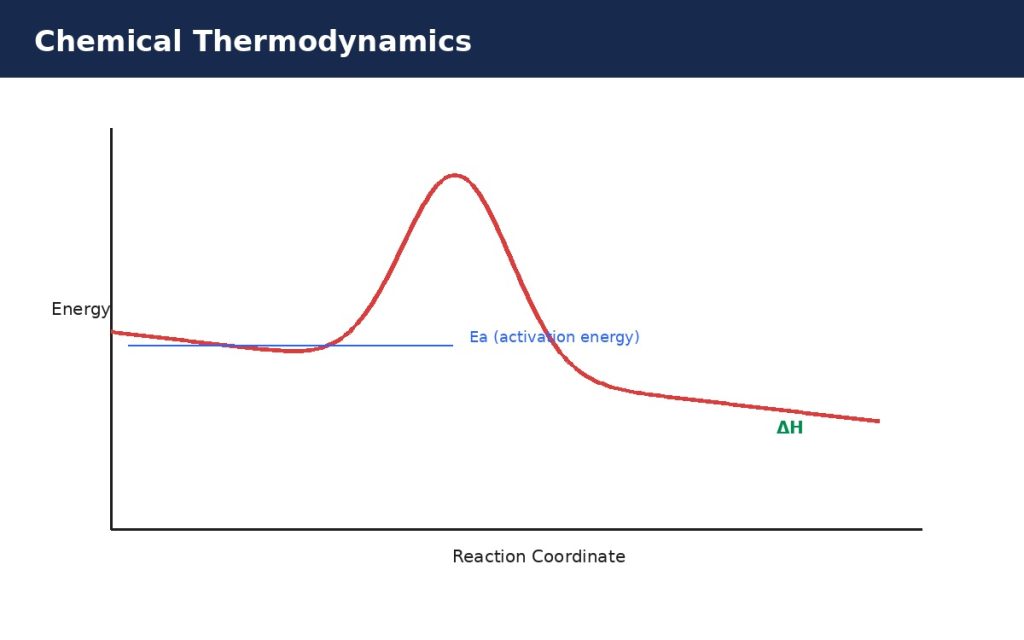
A common misconception in assignments is confusing “spontaneous” with “fast.” Thermodynamics (ΔG) tells us whether a reaction is favorable, but says nothing about the rate. A reaction can be highly spontaneous (very negative ΔG) yet proceed extremely slowly due to a high activation energy barrier — diamond converting to graphite is a classic example: thermodynamically favorable but kinetically negligible at room temperature. Rate and mechanism are the subject of chemical kinetics.
7. Common Assignment Pitfalls
Thermodynamics assignments often require careful handling of equations, units, sign conventions, and multi-step calculations. Students working through university chemistry coursework can also use our Chemistry Assignment Help service for academic assistance with thermodynamics problems and related chemistry topics.
- Confusing ΔH (state function, path-independent) with q (path-dependent, unless at constant pressure or volume).
- Forgetting to convert ΔS from J/(mol·K) to kJ/(mol·K) before combining with ΔH in kJ when calculating ΔG.
- Assuming all exothermic reactions are spontaneous — entropy also matters, especially when ΔS is negative.
- Forgetting that elements in their standard states have ΔH°f = 0 but not necessarily S° = 0 (only a perfect crystal at 0 K has zero entropy, per the third law).
8. Full Worked Problem
Question: For the reaction 2SO₂(g) + O₂(g) → 2SO₃(g), ΔH° = −198 kJ/mol and ΔS° = −187 J/(mol·K). Calculate ΔG° at 298 K and determine spontaneity.
Solution: ΔG° = ΔH° − TΔS° = −198,000 J/mol − (298 K)(−187 J/(mol·K)) = −198,000 + 55,726 = −142,274 J/mol ≈ −142.3 kJ/mol
Since ΔG° is negative, the reaction is spontaneous at 298 K, even though entropy decreases, because the large negative enthalpy dominates at this temperature.
Mastering thermodynamics gives you the conceptual bridge between energy changes and reaction feasibility, setting you up well for chemical equilibrium, electrochemistry (where ΔG relates directly to cell potential), and chemical kinetics. Work through multiple Hess’s Law and ΔG problems until the sign conventions become second nature.
Related Articles
Continue building your chemistry foundation with these related guides:
- Atomic Structure and Quantum Numbers
- Chemical Bonding and Molecular Geometry
- Chemical Kinetics and Rate Laws
- Chemical Equilibrium and Le Chatelier’s Principle
- Acids, Bases and pH Calculations
- Electrochemistry and Redox Reactions
- Organic Reaction Mechanisms (SN1, SN2, E1, E2)
- Coordination Chemistry and Bonding Theories
- Gas Laws and States of Matter