
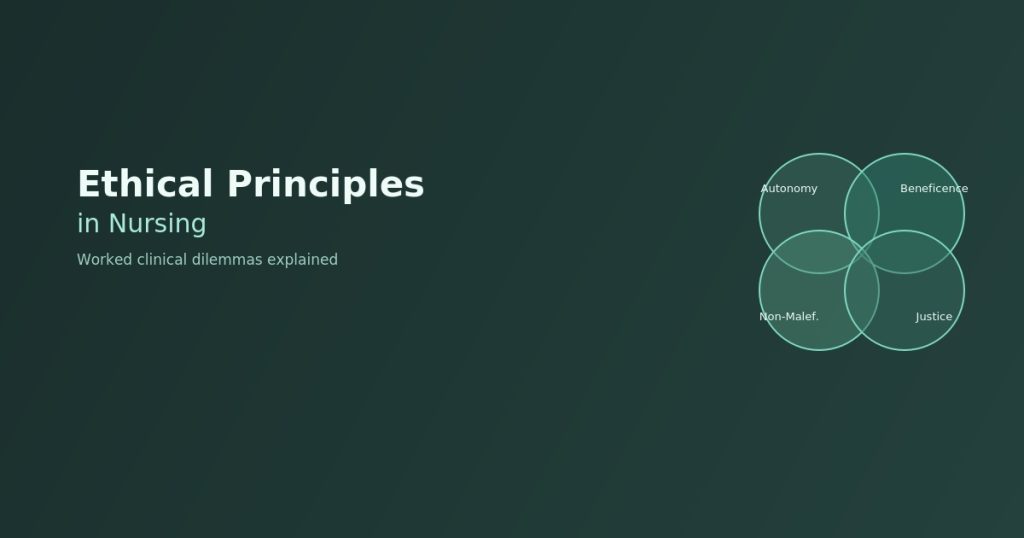
Nursing ethics gives structure to decisions that don’t have a single obviously correct answer — situations where good options conflict with each other, not just situations where a right answer is being obscured by a wrong one. The four-principles framework (developed by Beauchamp and Childress) is the most widely taught structure in nursing ethics education, and its real value isn’t memorizing four Latin-adjacent terms, but learning to recognize which principles are in tension in a specific scenario, since most genuinely difficult ethical situations involve a conflict between two or more of these principles rather than a violation of just one.
Table of Contents
ToggleThe Four Principles, Defined
Autonomy: the patient’s right to make informed decisions about their own care, based on their own values, even when that decision differs from what a clinician would recommend.
Beneficence: the obligation to act in the patient’s best interest — to do good, to promote wellbeing.
Non-maleficence: the obligation to avoid causing harm (“first, do no harm”) — distinct from beneficence in that it’s specifically about avoiding negative outcomes, not just promoting positive ones.
Justice: fair and equitable distribution of resources, care, and treatment — ensuring patients are treated fairly relative to each other, without unjustified discrimination.
Why These Principles Conflict More Often Than They Align
Most introductory treatments of these principles present them as a simple checklist, but the genuine skill in applied nursing ethics is recognizing situations where they pull in different directions — this is where real ethical reasoning, rather than principle-naming, actually happens.
Worked Example 1: Autonomy vs Beneficence
Scenario: A 78-year-old patient with a new diagnosis of type 2 diabetes refuses to start prescribed insulin therapy, stating a strong personal preference to manage the condition through diet alone, despite understanding (confirmed through teach-back) that this significantly increases his risk of serious complications.
The tension: Beneficence pulls toward encouraging, even strongly advocating for, the treatment most likely to produce the best clinical outcome. Autonomy requires respecting the patient’s informed decision, even when it isn’t the clinically optimal choice, provided the patient has full decision-making capacity and has been given accurate information.
How this is typically resolved in practice: Respecting autonomy takes priority here, provided the patient has demonstrated capacity (understanding of the information, ability to reason about it, and ability to communicate a consistent choice) and has been given a genuine opportunity to make an informed decision — this isn’t a violation of beneficence, but a recognition that beneficence, in modern nursing ethics, is understood through the lens of what the patient considers beneficial, not a purely clinical calculation imposed regardless of patient values. The nursing role here involves ensuring the decision is genuinely informed (confirming understanding of risks), documenting the discussion thoroughly, and continuing to offer support and re-education over time without coercion.
Worked Example 2: Beneficence vs Non-Maleficence
Scenario: A patient with severe, poorly controlled cancer pain requires an opioid dose increase to achieve adequate pain relief, but the increased dose carries a meaningfully elevated risk of respiratory depression.
The tension: Beneficence supports increasing the dose to relieve significant suffering. Non-maleficence raises concern about the increased risk of a serious adverse effect.
How this is typically resolved in practice: This is often addressed through the principle of double effect — an action with both a good and a potentially harmful effect can be ethically justified if the intent is the good effect (pain relief), the harmful effect isn’t the means to achieving the good effect, and the good effect is proportionate to the risk of harm. In practice, this translates into careful, monitored titration, appropriate use of adjuncts, and close respiratory monitoring — not avoiding adequate pain management out of harm-avoidance alone, since under-treating severe pain is itself a form of harm.
Worked Example 3: Justice in Resource Allocation
Scenario: During a period of significant nurse understaffing on a ward, a nurse must decide how to allocate limited time across patients with differing levels of need — some patients have urgent physical needs, while others have significant but less immediately dangerous needs (e.g., emotional support following a difficult diagnosis).
The tension: Justice requires fair treatment, but “fair” doesn’t necessarily mean “identical” — treating every patient with exactly equal time regardless of acuity could itself be unjust to the patients with more urgent needs.
How this is typically resolved in practice: Most nursing ethics frameworks distinguish between equality (identical treatment for everyone) and equity (fair treatment proportionate to need) — justice in a resource-constrained clinical environment usually means prioritizing based on clinical urgency and need, a form of equitable rather than strictly equal distribution, while still ensuring no patient’s needs are entirely disregarded. This is also where transparent, defensible prioritization criteria (rather than ad hoc or biased judgment) become an important safeguard for genuinely fair allocation.
A Fifth Consideration Often Added: Veracity and Fidelity
While the four-principles framework is foundational, many nursing ethics courses add related concepts:
- Veracity: the obligation to tell the truth, including disclosing difficult information honestly
- Fidelity: the obligation to keep promises and maintain loyalty to professional commitments (including confidentiality)
Worked example combining veracity with the other principles: A patient asks a nurse directly whether their prognosis is terminal, information the nurse knows but which the medical team hasn’t yet formally discussed with the patient. Veracity pulls toward honest disclosure; but scope-of-practice and team-communication considerations (avoiding contradicting or pre-empting a formal medical discussion the patient deserves to receive properly) create genuine tension. In practice, this is typically navigated by acknowledging the patient’s question honestly without evasion, while facilitating a timely, properly supported conversation with the appropriate clinician — rather than either lying by omission or delivering serious news outside the appropriate clinical process.
Applying the Framework: A Structured Approach to Ethical Reasoning
When faced with an ethical dilemma in coursework or reflective writing, a structured approach typically involves:
- Identify the facts of the situation clearly and completely
- Identify which principles are in tension, specifically naming which principles pull in which direction
- Consider the patient’s own values and voice, where known or ascertainable
- Consider relevant professional and legal guidance (e.g., the NMC Code, relevant capacity legislation)
- Reach a reasoned position, explicitly acknowledging the tension rather than pretending the “right” answer was obvious from the start — the same kind of honest, structured reasoning expected in reflective practice writing
This last point matters academically: markers are typically looking for genuine engagement with the difficulty of the dilemma, not a confident declaration that one principle obviously wins — an answer that fails to acknowledge genuine competing considerations often reads as ethically underdeveloped, even if the final conclusion reached is reasonable.
Common Student Mistakes
- Treating the four principles as a simple checklist rather than a framework for identifying genuine tension — the analytical skill being assessed is recognizing conflict between principles, not just naming all four in sequence
- Assuming autonomy always overrides other principles — autonomy is a major consideration but isn’t automatically decisive in every scenario, particularly where capacity is genuinely in question
- Confusing beneficence with simply “doing what the clinician thinks is best” — modern nursing ethics generally interprets beneficence through the lens of the patient’s own values and definition of wellbeing, not a purely externally-imposed clinical judgment
- Overlooking justice as primarily about resource allocation — while resource allocation is a major application, justice also covers non-discrimination and fair treatment more broadly, including in situations without scarce resources
- Presenting an ethical analysis as though there’s one uncontroversial correct answer — genuinely difficult ethical scenarios (the kind typically used in assignments) are difficult precisely because reasonable, ethically informed people can weigh the principles differently
Ethical analysis can be challenging because students need to balance competing principles, apply professional guidance, and develop a reasoned argument rather than simply identify the “right” answer. If you need help developing and structuring nursing coursework, academic support for your nursing studies can help you work through these requirements systematically.
Frequently Asked Questions
Do the four principles apply equally in every clinical context? The principles are a general framework, but how they’re weighted can vary by context — pediatric care, mental health settings, and end-of-life care often involve distinct additional considerations (such as best-interest decision-making for patients who cannot express autonomous preferences), building on but extending the basic framework.
What happens when a patient lacks capacity to exercise autonomy? When capacity is genuinely absent (assessed formally, not simply assumed), decision-making typically shifts toward a best-interest standard, guided by relevant legal frameworks (such as the Mental Capacity Act in the UK), input from family or previously expressed wishes, and the remaining three principles — this is a distinct process from simply overriding a capable patient’s autonomous choice.
Is the four-principles framework universally accepted, or are there criticisms of it? It’s widely taught and used, but it has been critiqued — for instance, feminist ethics and care ethics scholars argue the framework can underweight the relational and emotional dimensions of caregiving in favor of abstract principle-balancing. Being aware of these critiques can strengthen academic ethical analysis, showing engagement with the framework’s limitations, not just its application.
How is nursing ethics different from medical ethics more broadly? The same four principles are shared across healthcare ethics generally, but nursing ethics often places particular emphasis on the ongoing, relational nature of nursing care (continuous presence with patients over time) compared to the more episodic decision-making context often associated with medical ethics discussions.