
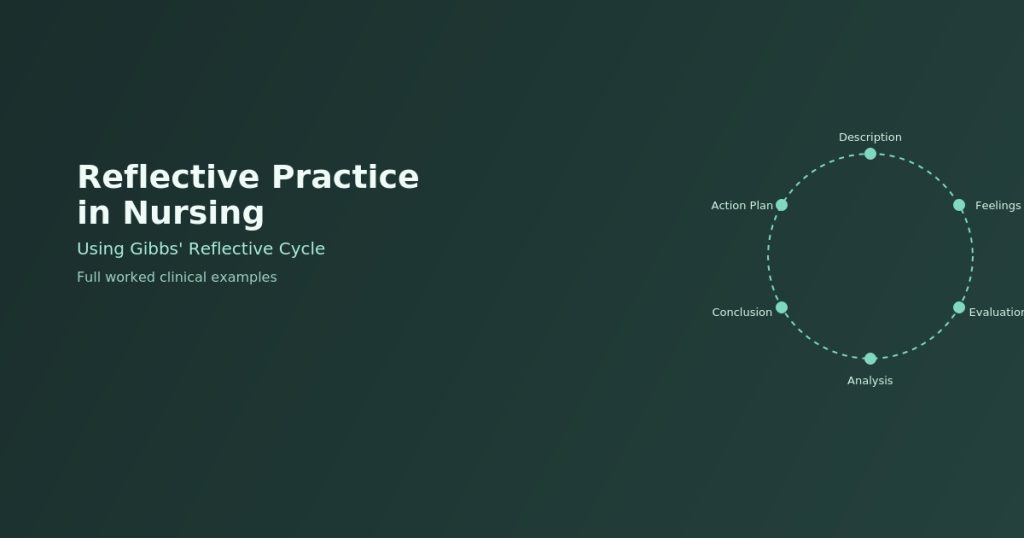
Reflective practice is a formal, required component of nursing education and professional revalidation in most countries — not an optional add-on, but a structured method for turning clinical experience into genuine learning. Gibbs’ Reflective Cycle (1988) remains one of the most widely used frameworks in nursing specifically because its six explicit stages prevent reflection from collapsing into a simple, superficial account of “what happened,” which is the single most common weakness in student reflective writing.
Table of Contents
ToggleWhy Nursing Reflection Requires More Than “What I Did Today”
A nursing shift produces enormous amounts of raw clinical experience, but experience alone doesn’t automatically produce learning — without structured reflection, the same mistake or missed opportunity can recur indefinitely because it was never genuinely analyzed. Gibbs’ Cycle forces a shift from description to genuine analysis by requiring you to move through feelings, evaluation, analysis, and a concrete action plan, not just a narrative account.
The Six Stages Applied to a Clinical Scenario
Throughout this post, each stage is illustrated using the same clinical scenario: a student nurse administering medication to a patient who became acutely anxious during the process.
1. Description
Question: What happened?
Keep this stage factual and concise — this is the only stage where pure description is appropriate.
Worked example: “While administering a scheduled oral medication to Mr. J, a 68-year-old post-operative patient, he became visibly anxious, gripping the bed rail and stating ‘I don’t think I can swallow this, I feel like I’m choking.’ I paused the administration and stayed with him while his breathing settled.”
2. Feelings
Question: What were you thinking and feeling, at the time and afterward?
Worked example: “In the moment, I felt a spike of anxiety myself, unsure whether this was a genuine swallowing or airway problem requiring immediate escalation, or an anxiety response. I felt some relief when his breathing settled without intervention, but afterward I felt uncertain about whether I’d responded appropriately, and slightly embarrassed that I hadn’t recognized the signs of anxiety more quickly.”
3. Evaluation
Question: What was good and bad about the experience?
Worked example: “Positively, I stopped the administration immediately rather than pushing through, and I stayed calm and present with the patient rather than leaving him alone. Less positively, I hadn’t reviewed his history closely enough beforehand to know he had a documented history of anxiety around swallowing medication following a previous choking incident — this information was in his notes, and having it in mind beforehand would have let me approach the administration differently from the start.”
4. Analysis
Question: Why did this happen? What sense can you make of the situation?
This is the stage where connecting to evidence, theory, or professional standards is expected, not just personal impression.
Worked example: “This incident reflects a gap in my pre-administration assessment process. The Nursing and Midwifery Council’s Code (2018) emphasizes the importance of working in partnership with patients and assessing needs holistically, not just clinically — a purely task-focused approach to medication administration (checking the five rights of medication administration) doesn’t capture psychological readiness, which turned out to be the actual barrier here. Anxiety around swallowing following a choking incident is a recognized and documented risk factor in dysphagia-adjacent presentations, and reviewing patient history specifically for this kind of psychological context, not just physical swallowing assessment, would likely have surfaced this in advance.”
5. Conclusion
Question: What else could you have done? What have you learned?
Worked example: “I’ve learned that thorough pre-administration review needs to include psychological and historical context, not just current physical presentation. I could have reviewed his notes more closely before approaching, or asked an open question about how he felt about taking oral medication before starting, which may have surfaced his anxiety proactively rather than reactively.”
6. Action Plan
Question: If this situation arose again, what would you do differently, specifically?
Worked example: “For future medication administration, particularly with patients who have any documented history of swallowing difficulty or related anxiety, I will review the full patient history section (not just the current medication chart) before approaching, and I will ask a brief, open question about the patient’s comfort with oral medication before beginning, rather than assuming readiness based on the prescription alone.”
Why the Analysis Stage Is Where Nursing Reflection Most Often Falls Short
Academic assessors consistently identify the Analysis stage as where student reflective writing is weakest — many students can describe an event and their feelings about it competently, but struggle to connect the specific incident to broader theory, evidence, or professional standards. A strong Analysis stage does three things: it names the underlying issue precisely (not just “I should communicate better,” but what specifically about the communication or assessment process broke down), it connects to relevant evidence or professional guidance (as in the NMC Code reference above — the same kind of professional standard that underpins nursing ethical decision-making more broadly), and it explains why the identified cause plausibly produced the outcome observed.
A Second Worked Example: Reflecting on a Positive Outcome
Reflective practice isn’t only for things that went wrong — reflecting rigorously on a success clarifies why it worked, which is necessary for reliably repeating it.
Scenario: A student nurse successfully de-escalated a confused, agitated post-operative patient attempting to climb out of bed.
- Description: Patient attempted to climb over the bed rail, stating he needed to “get to work.” Student approached calmly, used the patient’s name, gently redirected attention to a familiar topic (asking about his job), and guided him back to a comfortable position without physical restraint.
- Feelings: Initial alarm at the fall risk, followed by a conscious effort to project calm rather than urgency, since the patient’s agitation seemed to respond to the surrounding emotional tone.
- Evaluation: The approach worked — the patient settled within a few minutes without injury or need for further intervention.
- Analysis: This aligns with recognized de-escalation principles for post-operative delirium: using a calm tone, orienting the patient with familiar, personally relevant conversation topics, and avoiding immediate physical restraint (which can escalate agitation in a confused patient) rather than confrontation.
- Conclusion: Calm, personalized verbal redirection can be more effective than directive instruction for a confused, agitated patient, and should be attempted before considering more restrictive interventions.
- Action plan: In future similar situations, prioritize calm verbal redirection using personally relevant conversation topics as a first-line approach, reserving physical intervention for situations where verbal de-escalation genuinely isn’t working or immediate safety is at risk.
Confidentiality in Written Nursing Reflections
A practical point specific to nursing reflective writing, distinct from reflection in other professions: patient confidentiality must be maintained in any written reflection submitted for academic assessment or a professional portfolio. This typically means using non-identifying references (as in “Mr. J” above, or simply “the patient”) rather than full names, avoiding specific dates or ward details that could allow identification, and following your specific institution’s guidance on anonymization — this isn’t a minor formatting preference, but a genuine professional and legal requirement under confidentiality obligations.
Common Student Mistakes
- Staying descriptive throughout, especially in the Analysis stage — recounting what happened without genuinely examining why is the most common and most heavily penalized weakness in nursing reflective assignments
- Omitting connection to professional standards or evidence — nursing reflections are expected to engage with relevant codes of conduct, guidelines, or research literature in the Analysis stage, not rely purely on personal impression
- Writing a vague action plan — “I will communicate better” is far weaker than a specific, describable, repeatable strategy tied to the actual gap identified in Analysis
- Failing to anonymize patient details — a confidentiality breach in a reflective assignment is a serious professional issue, not just an academic formatting error
- Treating reflection as only appropriate for negative events — as the second worked example shows, reflecting on what worked well is equally valuable for building a repeatable, evidence-informed practice
If you’re working on a reflective nursing assignment and need help structuring your analysis, integrating evidence, or applying Gibbs’ Cycle to a clinical scenario, nursing assignment support can help you develop the assignment into a clear, evidence-informed academic response.
Frequently Asked Questions
Is Gibbs’ Cycle mandatory for nursing reflective writing, or can I use a different model? This depends on your specific program’s requirements — Gibbs’ Cycle is extremely widely used in nursing education, but some programs specify alternative models (such as Johns’ Model for Structured Reflection, which is also common in nursing specifically). Check your assignment brief for which model is expected.
How detailed should the Description stage be in a nursing reflection? Relatively brief — enough to give the reader necessary context, but the substantive analytical work (and therefore the majority of your word count) should sit in the Feelings, Evaluation, Analysis, and Action Plan stages, not the initial description.
Can I reflect on a colleague’s actions rather than my own? Most nursing reflective assignments expect reflection centered on your own actions, decisions, and learning, even when a scenario involves a team or colleague’s actions as context — the point is developing your own professional judgment, not evaluating others’ performance.
What’s the difference between reflection-in-action and reflection-on-action, and does Gibbs’ Cycle cover both? Reflection-in-action (a concept from Donald Schön) refers to adjusting your practice in real time, during the event itself. Gibbs’ Cycle is specifically a structured tool for reflection-on-action — the after-the-fact analysis conducted once the event has concluded, though the insights gained can certainly inform future in-the-moment judgment.