
Clinical governance is the framework through which healthcare organizations are accountable for continuously improving the quality of their services and safeguarding high standards of care — it’s the structural answer to a deceptively simple question: how does an organization actually ensure safe, high-quality care happens reliably, rather than depending purely on individual staff doing their best? For nursing students, this topic often feels abstract and organizational rather than clinical, but it directly shapes the systems (incident reporting, staffing ratios, audit processes) that determine what happens when something goes wrong — or, ideally, before it does.
The Seven Pillars of Clinical Governance
Clinical governance in the UK (and similar frameworks internationally) is commonly structured around seven interlocking components:
- Clinical effectiveness — ensuring care is based on the best available evidence
- Risk management — systematically identifying, assessing, and reducing risk
- Patient and public involvement — actively incorporating patient experience and feedback into service improvement
- Audit — systematic review of practice against defined standards
- Staff management and performance — ensuring staff are appropriately trained, supported, and supervised
- Education and training — ongoing professional development
- Information management — accurate, accessible, and appropriately used clinical data and records
Why this matters practically: these pillars aren’t independent checkboxes — a genuine patient safety incident typically reveals failures across multiple pillars simultaneously, which is exactly why serious incident investigations look at systemic contributing factors rather than isolating a single “cause.”
Worked Example: Tracing a Single Incident Through the Governance Framework
Scenario: A patient receives an incorrect medication dose due to a transcription error when a verbal order was documented.
Tracing this single incident through the seven pillars reveals how clinical governance actually operates in practice:
- Clinical effectiveness: Was there an evidence-based protocol for verbal order transcription that wasn’t followed, or was the protocol itself inadequate?
- Risk management: Was this type of error a previously identified risk? Were mitigations (e.g., read-back verification) already in place, and if so, why did they fail?
- Patient and public involvement: How is the patient (and family, where appropriate) informed and involved following the incident, consistent with duty of candour obligations?
- Audit: Does routine medication administration audit data show this as an isolated incident, or part of a broader pattern requiring systemic attention?
- Staff management: Was the staff member involved appropriately trained and supervised at the time, and was workload/staffing a contributing factor?
- Education and training: Does this incident reveal a training gap that should inform future induction or ongoing training content?
- Information management: Was the documentation system itself part of the problem (e.g., unclear verbal order transcription fields, illegible handwriting risk)?
This single scenario demonstrates why clinical governance frameworks resist simple “who made the mistake” narratives — a rigorous investigation typically finds several contributing systemic factors, not just individual error, which is central to how modern patient safety science approaches incident analysis.
The Swiss Cheese Model of Error
A widely used conceptual model in patient safety (developed by James Reason) visualizes system safety as multiple layered defenses, each represented as a slice of cheese with holes (weaknesses). A serious incident typically occurs only when the holes in multiple layers align, allowing a hazard to pass through all defenses rather than being caught by any single one.
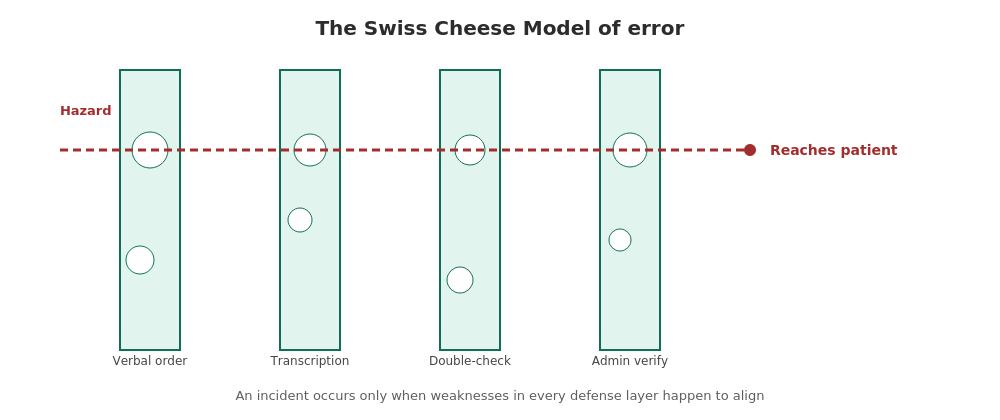
Applying this to the medication error example: the verbal order itself (layer 1), the transcription process (layer 2), a double-check step (layer 3), and the administering nurse’s own verification (layer 4) each represent a potential defense layer. The error reaching the patient means the “holes” (weaknesses) in each of these layers happened to align on this occasion — a normally functioning double-check process, for instance, might have caught the transcription error even if it occurred, meaning the actual incident reveals a weakness in that layer specifically, not just the original transcription mistake.
Why this model matters for how investigations are approached: it shifts focus from “which individual failed” toward “which systemic defenses failed, and why,” supporting a just culture approach to incident investigation (see below) rather than a purely blame-focused one.
Just Culture: Balancing Accountability and System Learning
A just culture distinguishes between different types of error based on intent and circumstance, rather than treating all errors identically:
| Category | Description | Typical response |
|---|---|---|
| Human error | Unintentional slip or mistake, could happen to any competent professional under similar circumstances | Systemic learning, process improvement — not individual blame |
| At-risk behavior | A drift toward unsafe shortcuts, often normalized within a team over time | Coaching, addressing systemic pressures that encourage the drift |
| Reckless behavior | Conscious disregard of substantial, known risk | Disciplinary action may be appropriate |
Worked example distinguishing these categories: A nurse who misreads a similarly-packaged medication due to poor labeling design has likely made a human error (a system/design contributing factor). A nurse who consistently skips a mandated double-check step because “it’s always fine” reflects at-risk behavior — a normalized shortcut, often reflecting workload or cultural pressure, that needs addressing at the team/systemic level, not just through individual reprimand. A nurse who deliberately bypasses a safety check despite explicit awareness of a specific, serious risk reflects reckless behavior, which typically does warrant individual accountability measures.
This distinction matters enormously for how a genuinely safety-improving culture functions — an organization that punishes honest reporting of human error as harshly as reckless behavior actively discourages the transparent incident reporting that clinical governance depends on to identify systemic risks in the first place.
Duty of Candour
A specific and increasingly formalized obligation within clinical governance: when a patient safety incident results in harm (or potential harm) above a defined threshold, healthcare providers have a legal and professional duty of candour — an obligation to inform the patient (or their representative) that an incident occurred, provide a truthful explanation, offer an apology, and outline what will be done in response.
Worked example of duty of candour in practice, continuing the medication error scenario: Following identification of the dosing error, the duty of candour obligation requires the clinical team to inform the patient promptly, explain clearly what happened (without minimizing or obscuring the error), apologize genuinely, and describe the steps being taken to investigate and prevent recurrence — this is a professional and often legal requirement, not merely a matter of good customer service or optional good practice.
Root Cause Analysis (RCA)
When a significant patient safety incident occurs, organizations typically conduct a root cause analysis — a structured investigation method aimed at identifying underlying systemic contributing factors, not just the immediate, visible cause.
A common RCA technique is the “Five Whys” — repeatedly asking “why” to move from a surface-level cause toward a genuine systemic root cause:
1. Why did the patient receive the wrong dose? → The transcribed order was incorrect.
2. Why was the transcription incorrect? → The verbal order wasn't read back for confirmation.
3. Why wasn't it read back? → No mandatory prompt or checklist step required it at that point.
4. Why was there no mandatory step? → The verbal order policy hadn't been updated
   since a previous near-miss review.
5. Why hadn't the policy been updated? → No formal process existed for translating
   near-miss learning into policy revision.
Notice how each “why” moves further from the individual action and closer to a genuine systemic gap — the final root cause identified (no formal process for translating near-miss learning into policy change) is a governance-level finding, not a statement about individual competence, and it’s this level of finding that drives meaningful, durable safety improvement rather than a one-off individual correction.
Common Student Mistakes
- Focusing analysis purely on individual error rather than systemic contributing factors — as the Swiss Cheese Model illustrates, serious incidents typically involve multiple layered failures, not a single point of blame
- Treating “just culture” as meaning no accountability at all — just culture explicitly distinguishes between human error, at-risk behavior, and reckless behavior; it isn’t a blanket excuse for all error types
- Confusing duty of candour with simply apologizing informally — it’s a structured, specific professional and legal obligation with defined components (disclosure, explanation, apology, and follow-up), not just an expression of regret
- Stopping a root cause analysis too early — the Five Whys technique specifically exists to push past the first, most obvious cause toward genuine systemic factors; stopping after one or two “whys” often produces a superficial finding
- Treating clinical governance as purely administrative/managerial rather than directly relevant to bedside practice — the seven pillars directly shape day-to-day clinical systems (staffing, protocols, documentation) that every practicing nurse works within
Frequently Asked Questions
What’s the difference between clinical governance and clinical audit? Clinical audit is one specific pillar within the broader clinical governance framework — a systematic process of comparing actual practice against defined standards and implementing improvement where gaps are found. Clinical governance is the overarching framework encompassing audit alongside the other six pillars.
Does duty of candour apply to every clinical error, however minor? No — duty of candour obligations are typically triggered by incidents meeting a specific harm threshold (defined by relevant national regulations, such as moderate harm or above in NHS contexts), though many organizations encourage a broadly transparent, open communication culture for lower-level incidents as good practice even where the formal legal threshold isn’t met.
Why is a “just culture” considered important for patient safety, rather than simply holding staff accountable for every error? Because punitive responses to honest human error tend to discourage transparent incident reporting — and without transparent reporting, organizations lose visibility into systemic risks before they cause more serious harm. A just culture aims to preserve genuine accountability for reckless behavior while protecting the psychological safety needed for honest reporting of ordinary human error.
How does root cause analysis differ from simply asking what went wrong? RCA is specifically structured to move beyond the immediately visible cause toward genuine systemic contributing factors, using techniques like the Five Whys precisely because surface-level explanations (“the nurse made an error”) rarely reveal the underlying systemic conditions that made the error possible or likely in the first place.