
Medication calculation errors are among the most consequential mistakes a nurse can make, and dosage calculation is consistently one of the areas nursing students report the least confidence in — not because the underlying arithmetic is advanced, but because the problem-solving structure (working through units, conversions, and formulas under exam or clinical pressure) is unfamiliar and unforgiving of small errors. This post works through the core calculation methods with full worked examples, using generic teaching values throughout — always follow your institution’s specific protocols and verify all calculations against current prescribing guidance in real clinical practice.
Table of Contents
ToggleWhy Units Matter More Than the Numbers
The single most common source of dosage calculation errors isn’t arithmetic mistakes — it’s unit inconsistency. A calculation that’s numerically correct but uses mismatched units (mixing milligrams and micrograms, or confusing mL with mg) produces a wrong answer that looks perfectly plausible. The first and most important habit to build is converting everything to consistent units before doing any arithmetic.
Standard unit conversions to know automatically:
1 gram (g) = 1000 milligrams (mg)
1 milligram (mg) = 1000 micrograms (mcg or µg)
1 liter (L) = 1000 milliliters (mL)
1 kilogram (kg) = 1000 grams (g)
Method 1: The Basic Formula Method
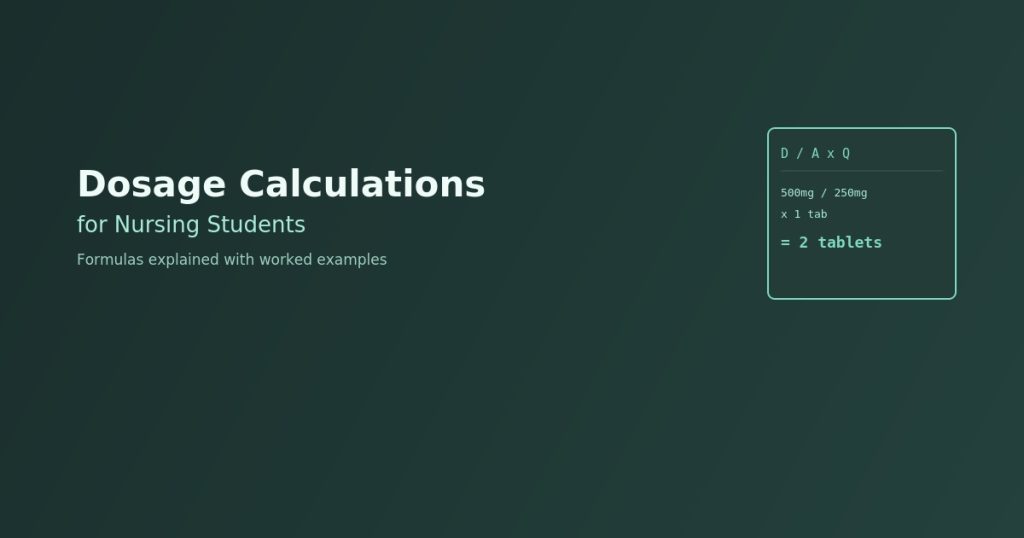
The most widely taught foundational formula for calculating how much of a medication to administer:
Dose required ÷ Dose available × Quantity = Amount to administerWorked example: A prescription calls for 500mg of a medication. The medication is available as tablets of 250mg each. How many tablets should be administered?
500mg (required) ÷ 250mg (available) × 1 (tablet) = 2 tabletsA liquid medication worked example: A prescription calls for 375mg. The medication is available as an oral suspension of 125mg per 5mL. How many mL should be administered?
375mg (required) ÷ 125mg (available) × 5mL (quantity) = 15mLMethod 2: Weight-Based Dosing (mg/kg)
Many medications, particularly in pediatric practice, are prescribed based on the patient’s body weight, requiring an additional calculation step before the basic formula can even be applied.
Worked example: A medication is prescribed at 15mg/kg for a child weighing 22kg. The medication is available as a suspension of 250mg per 5mL.
Step 1 — Calculate the total dose required:
15mg/kg × 22kg = 330mgStep 2 — Apply the basic formula to find the volume:
330mg ÷ 250mg × 5mL = 6.6mLA critical safety habit at this stage: always sanity-check the result against a known safe range. If a calculated dose comes out dramatically higher or lower than what seems clinically plausible for the medication and patient, this is a signal to re-check the calculation and the original prescription — weight-based dosing errors (especially decimal point errors) are a well-documented source of serious medication incidents, precisely because a misplaced decimal can produce a 10x or 100x error that still “looks like a number.”
Medication calculations require careful attention to units, formulas, and clinical context, making them a common area of nursing coursework and assessment. Students who need additional academic support with calculation-based nursing assignments can explore Nursing Assignment Help for guidance on structuring and developing their academic work.
Method 3: IV Flow Rate Calculations
Intravenous infusions require calculating the flow rate — either in mL/hour (common for infusion pumps) or drops/minute (for gravity-fed administration sets).
Calculating mL/hour
Total volume (mL) ÷ Total time (hours) = Rate (mL/hour)Worked example: 1000mL of IV fluid is to be infused over 8 hours.
1000mL ÷ 8 hours = 125mL/hourCalculating Drops per Minute (Gravity Infusion)
This requires an additional piece of information: the drop factor of the specific administration set being used, measured in drops per mL (gtts/mL) — this varies by equipment (commonly 15, 20, or 60 gtts/mL) and must be confirmed from the actual giving set packaging, not assumed.
(Volume in mL ÷ Time in minutes) × Drop factor (gtts/mL) = Drops per minuteWorked example: 500mL of fluid to be infused over 4 hours, using a giving set with a drop factor of 20 gtts/mL.
Step 1 — Convert time to minutes:
4 hours × 60 = 240 minutesStep 2 — Apply the formula:
(500mL ÷ 240 minutes) × 20 gtts/mL = 41.67, rounded to 42 drops/minuteMethod 4: Calculating Infusion Time From a Prescribed Rate
Sometimes the question runs in the opposite direction — given a prescribed rate, how long will the infusion take, or how much volume will be delivered in a given time?
Worked example: An IV is running at 150mL/hour. How long will it take to infuse a 750mL bag?
750mL ÷ 150mL/hour = 5 hoursWorked example (reverse): At a rate of 150mL/hour, how much fluid will have infused after 2.5 hours?
150mL/hour × 2.5 hours = 375mLMethod 5: Dimensional Analysis (An Alternative Approach)
Some nursing programs teach dimensional analysis (also called factor-label method) as an alternative to the basic formula method — rather than memorizing a specific formula, this approach sets up a chain of conversion factors so that unwanted units cancel out, leaving only the desired unit.
Worked example, using the same weight-based dosing scenario as above (15mg/kg for a 22kg child, medication available as 250mg per 5mL):
22 kg × (15 mg / 1 kg) × (5 mL / 250 mg) = 6.6 mLNotice how the units cancel diagonally: kg cancels with kg, mg cancels with mg, leaving only mL — this built-in unit cancellation is exactly why some students find dimensional analysis more error-resistant than the basic formula method, since a unit-setup mistake often becomes visually obvious (the units simply won’t cancel correctly) before you even finish the arithmetic.
A Worked Example Combining Multiple Steps
Scenario: A patient requires a continuous IV infusion of a medication at 5 mcg/kg/minute. The patient weighs 70kg. The medication is prepared as 400mg in 250mL of IV fluid. What rate (mL/hour) should the infusion pump be set to?
Step 1 — Calculate the required dose per minute:
5 mcg/kg/min × 70kg = 350 mcg/minStep 2 — Convert to mcg/hour:
350 mcg/min × 60 = 21,000 mcg/hourStep 3 — Convert the available concentration to mcg/mL (to match units):
400mg = 400,000 mcg
400,000 mcg ÷ 250mL = 1,600 mcg/mL
Step 4 — Calculate the required rate:
21,000 mcg/hour ÷ 1,600 mcg/mL = 13.125 mL/hour, rounded to 13.1 mL/hourThis multi-step example illustrates why building the habit of careful, sequential unit conversion matters — skipping or rushing any single step (particularly the mg-to-mcg conversion in Step 3) produces an error that compounds through the rest of the calculation.
Common Student Mistakes
- Mixing units without converting first — the single most common source of significant calculation errors; always convert to consistent units before applying any formula
- Misreading “mcg” as “mg” or vice versa — given how visually similar these abbreviations are, and how large the resulting error is (1000x), many institutions now require “micrograms” to be written in full rather than abbreviated, specifically to reduce this risk
- Skipping the sanity-check step — a calculated result that seems implausibly high or low relative to typical dosing should prompt a recheck before administration, not just be accepted because “the math worked out”
- Confusing the drop factor between different administration sets — assuming a standard drop factor without checking the actual equipment being used produces a systematically incorrect flow rate
- Rounding too early in a multi-step calculation — rounding intermediate results (rather than only the final answer) can introduce small errors that compound across several calculation steps
Frequently Asked Questions
Is dimensional analysis better than the basic formula method? Neither is universally “better” — they produce identical correct answers when applied correctly, and the choice often comes down to which approach your specific program teaches and which one helps you catch unit-related errors most naturally. Some students find dimensional analysis’s built-in unit-cancellation check particularly helpful for catching setup mistakes.
Why do drop factors vary between administration sets? Drop factor depends on the physical design of the giving set (the size of the drop-forming aperture) — macro-drip sets typically deliver larger drops (10-20 gtts/mL), while micro-drip sets deliver much smaller, more precise drops (60 gtts/mL), often used for pediatric or precise low-volume infusions.
How can I reduce the risk of calculation errors in real clinical practice? Common institutional safety practices include independent double-checking of calculations (particularly for high-risk medications), using standardized calculation tools or smart pumps with built-in dose-range checking, and always sanity-checking a result against expected clinical ranges before administration — calculation skill alone isn’t considered a sufficient safety net on its own.
Do all nursing programs require manual calculation skill, given that infusion pumps often calculate rates automatically? Yes — manual calculation competency remains a core, independently assessed skill in virtually all nursing programs, precisely because technology can fail, be misprogrammed, or simply be unavailable, and because understanding the underlying calculation is what allows a nurse to recognize when a pump-displayed or prescribed value looks clinically implausible.