
The nursing process is the systematic, cyclical framework nurses use to organize clinical decision-making — often taught through the acronym ADPIE: Assessment, Diagnosis, Planning, Implementation, and Evaluation. It’s easy to treat ADPIE as a rote sequence to memorize for an exam, but it’s genuinely the underlying logic structure behind almost every piece of clinical nursing documentation you’ll produce, including the nursing care plan itself. Understanding why each stage exists — and what specifically goes wrong when a stage is skipped or rushed — is more useful than memorizing the letters alone.
Why a Structured Process, Rather Than Intuition Alone?
Experienced nurses often appear to move through clinical reasoning quickly and intuitively, which can make ADPIE look like unnecessary scaffolding once you’re skilled. But the structure exists precisely because clinical reasoning under time pressure is prone to specific, predictable errors — jumping to an intervention before fully assessing, or missing a problem because it wasn’t explicitly checked for. ADPIE is a safeguard against exactly these failure modes, and it becomes the backbone of legal documentation and professional accountability, not just a teaching tool for students.
A — Assessment
Assessment is the systematic collection of both subjective data (what the patient reports) and objective data (what you observe, measure, or find in records) — this is where diagnostic decisions are grounded in actual evidence rather than assumption.
Two categories worth distinguishing precisely:
- Subjective data: the patient’s own words and reported experience (“I feel dizzy when I stand up,” pain rating, description of symptoms)
- Objective data: measurable, observable findings (vital signs, lab results, physical examination findings, wound appearance)
Worked example — assessing a patient post-fall:
Subjective: "I felt my legs give out, and I don't remember hitting the floor.
             I feel a bit shaky now."
Objective:  BP 98/62 (lying), 82/54 (standing) — orthostatic drop of 16/8 mmHg;
             HR 110; skin pale, slightly diaphoretic; no visible injury on
             examination; alert and oriented x4
Notice the objective data here isn’t just a vital signs list — it specifically captures the orthostatic blood pressure drop, which is directly clinically relevant to the presenting complaint (a fall associated with standing). A rushed or generic assessment might record vital signs without checking lying-vs-standing BP specifically, missing the single most diagnostically useful piece of data for this presentation.
D — Diagnosis
Building on the assessment data, the diagnosis stage identifies the specific patient problem(s) nursing care will address — using a structured NANDA-I format (diagnostic label + related factor + defining characteristics), the same structure covered in nursing care plan writing.
Worked example, continuing the fall assessment:
Risk for Falls related to orthostatic hypotension as evidenced by measured
blood pressure drop of 16/8 mmHg on standing and reported dizziness
A common early-student error at this stage is diagnosing the medical problem (e.g., “orthostatic hypotension”) rather than the nursing concern (the patient’s risk and how nursing care specifically addresses it) — the diagnosis above correctly identifies orthostatic hypotension as the related factor causing the nursing concern (fall risk), not as the diagnosis itself.
P — Planning
Planning translates the diagnosis into specific, measurable goals and a proposed set of interventions — this stage is where SMART goal-writing (Specific, Measurable, Achievable, Relevant, Time-bound) becomes essential, since a vague goal can’t be meaningfully evaluated later.
Worked example:
Goal: Patient will transition from lying to standing without symptomatic
blood pressure drop (>20/10 mmHg) or reported dizziness, by discharge.

Planned interventions:
- Educate patient on slow position changes (sit for 1-2 minutes before
  standing)
- Monitor lying/standing BP each shift
- Review current medication list for potential contributors (e.g.,
  antihypertensives, diuretics) with the prescribing team
- Ensure non-slip footwear and clear pathway to bathroom
Planning at this stage also involves prioritization — when a patient has multiple simultaneous nursing diagnoses, planning must determine which to address first. A widely used prioritization framework is Maslow’s hierarchy of needs, addressing physiological and safety needs (like fall risk) before higher-level psychosocial needs, unless a specific higher-level need is acutely urgent.
I — Implementation
Implementation is the actual delivery of the planned interventions — and critically, this stage requires documentation of what was actually done, not just what was planned, since planned interventions that aren’t documented as completed don’t legally or professionally count as having occurred.
Worked example of implementation documentation:
14:00 - Patient educated on orthostatic precautions (sit before standing,
        pause before ambulating); verbalized understanding, able to
        repeat back key points.
14:15 - Lying/standing BP reassessed: 102/64 lying, 94/58 standing
        (drop of 8/6 mmHg) — improved from initial assessment.
14:20 - Call bell placed within reach; non-slip socks applied.
Implementation isn’t passive execution of a checklist — it also includes ongoing reassessment during delivery, since a patient’s condition can change between the planning stage and the moment of care delivery, requiring the nurse to adapt in real time while still working from the overall plan.
E — Evaluation
Evaluation determines whether the stated goal was actually achieved, using the same measurable criteria specified during planning — this is why vague goals undermine the entire process; there’s no clear standard to evaluate against.
Worked example:
Evaluation at 48 hours: Goal partially met. Orthostatic BP drop reduced
from 16/8 mmHg to 8/6 mmHg following medication review (diuretic dose
adjusted by medical team) and patient education. Patient reports no
further dizziness with position changes, but standing BP drop remains
slightly above target threshold — continue monitoring and reassess at
72 hours.
Note that “partially met” is a legitimate and clinically honest evaluation outcome — the process doesn’t require a binary pass/fail, and a partial result appropriately triggers continued monitoring rather than either declaring premature success or discarding the entire plan.
Why ADPIE Is Cyclical, Not Linear
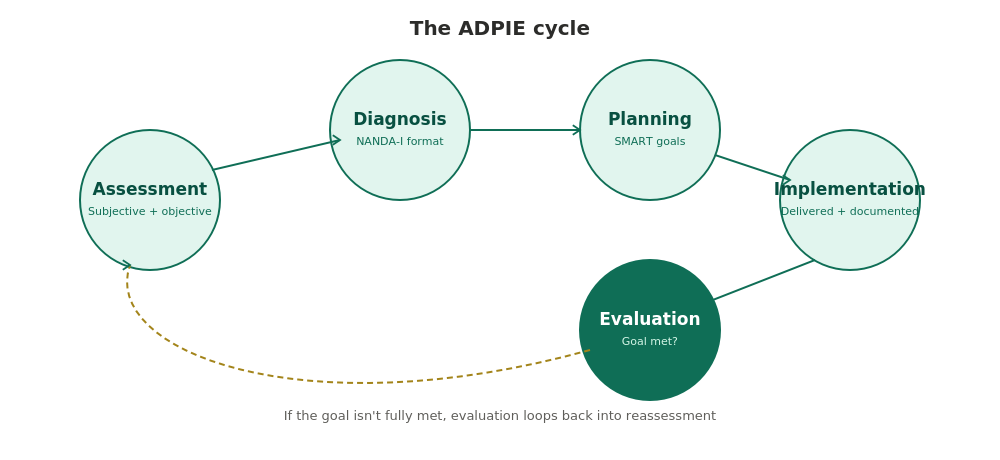
A critical structural point: ADPIE is not a one-time, start-to-finish sequence — it’s a continuous cycle. Evaluation findings feed directly back into reassessment, which may reveal new or evolving problems, generating a revised diagnosis, updated plan, and further implementation. In the worked example above, the “partially met” evaluation doesn’t end the process — it triggers a return to assessment and planning with adjusted parameters.
How ADPIE Relates to the Nursing Care Plan
Students sometimes experience ADPIE and the nursing care plan as two separate things to learn, when in fact the care plan is ADPIE’s Diagnosis, Planning, and Implementation stages, formalized into a written document. The care plan’s five components (assessment, nursing diagnosis, goals, interventions, evaluation) map directly onto ADPIE’s five stages — understanding one reinforces the other rather than being a separate topic to learn from scratch. For students working on nursing coursework, Nursing Assignment Help can provide additional academic support when developing assignments involving the nursing process, care planning, and clinical reasoning.
Common Student Mistakes
- Rushing or skipping assessment before jumping to intervention — this is the most consequential error, since every later stage depends on the accuracy and completeness of the initial assessment data
- Writing a medical diagnosis instead of a nursing diagnosis at the D stage — the same error covered in care plan writing, since ADPIE’s D stage uses the identical NANDA-I structure
- Treating implementation as complete without documentation — an intervention that occurred but wasn’t documented is, from a legal and professional accountability standpoint, treated as if it didn’t happen
- Evaluating against vague or unstated criteria — if the planning stage didn’t specify a measurable target, the evaluation stage has nothing concrete to assess against, making the evaluation essentially meaningless
- Treating the cycle as one-directional — assuming the process ends at evaluation, rather than recognizing that evaluation findings should actively feed back into reassessment when goals aren’t fully met
Frequently Asked Questions
Is ADPIE the same in every country’s nursing curriculum? The core five-stage structure is very widely used internationally, though some regions or institutions use slightly different terminology or additional stages (for example, some frameworks separate “outcome identification” as a distinct stage between diagnosis and planning) — check your specific program’s exact terminology expectations.
How often should the ADPIE cycle repeat for a single patient? There’s no fixed schedule — it depends on the acuity and stability of the patient’s condition. An acutely unstable patient might cycle through reassessment multiple times per shift, while a stable patient on a long-term care plan might be formally reassessed daily or per shift, with evaluation criteria checked at defined intervals matching the specific goals set.
What’s the difference between assessment and reassessment? Assessment refers to the initial, comprehensive data collection when a patient problem is first identified. Reassessment refers to the ongoing, often more targeted data collection that occurs throughout implementation and at the evaluation stage, checking specifically whether the situation has changed relative to the original assessment.
Can implementation and evaluation happen simultaneously? In a practical sense, yes — especially during a single patient interaction, a nurse might implement an intervention and immediately gather data relevant to evaluating it (as in the orthostatic BP reassessment example above, done shortly after patient education). The conceptual stages remain distinct even when they occur close together in real time.