
A nursing care plan is the structured document that translates a patient assessment into a coordinated, evidence-based course of action — it’s simultaneously a clinical reasoning tool, a communication device across the care team, and one of the most heavily assessed pieces of academic writing in nursing programs. Students frequently find care plans difficult not because the individual components are conceptually hard, but because the format demands a level of specificity and internal logical consistency that’s easy to underestimate until you’re actually writing one.
Why Care Plans Are Structured the Way They Are
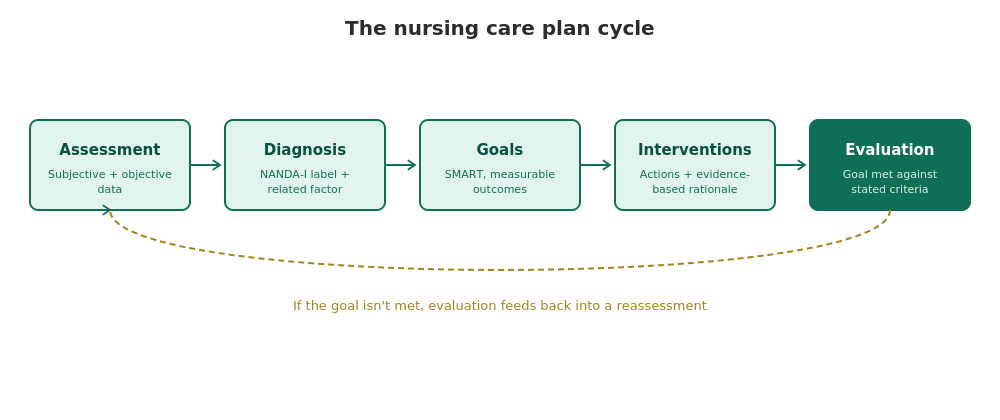
A care plan isn’t a free-form document — it follows a deliberate structure because each section depends logically on the one before it. A vague or inaccurate assessment produces an inaccurate diagnosis, which produces poorly targeted goals, which produces interventions that don’t actually address the patient’s real problem. Understanding this chain of dependency is more useful than memorizing the section headings in isolation.
The Five Core Components
1. Assessment
The foundation of the entire care plan — subjective data (what the patient reports: pain level, concerns, history) and objective data (what you observe or measure: vital signs, wound appearance, lab values, mobility). This section must be specific and evidence-based, not interpretive; interpretation happens in the next stage.
Worked example — objective and subjective data for a post-operative patient:
- Subjective: Patient reports “sharp, stabbing pain” at the surgical site, rated 7/10, worse with movement
- Objective: BP 142/88, HR 96, RR 20, surgical dressing dry and intact, patient guarding the incision site, reluctant to reposition in bed
2. Nursing Diagnosis (NANDA-I)
This is where many students go wrong first: a nursing diagnosis is not the same as a medical diagnosis. A medical diagnosis identifies a disease or condition (e.g., “post-operative appendectomy”); a nursing diagnosis identifies how the patient is responding to that condition or situation, in a way nursing care can directly address.
NANDA-I (North American Nursing Diagnosis Association International) provides a standardized taxonomy of nursing diagnoses, each with a specific, structured format:
[Diagnostic label] related to [related factor] as evidenced by [defining characteristics]Worked example, continuing the post-operative patient:
Acute Pain related to surgical tissue trauma as evidenced by patient-reported pain
rating of 7/10, guarding behavior, and reluctance to reposition
Notice the three-part structure: the diagnostic label (Acute Pain) is a standardized NANDA-I term, the related factor (surgical tissue trauma) identifies the underlying cause, and the evidence (pain rating, guarding, reluctance to move) is drawn directly from the assessment data — this is why a vague assessment makes it genuinely difficult to write a specific diagnosis; there’s nothing concrete to cite as evidence.
Common error: writing a nursing diagnosis as a medical diagnosis restated (“Diagnosis: appendectomy”) rather than a patient response (“Acute Pain related to surgical tissue trauma”). A medical diagnosis is a label for a disease process; a nursing diagnosis is what nursing intervention can actually influence.
3. Goals and Expected Outcomes
Goals must be SMART — Specific, Measurable, Achievable, Relevant, and Time-bound. A goal that isn’t measurable can’t be evaluated later, which undermines the entire purpose of having a formal goal in the first place.
Weak goal: “Patient will have less pain.”
Strong goal: “Patient will report pain at 3/10 or lower on a 0-10 numeric pain scale within 45 minutes of analgesic administration, by end of shift.”
The strong version specifies exactly what’s being measured (numeric pain scale), what counts as success (3/10 or lower), and a clear timeframe (45 minutes post-medication, by end of shift) — all necessary for the evaluation stage to be meaningful rather than a vague impression.
Goals are typically split into:
- Short-term goals: achievable within hours to a few days (appropriate for the pain example above)
- Long-term goals: achievable over a longer period, often spanning the full care episode or beyond discharge (e.g., “Patient will demonstrate independent wound care technique prior to discharge”)
4. Interventions (with Rationale)
Interventions are the specific nursing actions planned to achieve the stated goal — and in academic nursing writing, each intervention should be paired with a rationale: the evidence-based reasoning for why this specific action is expected to work, not just a description of the action itself.
Worked example, continuing the pain management plan:
| Intervention | Rationale |
|---|---|
| Administer prescribed analgesia as ordered, 30 minutes before planned repositioning or ambulation | Pre-emptive analgesia reduces pain intensity during movement, improving patient willingness to mobilize, which reduces post-operative complication risk (e.g., DVT, pneumonia) |
| Reposition patient every 2 hours, supporting the surgical site with a pillow during movement | Reduces pressure injury risk and provides physical support that reduces pain during repositioning |
| Teach and encourage use of relaxation/deep breathing techniques during pain episodes | Non-pharmacological adjuncts can reduce perceived pain intensity and reduce reliance on analgesia alone (evidence-based complementary approach) |
| Reassess pain using the 0-10 scale 30-45 minutes after each analgesic dose | Provides objective data on medication effectiveness, informing whether the current pain management approach needs adjustment |
The rationale column is what elevates a care plan from a task list into a demonstration of clinical reasoning — markers are specifically looking for evidence that you understand why an intervention works, not just that you know it’s a standard action.
5. Evaluation
The final stage assesses whether the goal was actually met, using the same measurable criteria specified in the goal itself — this is why vague goals are so problematic; there’s no clear standard against which to evaluate.
Worked example:
Goal met: At 14:45 (45 minutes post-analgesic administration), patient reported
pain at 2/10, ambulated to bathroom with minimal guarding, and stated pain was
"much more manageable."
If the goal isn’t met, the evaluation stage should analyze why, and feed back into a revised plan — evaluation isn’t simply a pass/fail checkbox, but the point where the whole care plan cycle either confirms the current approach or triggers a reassessment.
A Complete Worked Care Plan (Condensed)
| Section | Content |
|---|---|
| Assessment | Patient reports 7/10 sharp pain at surgical site; BP 142/88, HR 96, guarding behavior observed |
| Nursing Diagnosis | Acute Pain related to surgical tissue trauma as evidenced by 7/10 pain rating, guarding, reluctance to reposition |
| Goal | Patient will report pain ≤3/10 within 45 minutes of analgesic administration, by end of shift |
| Interventions | Administer prescribed analgesia pre-emptively; reposition with support every 2 hours; teach relaxation techniques; reassess pain 30-45 min post-medication |
| Evaluation | Goal met — pain reported at 2/10 at 45-minute reassessment, improved mobility observed |
A Second Worked Example: A Different NANDA-I Category
To illustrate that care plans aren’t only about pain, here’s a second example addressing fall risk in an elderly post-operative patient:
Nursing Diagnosis: Risk for Falls related to post-operative weakness, unsteady gait, and unfamiliar hospital environment
Goal: Patient will remain free from falls throughout hospital admission, as evidenced by no fall incidents documented.
Interventions and rationale:
| Intervention | Rationale |
|---|---|
| Implement bed alarm and ensure call bell within reach | Provides immediate alert to staff if patient attempts to mobilize unassisted |
| Conduct hourly rounding to proactively address needs (pain, toileting, positioning) | Reduces likelihood of patient attempting unassisted mobilization due to unmet needs |
| Ensure non-slip footwear and clear pathway to bathroom | Reduces environmental hazards directly contributing to fall risk |
| Reassess fall risk score (e.g., Morse Fall Scale) each shift | Provides ongoing, objective tracking of risk level as patient’s post-operative status changes |
Evaluation: No falls occurred during the admission; Morse Fall Scale score decreased from 55 (high risk) to 35 (moderate risk) by discharge, reflecting improved mobility and reduced risk.
Common Student Mistakes
- Writing a medical diagnosis instead of a nursing diagnosis — the most frequent structural error; remember a nursing diagnosis addresses the patient’s response to a condition, not the condition itself
- Writing goals that aren’t measurable — a goal without a specific, quantifiable success criterion can’t be meaningfully evaluated later
- Listing interventions without rationale — a task list of actions doesn’t demonstrate clinical reasoning; the rationale is what shows you understand the evidence behind each action
- Mismatching interventions to the stated diagnosis — every intervention should trace back logically to addressing the specific related factor identified in the nursing diagnosis, not just be generically “good care”
- Treating evaluation as an afterthought — evaluation should reference the exact criteria set in the goal, not a vague general impression of how the patient is doing
Writing a nursing care plan requires careful attention to assessment data, nursing diagnoses, measurable outcomes, interventions, and evaluation. For additional guidance on nursing coursework and academic requirements, students can explore Nursing Assignment Help for further support with nursing-related assignments.
Frequently Asked Questions
What’s the difference between a nursing diagnosis and a medical diagnosis? A medical diagnosis identifies a disease or condition (diagnosed by a physician), while a nursing diagnosis identifies how the patient is responding to that condition in ways nursing care can directly address — the same medical diagnosis can produce several different nursing diagnoses depending on the individual patient’s specific responses.
Do all nursing programs use NANDA-I specifically? NANDA-I is the most widely used standardized taxonomy in nursing education, particularly in the US, UK, and many other countries, though some institutions or clinical settings use alternative or locally adapted diagnostic frameworks — check your specific program’s requirements.
How many nursing diagnoses should a single care plan address? This depends on the complexity of the patient and the assignment brief, but academic care plans often focus on one or two priority diagnoses in depth (demonstrating thorough clinical reasoning) rather than superficially covering many at once.
What makes a goal “measurable” if pain is inherently subjective? Using a standardized, validated scale (like a 0-10 numeric pain rating) turns a subjective experience into a comparable data point over time — it doesn’t remove the subjectivity of the underlying experience, but it creates a consistent, trackable measure the patient and clinician can both reference.