
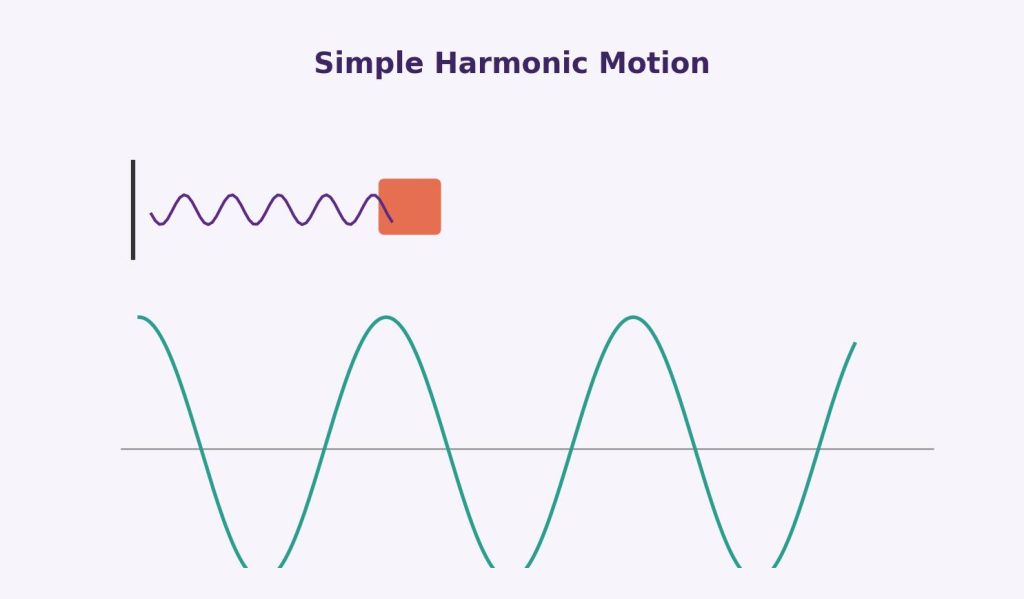
Simple harmonic motion is where physics starts to feel less like “objects moving in straight lines or circles” and more like genuinely new territory — sine and cosine functions describing position, a restoring force that’s proportional to displacement, and energy sloshing back and forth between kinetic and potential forms. Students often understand the individual pieces but struggle to connect them into a single coherent picture, especially when a problem mixes concepts (asking for velocity at a specific position, say, rather than at a specific time). This guide builds that connected picture, with worked examples covering springs, pendulums, and energy in SHM.
Table of Contents
ToggleWhat Makes Motion “Simple Harmonic”
Simple harmonic motion occurs whenever the restoring force on an object is directly proportional to its displacement from equilibrium, and points back toward equilibrium:
F = −kx
This is Hooke’s Law, and it’s the defining condition for SHM — a direct extension of the force and acceleration relationship from Newton’s second law — any system obeying this relationship (not just springs) will oscillate sinusoidally. This is why a mass on a spring and a simple pendulum (for small angles) both qualify as SHM, even though they look like very different physical setups.
The Core SHM Equations
- Position: x(t) = A cos(ωt + φ), where A is amplitude, ω is angular frequency, and φ is the phase constant (determined by initial conditions)
- Velocity: v(t) = −Aω sin(ωt + φ)
- Acceleration: a(t) = −Aω² cos(ωt + φ) = −ω²x
- Angular frequency (mass-spring system): ω = √(k/m)
- Period: T = 2π/ω = 2π√(m/k)
- Frequency: f = 1/T
A relationship worth memorizing directly, since it appears constantly in assignments: v_max = Aω (maximum speed occurs at the equilibrium position, x = 0) a_max = Aω² (maximum acceleration occurs at the extremes, x = ±A)
Worked Example 1: Basic Mass-Spring System
Problem: A 0.4 kg mass is attached to a spring with spring constant k = 100 N/m. It is pulled 0.05 m from equilibrium and released from rest. Find (a) the angular frequency, (b) the period, and (c) the maximum speed.
Step 1 — Angular frequency: ω = √(k/m) = √(100/0.4) = √250 = 15.8 rad/s
Step 2 — Period: T = 2π/ω = 2π/15.8 = 0.398 s
Step 3 — Maximum speed (amplitude A = 0.05 m, since the mass is released from rest at its maximum displacement): v_max = Aω = (0.05)(15.8) = 0.79 m/s
Answer: ω ≈ 15.8 rad/s, T ≈ 0.398 s, v_max ≈ 0.79 m/s.
Common mistake to avoid: Confusing the release displacement with something other than the amplitude. Since the mass is released from rest, the point of release is automatically the amplitude (the maximum displacement) — this wouldn’t be true if the mass were released with some initial velocity instead, which would require a slightly different approach to find A.
Worked Example 2: Finding Velocity at a Specific Position (Not Time)
This is one of the most commonly assigned SHM problem types, and it’s where many students get stuck because they instinctively reach for the time-based velocity equation when the question doesn’t give a time at all.
Problem: Using the same spring system as above (A = 0.05 m, ω = 15.8 rad/s), find the mass’s speed when it is 0.03 m from equilibrium.
Step 1 — Recognize this requires the position-velocity relationship, derived from conservation of energy (shown in the next section), rather than the time-based v(t) equation, since no time value is given:
v = ω√(A² − x²)
Step 2 — Substitute values: v = 15.8√(0.05² − 0.03²) = 15.8√(0.0025 − 0.0009) = 15.8√0.0016 = 15.8(0.04) = 0.632 m/s
Answer: The speed at x = 0.03 m is 0.632 m/s.
Common mistake to avoid: Trying to first solve for t using x(t) = A cos(ωt), then substituting that time into v(t) = −Aω sin(ωt). This works but is significantly more error-prone and time-consuming than using the direct position-velocity relationship shown above — recognizing when a problem gives position (not time) as the known variable is the key skill this example tests.
Energy in Simple Harmonic Motion
Total mechanical energy in SHM is constant and continuously exchanges between kinetic and potential energy:
E_total = ½kA² = ½mv² + ½kx²
This equation is exactly where the position-velocity relationship used above comes from — rearranging it for v gives v = ω√(A² − x²), using the fact that ω² = k/m.
Worked example 3: Using energy conservation directly
Problem: A 0.25 kg mass on a spring (k = 60 N/m) has an amplitude of 0.1 m. Find its kinetic energy and potential energy when it is at x = 0.06 m.
Step 1 — Total energy: E_total = ½kA² = ½(60)(0.1²) = ½(60)(0.01) = 0.3 J
Step 2 — Potential energy at x = 0.06 m: PE = ½kx² = ½(60)(0.06²) = ½(60)(0.0036) = 0.108 J
Step 3 — Kinetic energy (remaining energy): KE = E_total − PE = 0.3 − 0.108 = 0.192 J
Answer: At x = 0.06 m, PE = 0.108 J and KE = 0.192 J.
Common mistake to avoid: Forgetting that total energy stays constant throughout the motion — a common error is recalculating total energy using the current position instead of the amplitude, which would incorrectly treat the current position as if it were the maximum displacement.
The Simple Pendulum: A Second Common SHM System
For small angles (typically under about 15°), a simple pendulum also exhibits SHM, with:
T = 2π√(L/g)
where L is the pendulum’s length and g is gravitational acceleration. Notably, this period is independent of both mass and amplitude (for small angles) — a frequently tested conceptual point.
Worked example 4: Pendulum period
Problem: Find the length of a simple pendulum that has a period of exactly 2 seconds on Earth (g = 9.8 m/s²).
Step 1 — Rearrange the period formula for L: T = 2π√(L/g) T² = 4π²(L/g) L = gT²/(4π²)
Step 2 — Substitute values: L = (9.8)(2²)/(4π²) = (9.8)(4)/(39.48) = 39.2/39.48 = 0.993 m
Answer: The pendulum needs to be approximately 0.993 m (close to 1 m) long.
Common mistake to avoid: Assuming a heavier pendulum bob changes the period. Because mass doesn’t appear anywhere in the pendulum period formula, changing the bob’s mass alone has no effect on the period — only length (and, to a lesser degree at larger angles, amplitude) affects it, which is a common conceptual trap in exam-style questions.
A Step-by-Step Checklist for Students Stuck on an SHM Problem
- Identify what type of SHM system you’re dealing with (mass-spring or pendulum), since they use different formulas for angular frequency and period.
- Check whether the problem gives you a time value or a position value — this determines whether you need the time-based equations (x(t), v(t)) or the position-based energy relationship (v = ω√(A² − x²)).
- Remember that amplitude A is the maximum displacement, and it only equals the release position if the object was released from rest.
- For energy problems, always calculate total energy using the amplitude (½kA²), since this stays constant throughout the motion, and use it to find KE or PE at any other position.
- For pendulum problems, double check whether the small-angle approximation applies, and remember mass does not affect the period.
SHM problems can also appear alongside mechanics, energy, waves, and oscillations in broader university coursework. If you need support working through a complete physics assignment that combines these topics, you can explore our Physics Assignment Help service.
FAQs
Q1: What’s the difference between period and angular frequency in SHM? Period (T) is the time for one complete oscillation, measured in seconds, while angular frequency (ω) describes how quickly the phase of the oscillation advances, measured in radians per second. They’re related by ω = 2π/T, and angular frequency is what appears directly inside the sine and cosine functions describing position, velocity, and acceleration.
Q2: Why does maximum speed occur at the equilibrium position, not at the extremes? At the extremes (x = ±A), the object is momentarily at rest as it changes direction, so velocity is zero there. As the object moves back toward equilibrium, potential energy converts into kinetic energy, and speed increases continuously until reaching a maximum exactly at x = 0, where all the system’s energy is kinetic.
Q3: How do I know when to use v(t) versus v = ω√(A² − x²)? Use v(t) = −Aω sin(ωt + φ) when the problem gives you a specific time and asks for velocity at that time. Use v = ω√(A² − x²) when the problem gives you a specific position and asks for velocity at that position — this second equation comes directly from energy conservation and avoids needing to solve for time first.
Q4: Does a pendulum’s amplitude affect its period? For the small-angle approximation used in most introductory SHM (typically under about 15°), amplitude does not significantly affect the period. At larger angles, this approximation breaks down and the period does begin to depend slightly on amplitude, though this more complex case is generally beyond the scope of introductory SHM coverage.
Q5: Is all oscillating motion simple harmonic motion? No — SHM specifically requires the restoring force to be directly proportional to displacement (F = −kx). Many real oscillating systems only approximate this behavior under certain conditions (like a pendulum at small angles) and deviate from true SHM at larger displacements or under more complex force conditions, which is why the small-angle qualifier matters for pendulum problems specifically.
Q6: How does SHM connect to other topics you’ll study? The energy-exchange logic here is the exact same one introduced in Work, Energy, and Power in Physics — SHM just applies it to a system where kinetic and potential energy trade back and forth continuously rather than only once. If your course moves on to sound or light, the same sinusoidal position function x(t) = A cos(ωt + φ) reappears as the building block for Wave Interference and Diffraction.