
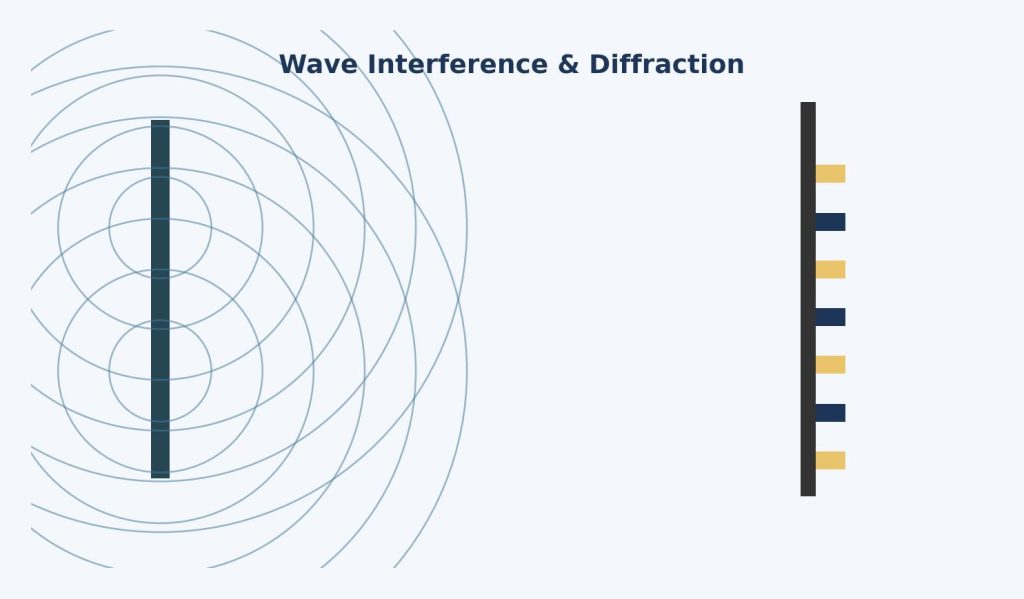
Young’s double-slit experiment is one of the most famous experiments in physics, and it’s also one of the most consistently assigned — which means it’s worth understanding thoroughly rather than just memorizing the final formula. Students often get the formula right but struggle when a problem changes the given variables (asking for wavelength instead of fringe spacing, say, or mixing in a diffraction grating instead of a double slit). This guide builds the concept from the ground up and works through the variations that show up most often in assignments.
Table of Contents
ToggleWhy Interference Happens: The Core Idea
When two coherent light sources (like light passing through two closely spaced slits) overlap, the resulting pattern depends on the path difference — the difference in distance traveled by light from each slit to a given point on the screen.
- Constructive interference (bright fringe): occurs when the path difference is a whole number of wavelengths: Δx = mλ, where m = 0, ±1, ±2…
- Destructive interference (dark fringe): occurs when the path difference is a half-integer number of wavelengths: Δx = (m + ½)λ
The intuitive picture worth holding onto: if two waves arrive at a point exactly “in step” (crest meeting crest, the same in-phase idea behind constructive addition in oscillating systems), they reinforce each other (bright). If they arrive exactly “out of step” (crest meeting trough), they cancel each other out (dark). Path difference is simply a way of quantifying how “in step” or “out of step” the two waves are by the time they reach a given point.
The Young’s Double-Slit Formula
For two slits separated by distance d, with light of wavelength λ, projected onto a screen a distance L away, the position of bright fringes measured from the center is given by:
y_m = mλL/d (small-angle approximation, valid when L is much larger than d and y)
Equivalently, the fringe spacing (distance between adjacent bright fringes) is:
Δy = λL/d
Worked Example 1: Basic Fringe Spacing Calculation
Problem: Light of wavelength 600 nm passes through two slits separated by 0.15 mm, projected onto a screen 2.5 m away. Find the spacing between adjacent bright fringes.
Step 1 — Convert all units to meters: λ = 600 nm = 600 × 10⁻⁹ m d = 0.15 mm = 0.15 × 10⁻³ m L = 2.5 m
Step 2 — Apply the fringe spacing formula: Δy = λL/d = (600 × 10⁻⁹)(2.5) / (0.15 × 10⁻³) Δy = (1.5 × 10⁻⁶) / (1.5 × 10⁻⁴) Δy = 0.01 m = 1 cm
Answer: Adjacent bright fringes are spaced 1 cm apart.
Common mistake to avoid: Forgetting to convert nanometers and millimeters into consistent SI units (meters) before substituting into the formula. This is overwhelmingly the most common source of numerical errors in double-slit problems — always convert every given quantity to base SI units first, and only then substitute into the formula.
Worked Example 2: Solving for Wavelength (Rearranging the Formula)
Problem: In a double-slit experiment, slits are separated by 0.2 mm, and the screen is 3 m away. The third bright fringe (m = 3) appears 2.7 cm from the central maximum. Find the wavelength of the light used.
Step 1 — Convert units: d = 0.2 × 10⁻³ m, L = 3 m, y₃ = 2.7 × 10⁻² m, m = 3
Step 2 — Rearrange y_m = mλL/d for λ: λ = y_m·d / (mL) λ = (2.7 × 10⁻²)(0.2 × 10⁻³) / (3 × 3) λ = (5.4 × 10⁻⁶) / 9 λ = 6.0 × 10⁻⁷ m = 600 nm
Answer: The wavelength is 600 nm (visible orange-red light).
Common mistake to avoid: Miscounting which fringe is “m = 3.” The central bright fringe (directly opposite the midpoint of the two slits) is always m = 0, not m = 1 — if a problem refers to “the third bright fringe from the center,” this is m = 3, but if it says “the third fringe” ambiguously, double-check whether the central fringe is meant to be counted as the first one or as m = 0, since this affects the calculation by one full fringe spacing.
Diffraction Gratings: The Same Principle, More Slits
A diffraction grating extends the double-slit idea to many closely spaced slits (often thousands per millimeter), producing much sharper, more well-defined bright fringes. The governing equation looks similar to the double-slit case, but is typically written in terms of angle rather than screen position:
d sin(θ) = mλ
where d is now the spacing between adjacent slits in the grating (often calculated from “lines per millimeter”), and θ is the angle from the central maximum to the m-th order bright fringe.
Worked example 3: Diffraction grating
Problem: A diffraction grating has 5000 lines per centimeter. Light of wavelength 500 nm is shone through it. Find the angle of the first-order (m = 1) bright fringe.
Step 1 — Find the slit spacing d from the lines-per-centimeter value: d = 1 cm / 5000 lines = 0.0002 cm = 2 × 10⁻⁶ m
Step 2 — Apply the grating equation, solving for θ: d sin(θ) = mλ sin(θ) = mλ/d = (1)(500 × 10⁻⁹) / (2 × 10⁻⁶) = 0.25 θ = sin⁻¹(0.25) = 14.5°
Answer: The first-order bright fringe appears at an angle of 14.5° from the central maximum.
Common mistake to avoid: Confusing “lines per centimeter” with the slit spacing d directly. The slit spacing is the reciprocal of the line density (1 divided by the number of lines per unit length) — using the line density value directly in place of d is a very common unit-conversion error in grating problems.
Diffraction: A Related But Distinct Phenomenon
While interference concerns the combination of waves from multiple sources (like two slits), diffraction concerns the spreading of a wave as it passes through or around a single opening or obstacle. Single-slit diffraction produces its own pattern, with the condition for dark fringes (note: dark, not bright, is the standard formula for single-slit diffraction) given by:
a sin(θ) = mλ (where a is the width of the single slit, and m = ±1, ±2, ±3…; note m = 0 is not included, since the center is always a bright maximum in single-slit diffraction)
Worked example 4: Single-slit diffraction (distinguishing it from double-slit interference)
Problem: Light of wavelength 550 nm passes through a single slit of width 0.03 mm. Find the angle of the first dark fringe.
Step 1 — Apply the single-slit diffraction formula with m = 1: a sin(θ) = mλ sin(θ) = mλ/a = (1)(550 × 10⁻⁹) / (0.03 × 10⁻³) = 0.01833 θ = sin⁻¹(0.01833) ≈ 1.05°
Answer: The first dark fringe appears at approximately 1.05°.
Common mistake to avoid: Applying the double-slit bright fringe formula (mλ = d sinθ, bright fringes) to a single-slit diffraction problem, where the standard formula actually locates dark fringes instead, with the center itself always being the brightest point (unlike double-slit interference, where the pattern near the center alternates between bright and dark at regular, evenly spaced intervals). Reading the problem carefully to identify whether it describes a single slit (diffraction) or multiple slits/a grating (interference) is the essential first step.
A Step-by-Step Checklist for Students Stuck on an Interference or Diffraction Problem
- Identify whether the problem involves a double slit, a diffraction grating (many slits), or a single slit — each uses a related but distinct formula, and single-slit diffraction locates dark fringes rather than bright ones by default.
- Convert every given quantity into consistent SI base units (meters) before substituting into any formula.
- For grating problems given in “lines per unit length,” remember that slit spacing d is the reciprocal of that value, not the value itself.
- Carefully identify which fringe order (m) the problem is describing, remembering the central maximum is m = 0 for double-slit and grating patterns.
- Use the small-angle approximation formula (y_m = mλL/d) only when the angle involved is genuinely small (typically under about 10°); for larger angles, especially in grating problems, use the angular form (d sinθ = mλ) directly instead.
Problems involving interference, diffraction, and wave optics can become more challenging when several concepts appear in the same assignment. Students working on broader coursework can also explore our Physics Assignment Help service.
FAQs
Q1: What’s the difference between interference and diffraction? Interference refers to the combination of waves from two or more distinct coherent sources (like two slits), producing a pattern based on path difference between those sources. Diffraction refers to the spreading and bending of a wave as it passes through or around a single opening or obstacle — single-slit diffraction produces its own pattern, distinct from (but related to) the multi-slit interference pattern.
Q2: Why does a diffraction grating produce sharper fringes than a simple double slit? Because a grating combines light from many more slits (often thousands), and constructive interference only occurs very precisely at the specific angles where light from every slit aligns in phase — even a small deviation from that exact angle causes significant cancellation across the many slits, producing much narrower, sharper bright fringes compared to the broader fringes from just two slits.
Q3: Why is the central fringe always bright in double-slit interference, but the center is treated differently in single-slit diffraction? In double-slit interference, the central point is equidistant from both slits (zero path difference), which always produces constructive interference there, making it the central bright fringe. In single-slit diffraction, there’s no second source to interfere with — the “central maximum” refers to the wide, bright central peak of the diffraction pattern itself, which is why the standard formula for single-slit diffraction locates the surrounding dark fringes instead.
Q4: Do I need to use radians or degrees for the angle in these formulas? The formulas themselves work with the sine of the angle, so as long as your calculator is set to the correct mode (degrees or radians) consistently when computing sin(θ), either can technically work — but most introductory courses and textbooks report final angle answers in degrees, so double-check your calculator’s mode before finalizing an answer.
Q5: What happens if the small-angle approximation isn’t valid for a double-slit problem? The formula y_m = mλL/d relies on the approximation that sin(θ) ≈ tan(θ) ≈ θ (in radians) for small angles, which breaks down at larger angles. In these cases, use the more general angular formula d sin(θ) = mλ directly, and if you need the screen position, use y = L tan(θ) rather than the small-angle approximation.
Q6: How does this topic connect to what you’ve already studied? The sinusoidal wave pattern here comes from the exact same math as Simple Harmonic Motion — a wave is essentially SHM propagating through space rather than a single object oscillating in place. And every one of the unit-conversion pitfalls flagged above is worth pairing with proper significant-figure reporting, covered in Error Analysis and Uncertainty in Physics Lab Reports.