
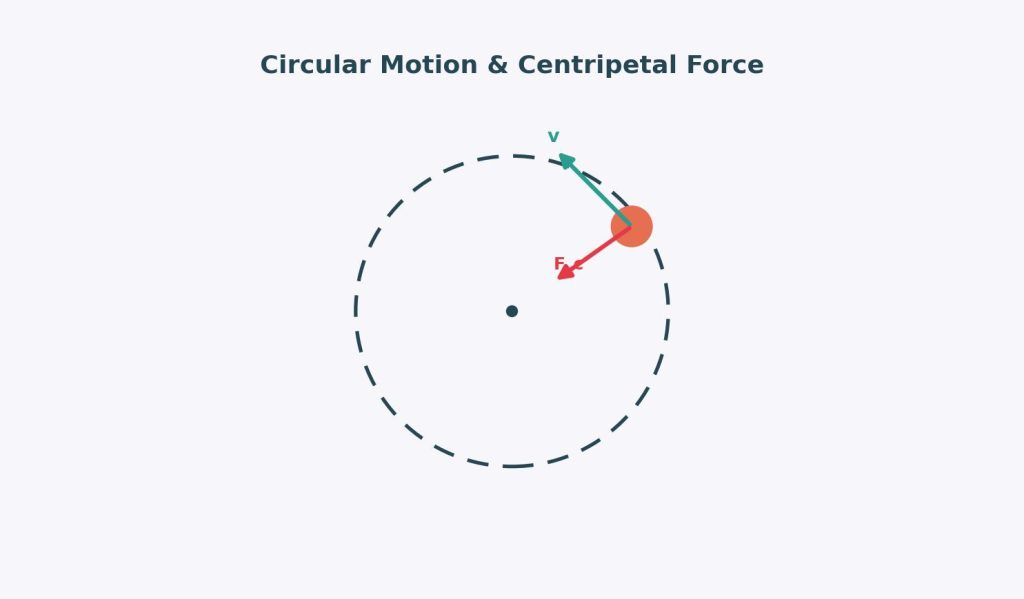
Circular motion is where a lot of students hit a specific conceptual wall: “if the object is moving at constant speed, why is there a net force at all?” Once that click happens — that constant speed doesn’t mean constant velocity, since direction is constantly changing — the rest of the topic becomes much more manageable. This guide clarifies that core concept, then works through the most commonly assigned circular motion scenarios: flat curves, banked curves, and vertical circles, each with a fully worked example.
Table of Contents
ToggleWhy Circular Motion Needs a Net Force at All
An object moving in a circle at constant speed is still accelerating, because velocity is a vector — even if its magnitude (speed) doesn’t change, its direction is constantly changing as the object moves around the circle. This acceleration is called centripetal acceleration, and it always points toward the center of the circle:
a_c = v²/r
By Newton’s second law — the same F = ma relationship used for straight-line force problems — this acceleration requires a net force pointing toward the center, called the centripetal force:
F_c = ma_c = mv²/r
A critical point assignments often specifically test: Centripetal force is not a separate, distinct type of force like gravity or friction — it’s the label for whatever combination of real forces (tension, gravity, normal force, friction) happens to be providing the net inward force in a given situation. Writing “centripetal force” as though it’s an independent force acting alongside gravity and tension in a free-body diagram is a common and serious conceptual error.
Worked Example 1: Basic Horizontal Circular Motion (String)
Problem: A 0.3 kg ball is swung in a horizontal circle of radius 0.8 m on a string, completing one revolution every 0.5 seconds. Find the tension in the string.
Step 1 — Find the speed using the period T = 0.5 s: v = 2πr/T = 2π(0.8)/0.5 = 10.05 m/s
Step 2 — Identify the source of centripetal force: In this horizontal setup (ignoring gravity’s effect on the string angle for simplicity, as many introductory problems do), tension provides the entire centripetal force.
Step 3 — Apply F_c = mv²/r: T = mv²/r = (0.3)(10.05²)/0.8 = (0.3)(101.0)/0.8 = 37.9 N
Answer: The tension in the string is approximately 37.9 N.
Common mistake to avoid: Adding a separate “centripetal force” term to the free-body diagram alongside tension. In this problem, tension is the centripetal force — there’s no additional force to add; the equation T = mv²/r simply states that the net inward force (which happens to be entirely tension here) equals mv²/r.
Worked Example 2: A Car on a Flat, Curved Road (Friction Provides the Centripetal Force)
Problem: A car of mass 1000 kg rounds a flat curve of radius 50 m. The coefficient of static friction between the tires and road is 0.4. Find the maximum speed the car can travel without skidding.
Step 1 — Identify the force providing centripetal force: On a flat road, static friction between the tires and road surface is the only horizontal force available, so it must provide the entire centripetal force.
Step 2 — Set maximum static friction equal to the required centripetal force: f_s,max = mv²/r μ_s mg = mv²/r
Step 3 — Notice mass cancels: μ_s g = v²/r v² = μ_s g r = (0.4)(9.8)(50) = 196 v = 14 m/s
Answer: The car can travel at a maximum of 14 m/s (about 50.4 km/h) without skidding.
Common mistake to avoid: Forgetting that mass cancels out of this type of problem. Many students spend time trying to find the car’s mass from other clues in a problem, not realizing the maximum safe speed on a flat curve is actually independent of the vehicle’s mass — a heavier car isn’t safer or less safe purely due to its weight in this scenario, since both the required centripetal force and the available friction force scale with mass identically.
Worked Example 3: A Banked Curve (No Friction)
Problem: A curve of radius 60 m is banked at an angle of 25° specifically so that a car can round it at a certain speed with no reliance on friction at all. Find that speed.
Step 1 — Free-body diagram: On a frictionless banked curve, only gravity (mg, down) and the normal force (N, perpendicular to the road surface) act on the car. The normal force is tilted, giving it both a vertical component (N cos θ) and a horizontal component (N sin θ) pointing toward the center of the curve.
Step 2 — Vertical equilibrium (no vertical acceleration): N cos θ = mg
Step 3 — Horizontal equation (the horizontal component of N provides the centripetal force): N sin θ = mv²/r
Step 4 — Divide the horizontal equation by the vertical equation (this conveniently eliminates both N and m): (N sin θ)/(N cos θ) = (mv²/r)/(mg) tan θ = v²/(rg) v² = rg tan θ = (60)(9.8)tan(25°) = (60)(9.8)(0.4663) = 274.2 v = 16.6 m/s
Answer: The car can round the curve at 16.6 m/s with no friction needed at all.
Common mistake to avoid: Trying to solve the vertical and horizontal equations separately without dividing them. Dividing one equation by the other is the standard technique for banked curve problems specifically because it eliminates both the unknown normal force and the mass in one step — attempting to solve for N first and then substitute is a valid but much longer route to the same answer.
Worked Example 4: Vertical Circular Motion (A Common “Trick” Assignment Question)
Problem: A 0.5 kg ball is swung in a vertical circle of radius 1.2 m on a string. Find the minimum speed the ball must have at the very top of the circle to keep the string taut.
Step 1 — Identify forces at the top of the circle: Both gravity (mg, down) and tension (T, down, since at the top of the circle “toward the center” means straight down) point toward the center.
Step 2 — Apply the centripetal force equation: T + mg = mv²/r
Step 3 — Find the minimum speed condition: The string can only pull, not push, so tension can decrease toward zero but not go negative. The minimum possible speed occurs exactly when T = 0 — at any slower speed, the string would go slack and the ball would fall out of its circular path before reaching the top.
Step 4 — Solve with T = 0: mg = mv²/r g = v²/r v² = gr = (9.8)(1.2) = 11.76 v = 3.43 m/s
Answer: The minimum speed at the top is 3.43 m/s.
Common mistake to avoid: Assuming tension must always be a specific positive value, or forgetting that gravity itself can fully provide the centripetal force at exactly the critical minimum speed. This “minimum speed at the top” question is one of the most frequently assigned circular motion problems specifically because it tests whether students understand that a string (or track) can only push or pull in one direction, unlike a rigid connection.
A Step-by-Step Checklist for Students Stuck on a Circular Motion Problem
- Identify which real force (or combination of forces — tension, friction, gravity, a component of the normal force) is actually providing the centripetal force in this specific scenario. Never add “centripetal force” as an extra, separate force in your diagram.
- Draw a free-body diagram at the specific point in the circular path the question asks about (top, bottom, side) — the force balance can be different at different points, especially in vertical circles.
- Set the net inward force equal to mv²/r, and solve for whatever the problem asks.
- For banked curve problems, try dividing the horizontal and vertical equilibrium equations to eliminate the normal force and mass in one step.
- For “minimum speed” problems, look for the physical constraint that defines the critical point — usually where a force (like tension or normal force) reaches zero, since forces like tension and normal force can’t go negative.
Need Help With a More Challenging Physics Problem?
Circular motion questions can become significantly more involved when they combine free-body diagrams, friction, energy conservation, or multiple forces acting at different points in the motion. If you’re working through a difficult physics assignment, you can explore our Physics Assignment Help service for additional academic support.
FAQs
Q1: Is centripetal force a real, separate force like gravity or friction? No — centripetal force is a label describing the net inward force required for circular motion, provided by one or more real forces (tension, friction, gravity, or a component of the normal force) depending on the specific situation. It should never be added as an extra force in a free-body diagram alongside the real forces already present.
Q2: Why does an object moving at constant speed in a circle still accelerate? Because acceleration depends on the rate of change of velocity, and velocity is a vector with both magnitude and direction — even if speed (magnitude) stays constant, the direction of motion is continuously changing in circular motion, which means velocity is changing, and therefore the object is accelerating, even though it isn’t speeding up or slowing down.
Q3: Why does mass cancel out in some circular motion problems but not others? Mass cancels when it appears on both sides of an equation in the same way — for example, in the flat-curve friction problem, both the required centripetal force (mv²/r) and the maximum available friction (μmg) are proportional to mass, so it cancels. In problems where forces don’t scale with mass in the same proportional way (or where you’re solving directly for a force like tension), mass remains in the final answer.
Q4: What’s the difference between centripetal force and centrifugal force? Centripetal force is a real, inward-pointing net force that causes circular motion, observed correctly from a stationary (inertial) reference frame. “Centrifugal force” is an apparent outward force that only appears to exist from within a rotating reference frame (like a passenger’s perspective inside a turning car) — it isn’t a real force acting on the object, which is why it’s generally avoided in standard free-body diagram analysis at the introductory level.
Q5: How do I handle a circular motion problem where the object is on the inside of a vertical loop, like a roller coaster? The same principle applies as the vertical circle example above: at the top of a loop, both gravity and the track’s normal force point toward the center (downward), so N + mg = mv²/r, and the minimum speed to maintain contact with the track occurs when N = 0. At the bottom of the loop, gravity points away from the center while the normal force points toward it, giving N − mg = mv²/r instead — always re-derive the equation based on which forces point toward the center at that specific location.
Q6: How does circular motion connect to other mechanics topics? The same F_net = ma logic from Newton’s Laws of Motion is what’s being applied here — the only change is that “net force” now points toward a center instead of along a straight line. And once an object spins about its own axis rather than moving along a circular path, the framework shifts again to Rotational Motion and Moment of Inertia, which uses torque and angular acceleration instead of centripetal force.