
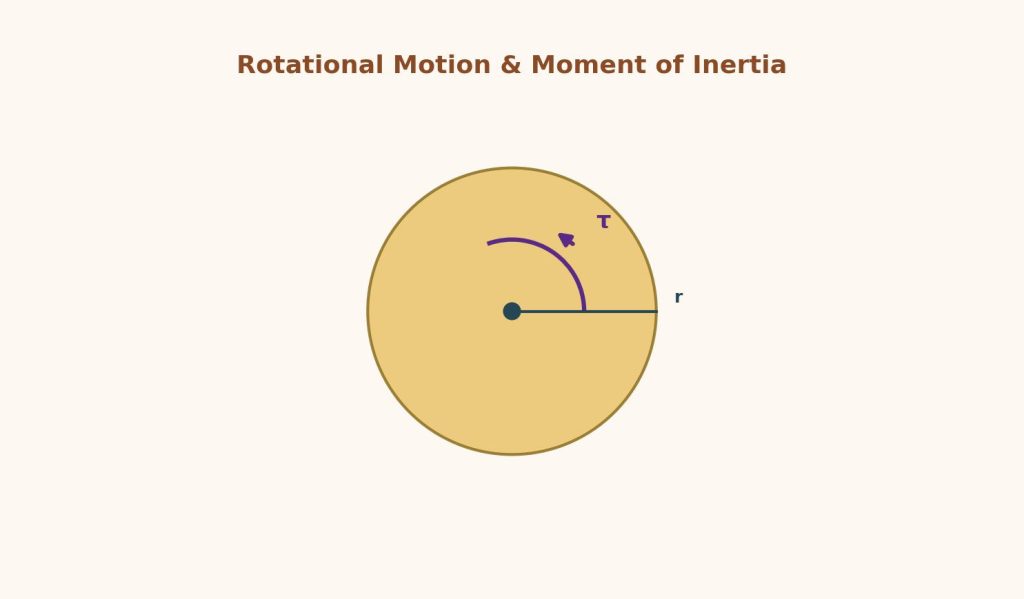
Rotational motion is often taught as “linear motion, but with different letters” — and while that’s a useful starting point, it’s also exactly where students get tripped up, because the analogy breaks down in a few specific, testable places. Moment of inertia depends on how mass is distributed, not just how much mass there is, and torque depends on where a force is applied, not just its magnitude. This guide walks through the linear-to-rotational analogy carefully, flags where it breaks down, and works through fully solved examples covering torque, moment of inertia, and rotational energy.
Table of Contents
ToggleThe Linear-to-Rotational Analogy (And Where It’s Genuinely Useful)
| Linear quantity | Rotational quantity |
|---|---|
| Position (x) | Angular position (θ) |
| Velocity (v) | Angular velocity (ω) |
| Acceleration (a) | Angular acceleration (α) |
| Mass (m) | Moment of inertia (I) |
| Force (F) | Torque (τ) |
| Newton’s second law: F = ma | Rotational second law: τ = Iα |
| Kinetic energy: ½mv² | Rotational kinetic energy: ½Iω² |
| Momentum: p = mv | Angular momentum: L = Iω |
This analogy is genuinely useful for remembering the structure of rotational equations. But it can mislead students into thinking moment of inertia is simply “rotational mass” in a fixed sense — it isn’t fixed the way mass is, because it depends on the axis of rotation and how mass is distributed relative to that axis, as the next section shows.
Moment of Inertia: Why Distribution Matters
Moment of inertia measures an object’s resistance to changes in rotational motion, and for a point mass it’s defined as:
I = mr²
where r is the distance from the axis of rotation — not the total distance traveled, but the perpendicular distance to the rotation axis. For extended objects, moment of inertia is found by summing (or integrating) mr² over every bit of mass in the object, which is why standard shapes have known formulas:
- Solid sphere (about its center): I = (2/5)mr²
- Solid cylinder or disk (about its central axis): I = (1/2)mr²
- Thin rod (about its center): I = (1/12)mL²
- Thin rod (about one end): I = (1/3)mL²
- Hoop or thin ring (about its central axis): I = mr²
The key conceptual point assignments test: Two objects with identical mass can have very different moments of inertia depending on how that mass is distributed relative to the rotation axis. Mass concentrated far from the axis (like a hoop) contributes much more to moment of inertia than the same mass concentrated near the axis (like a solid disk of the same mass and radius).
Worked Example 1: Comparing Moment of Inertia for Different Shapes
Problem: A solid disk and a thin hoop, both of mass 2 kg and radius 0.3 m, are compared. Find the moment of inertia of each about their central axis, and explain the physical difference.
Step 1 — Solid disk: I_disk = (1/2)mr² = (1/2)(2)(0.3²) = (1/2)(2)(0.09) = 0.09 kg·m²
Step 2 — Hoop: I_hoop = mr² = (2)(0.3²) = (2)(0.09) = 0.18 kg·m²
Answer: The hoop’s moment of inertia (0.18 kg·m²) is exactly double the disk’s (0.09 kg·m²), despite having identical mass and radius, because the hoop’s entire mass sits at the maximum distance from the axis, while the disk’s mass is distributed from the center outward, with much of it closer to the axis.
Common mistake to avoid: Assuming equal mass and radius automatically means equal moment of inertia. This worked example is a classic assignment question specifically because it tests whether students understand that mass distribution, not just total mass, determines rotational inertia.
Torque: Force, Distance, and Angle All Matter
Torque is the rotational equivalent of force, defined as:
τ = rF sin(θ)
where r is the distance from the pivot point to where the force is applied, F is the magnitude of the force, and θ is the angle between the force vector and the lever arm (the line from the pivot to the point of application).
Worked example 2: Torque with an angled force
Problem: A wrench 0.25 m long is used to turn a bolt. A force of 80 N is applied at the end of the wrench, at an angle of 60° to the wrench’s handle. Find the torque.
Step 1 — Apply the torque formula directly: τ = rF sin(θ) = (0.25)(80)sin(60°) = (0.25)(80)(0.866) = 17.3 N·m
Answer: The torque is 17.3 N·m.
Common mistake to avoid: Using the full force (80 N) without the sine factor, which would overestimate the torque. Only the component of force perpendicular to the lever arm contributes to torque — a force applied exactly along the length of the wrench handle (θ = 0°) would produce zero torque no matter how large it is, since sin(0°) = 0.
Worked Example 3: Rotational Second Law (τ = Iα)
Problem: A solid cylindrical flywheel of mass 8 kg and radius 0.2 m starts at rest and is brought up to an angular velocity of 30 rad/s in 5 seconds by a constant applied torque. Find the required torque.
Step 1 — Find angular acceleration: α = Δω/Δt = (30 − 0)/5 = 6 rad/s²
Step 2 — Find moment of inertia (solid cylinder about its central axis): I = (1/2)mr² = (1/2)(8)(0.2²) = (1/2)(8)(0.04) = 0.16 kg·m²
Step 3 — Apply τ = Iα: τ = (0.16)(6) = 0.96 N·m
Answer: A torque of 0.96 N·m is required.
Common mistake to avoid: Confusing angular velocity (rad/s) with angular acceleration (rad/s²), or forgetting to convert if a problem gives values in revolutions per minute (RPM) instead of radians per second — always convert to consistent SI units (radians, not degrees or revolutions) before applying rotational equations.
Worked Example 4: Rotational Kinetic Energy and Rolling Objects
Problem: A solid sphere of mass 3 kg and radius 0.1 m rolls without slipping down a hill, reaching a linear speed of 4 m/s at the bottom. Find its total kinetic energy (translational plus rotational).
Step 1 — Translational kinetic energy: KE_trans = ½mv² = ½(3)(4²) = ½(3)(16) = 24 J
Step 2 — Find angular velocity using the rolling-without-slipping condition (v = ωr, so ω = v/r): ω = 4/0.1 = 40 rad/s
Step 3 — Moment of inertia for a solid sphere: I = (2/5)mr² = (2/5)(3)(0.1²) = (2/5)(3)(0.01) = 0.012 kg·m²
Step 4 — Rotational kinetic energy: KE_rot = ½Iω² = ½(0.012)(40²) = ½(0.012)(1600) = 9.6 J
Step 5 — Total kinetic energy: KE_total = KE_trans + KE_rot = 24 + 9.6 = 33.6 J
Answer: The sphere’s total kinetic energy is 33.6 J.
Common mistake to avoid: Calculating only translational kinetic energy (½mv²) for a rolling object and stopping there. Rolling objects have kinetic energy in both forms simultaneously — this is one of the most commonly missed points in energy conservation problems involving rolling objects on inclines, and forgetting the rotational term leads to a systematically wrong (too low) final speed when using energy conservation to solve for velocity at the bottom of a hill.
A Step-by-Step Checklist for Students Stuck on a Rotational Motion Problem
- Identify the correct moment of inertia formula for the object’s shape and, critically, the specific axis of rotation described in the problem — the same object can have different I values about different axes.
- For torque problems, always include the sin(θ) factor unless the force is already stated to be perpendicular to the lever arm.
- Convert all angular quantities to radians and radians per second (not degrees or RPM) before applying rotational equations.
- For rolling-without-slipping problems, remember to include both translational (½mv²) and rotational (½Iω²) kinetic energy — using the constraint v = ωr to connect them.
- Use the linear-to-rotational analogy table to identify the correct rotational equation structure, but don’t assume moment of inertia behaves like a fixed, shape-independent property the way mass does in linear motion.
Working Through a More Complex Rotational Motion Problem?
Problems involving composite objects, parallel-axis calculations, rolling motion, or torque systems can require several concepts to be applied together. If you need additional academic support with a physics assignment, you can explore our Physics Assignment Help service.
FAQs
Q1: Why does moment of inertia depend on the axis of rotation? Because moment of inertia depends on how far each bit of an object’s mass sits from the specific axis being used — the same rod, for example, has a much smaller moment of inertia when rotated about its center than when rotated about one end, since more of its mass sits farther from an end-axis than from a center-axis.
Q2: What does “rolling without slipping” actually mean, and why does it matter? It means a rolling object’s point of contact with the surface is momentarily at rest relative to the surface (no sliding), which creates a direct mathematical relationship between linear speed and angular speed: v = ωr. This condition is what allows you to connect translational and rotational motion equations in problems involving wheels, balls, and cylinders rolling down inclines.
Q3: Why do a solid sphere and a hollow sphere roll down a ramp at different speeds even with the same mass and radius? Because they have different moments of inertia (a hollow sphere has more mass farther from the center, giving it a larger I), meaning more of the available gravitational potential energy converts into rotational kinetic energy for the hollow sphere, leaving less for translational kinetic energy — so the solid sphere reaches a higher linear speed at the bottom, despite starting with identical total energy.
Q4: What’s the difference between torque and force? Force is a push or pull that can cause linear acceleration, while torque is the rotational effectiveness of a force, which depends not just on the force’s magnitude but also on how far from the pivot point it’s applied and at what angle — the same force can produce a large or small torque (or even zero torque) depending entirely on where and how it’s applied.
Q5: How do I know which moment of inertia formula to use if a problem doesn’t specify the shape explicitly? Read the problem carefully for descriptive words like “solid disk,” “thin rod,” “hollow sphere,” or “hoop,” which directly indicate which standard formula applies. If a problem describes a more complex or composite shape, moment of inertia is typically found by summing the individual moments of inertia of each component part about the same axis (using the parallel axis theorem if the parts aren’t centered on that axis).
Q6: What other topics build on moment of inertia and torque? Rotational kinetic energy (½Iω²) plugs directly into the same conservation-of-energy framework covered in Work, Energy, and Power in Physics, which is exactly what the rolling-sphere example above relies on. If your course extends into oscillating rotational systems — a torsion pendulum, for instance — the same restoring-force logic from Simple Harmonic Motion applies, just with torque and angular displacement in place of force and linear displacement.