
Kinematics is usually the very first topic in an introductory university physics course, and it’s also where a lot of students form their first real doubts about whether they’re “a physics person.” The frustrating part is that the concepts themselves — position, velocity, acceleration — are intuitive. What trips students up is knowing which equation to use, when, and how to handle problems with multiple stages (like projectile motion) without getting lost in signs and directions. This guide gives you a reliable method for approaching any kinematics problem, plus fully worked examples covering the situations that show up most often in assignments.
Table of Contents
ToggleThe Four Key Kinematics Equations You Need
Kinematics problems involving constant acceleration are built from four core equations. You don’t need to memorize dozens of variations — you need to recognize which of these four fits the information you’re given.
- v = v₀ + at (final velocity, no displacement)
- x = x₀ + v₀t + ½at² (displacement, no final velocity)
- v² = v₀² + 2a(x − x₀) (final velocity, no time)
- x = x₀ + ½(v₀ + v)t (displacement, no acceleration)
Where: x = position, v = velocity, a = acceleration, t = time, and the subscript “0” denotes the initial value.
The single most useful problem-solving habit in kinematics: Before touching any equation, write out a list of every variable you know and every variable you need to find. Whichever equation contains only known variables plus the one unknown you need is the correct equation to use. This turns “which formula do I use?” from a guessing game into a simple matching exercise.
A Reliable Method for Any Kinematics Problem
- Draw a diagram. Even a simple sketch showing the direction of motion prevents the most common kinematics mistake: sign errors.
- Define a positive direction. Decide once, at the start, which direction is positive (usually “up” or “the direction of initial motion”) and stay consistent for the entire problem.
- List known and unknown variables. Write out x₀, v₀, v, a, and t, filling in what the problem gives you and marking what you need to find.
- Select the equation that includes only your knowns and the one unknown you want.
- Solve algebraically before plugging in numbers, when possible — this makes it much easier to spot mistakes than substituting numbers early.
- Check units and reasonableness. A car accelerating at 500 m/s² or a ball landing before it’s thrown are signs of an arithmetic or sign error, not physically real answers.
Worked Example 1: Basic One-Dimensional Motion
Problem: A car starts from rest and accelerates uniformly at 3 m/s² for 8 seconds. Find its final velocity and the distance traveled.
Step 1 — Known/unknown: v₀ = 0, a = 3 m/s², t = 8 s. Find v and x (taking x₀ = 0).
Step 2 — Final velocity: Using v = v₀ + at: v = 0 + (3)(8) = 24 m/s
Step 3 — Distance: Using x = x₀ + v₀t + ½at²: x = 0 + 0 + ½(3)(8²) = ½(3)(64) = 96 m
Answer: The car reaches 24 m/s and travels 96 m.
Common mistake to avoid: Using v² = v₀² + 2a(x − x₀) to find distance here would also work, but only after already knowing v — using the equation that directly matches your knowns (as done above) avoids an unnecessary extra step and reduces the chance of a carried-over rounding error.
Worked Example 2: Deceleration (Negative Acceleration)
Problem: A train traveling at 30 m/s brakes with a deceleration of 2 m/s². How far does it travel before stopping?
Step 1 — Known/unknown: v₀ = 30 m/s, v = 0 (stopped), a = −2 m/s² (negative because it’s decelerating in the direction of motion). Find x − x₀.
Step 2 — Select equation: v² = v₀² + 2a(x − x₀), since we don’t know t.
Step 3 — Solve: 0² = 30² + 2(−2)(x − x₀) 0 = 900 − 4(x − x₀) x − x₀ = 900 / 4 = 225 m
Answer: The train travels 225 m before stopping.
Common mistake to avoid: Forgetting to make the acceleration negative because the train is slowing down. A very common error is plugging in a = 2 (positive) out of habit, which would give a nonsensical negative displacement when solved. Always assign the sign of acceleration based on your defined positive direction, not on whether the object is speeding up or slowing down in a generic sense.
Worked Example 3: Two-Dimensional Projectile Motion
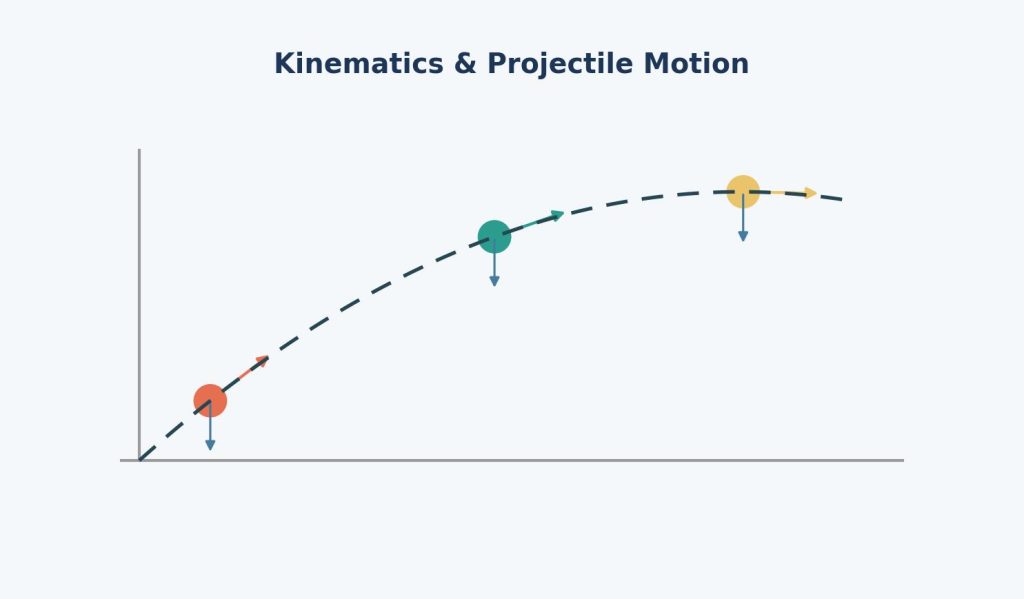
Projectile motion problems are where kinematics assignments get significantly harder, because you must treat the horizontal and vertical directions as two completely independent one-dimensional kinematics problems, connected only by a shared time variable. The same “break it into independent directions” logic shows up again later in Circular Motion and Centripetal Force, where velocity and acceleration are split into tangential and radial components instead.
Problem: A ball is launched from the ground at 20 m/s at an angle of 30° above the horizontal. Find (a) the maximum height, (b) the total time of flight, and (c) the horizontal range. Use g = 9.8 m/s².
Step 1 — Break the initial velocity into components: v₀ₓ = v₀cos(θ) = 20cos(30°) = 17.3 m/s v₀ᵧ = v₀sin(θ) = 20sin(30°) = 10 m/s
Step 2 — Maximum height (vertical motion only, using v² = v₀² + 2a(x − x₀) with v = 0 at the peak): 0² = 10² + 2(−9.8)(h) 0 = 100 − 19.6h h = 100 / 19.6 = 5.1 m
Step 3 — Total time of flight (using v = v₀ + at, noting the ball returns to the same height so final vertical velocity is −10 m/s): −10 = 10 + (−9.8)t −20 = −9.8t t = 2.04 s
Step 4 — Horizontal range (horizontal motion has zero acceleration, so x = v₀ₓ·t): Range = 17.3 × 2.04 = 35.3 m
Answer: Maximum height ≈ 5.1 m, time of flight ≈ 2.04 s, range ≈ 35.3 m.
Common mistake to avoid: Using the launch speed (20 m/s) directly in the vertical equations instead of the vertical component (10 m/s). Every projectile motion problem requires this component split as the very first step — skipping it is the single most common reason students get the wrong answer despite understanding the concept.
Worked Example 4: Relative Motion (Two Objects)
Problem: Car A is 100 m behind Car B. Both start from rest at the same moment. Car A accelerates at 4 m/s² and Car B accelerates at 2 m/s². When does Car A catch up to Car B?
Step 1 — Set up position equations for each car (with Car A starting at x = 0, Car B starting at x = 100):
Car A: xₐ = 0 + 0(t) + ½(4)t² = 2t² Car B: x_B = 100 + 0(t) + ½(2)t² = 100 + t²
Step 2 — Set positions equal (Car A catches Car B when xₐ = x_B): 2t² = 100 + t² t² = 100 t = 10 s
Answer: Car A catches up to Car B after 10 seconds.
Common mistake to avoid: Forgetting to include Car B’s 100 m head start as an initial position term. Relative motion problems are really just two ordinary kinematics equations solved simultaneously — the only new skill is setting up both position equations relative to the same coordinate origin before solving.
Building Your Own Diagram: A Habit Worth Forming
Every worked example above started with defining a positive direction and identifying knowns/unknowns before touching a formula. For projectile motion specifically, sketching a simple trajectory arc with the launch angle labeled, and marking horizontal (x) and vertical (y) axes separately, prevents the majority of sign and component errors that show up in graded assignments.
A Step-by-Step Checklist for Students Stuck on a Kinematics Problem
- Sketch the situation and define a positive direction before writing any equation.
- List every known variable (x₀, v₀, v, a, t) and identify exactly which one you need to find.
- For 2D problems, immediately split initial velocity into horizontal and vertical components — never use the original launch speed directly in a one-dimensional equation.
- Choose the kinematics equation that includes only your known variables plus the single unknown.
- Solve symbolically first, then substitute numbers, and sanity-check the final answer’s units and physical plausibility.
If you’re working through projectile motion, acceleration, relative motion, or other multi-step kinematics problems, you can get help with physics assignments for step-by-step guidance with calculations and problem-solving methods.
FAQs
Q1: How do I know which of the four kinematics equations to use? List everything you know (x₀, v₀, v, a, t) and what you need to find, then pick the equation that contains only those known variables plus your one unknown — this removes the guesswork and turns equation selection into a simple matching process.
Q2: Why is acceleration due to gravity sometimes positive and sometimes negative? It depends entirely on which direction you defined as positive at the start of the problem. If “up” is positive, gravity is −9.8 m/s²; if “down” is positive, gravity is +9.8 m/s². The sign itself isn’t fixed — consistency with your own chosen convention throughout the problem is what matters.
Q3: Do I need calculus for basic kinematics problems? Introductory kinematics problems assuming constant acceleration can be solved entirely with the four algebraic equations shown here, without calculus. Calculus-based kinematics (where acceleration varies with time) typically appears later in a calculus-based physics sequence and uses integration and differentiation instead.
Q4: Why does horizontal velocity stay constant in projectile motion? Because, ignoring air resistance, there is no horizontal force acting on the projectile once it’s launched, and therefore no horizontal acceleration — only gravity acts, and gravity acts purely vertically, which is exactly why horizontal and vertical motion can be treated as two separate, independent problems.
Q5: What’s the most common reason I get the right method but the wrong numerical answer? Sign errors are overwhelmingly the most common cause — forgetting to make deceleration negative, using the wrong sign for gravity relative to your chosen positive direction, or plugging in the full launch speed instead of a velocity component. Reviewing your sign convention at each step, rather than only at the start, catches most of these errors before they propagate through the rest of the solution.
Q6: What comes after kinematics in a typical mechanics course? Kinematics describes how things move; the next step is usually explaining why, which is where Newton’s Laws of Motion come in — the free-body diagram method you’ll learn there determines the acceleration values you plug straight into the kinematics equations above. If your course reports experimental values of g or acceleration from a lab, pairing that result with a properly calculated uncertainty (see Error Analysis and Uncertainty in Physics Lab Reports) is usually expected too.