
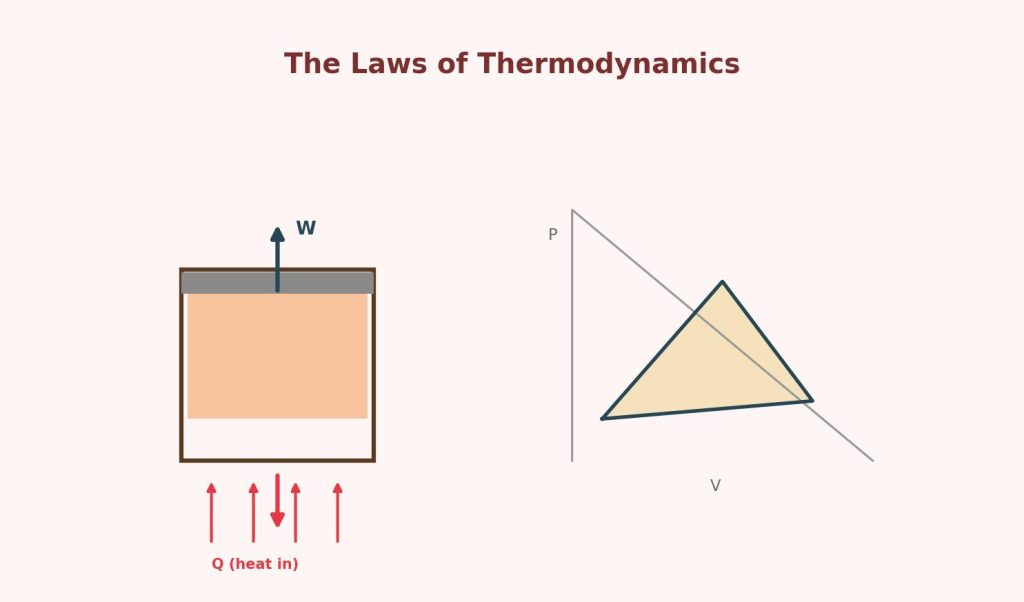
Thermodynamics assignments have a specific way of tripping students up: the concepts (heat, work, internal energy) sound familiar from everyday language and from work and energy problems earlier in the course, but the sign conventions are strict and unforgiving, and a single flipped sign turns a correct approach into a wrong answer. This guide clarifies the sign conventions clearly from the start, walks through the first and second laws with fully worked examples, and covers heat engine efficiency — one of the most commonly assigned thermodynamics problem types.
Table of Contents
ToggleGetting the Sign Convention Right (This Solves Most Thermodynamics Confusion)
The first law of thermodynamics is usually written as:
ΔU = Q − W
where ΔU is the change in internal energy of the system, Q is heat added to the system (positive) or removed from the system (negative), and W is work done by the system (positive) or done on the system (negative).
This sign convention matters enormously, and different textbooks use different conventions — some write ΔU = Q + W, treating work done on the system as positive instead. Always check which convention your specific course uses before starting a problem, and state it explicitly in your assignment answer, since using the wrong convention consistently throughout a problem will still give a self-consistent but ultimately incorrect final answer relative to what’s expected.
For the rest of this guide, we’ll use ΔU = Q − W, with Q positive when heat is added to the system, and W positive when the system does work on its surroundings (such as gas expanding and pushing a piston outward).
Worked Example 1: Basic First Law Application
Problem: A gas absorbs 500 J of heat and does 200 J of work on its surroundings as it expands. Find the change in internal energy.
Step 1 — Apply the first law directly: ΔU = Q − W = 500 − 200 = 300 J
Answer: The internal energy increases by 300 J.
Common mistake to avoid: Forgetting that Q and W are independent quantities that must both be correctly signed based on the problem description — “absorbs heat” means Q is positive, and “does work on surroundings” (expansion) means W is positive in this convention. If the problem instead described the gas being compressed (work done on the gas), W would be negative.
The Four Key Thermodynamic Processes
Assignments frequently ask you to analyze one of four standard idealized processes, each with a simplified version of the first law:
- Isobaric (constant pressure): W = PΔV
- Isochoric / isovolumetric (constant volume): W = 0, so ΔU = Q entirely
- Isothermal (constant temperature, ideal gas): ΔU = 0 (since internal energy of an ideal gas depends only on temperature), so Q = W entirely
- Adiabatic (no heat exchange): Q = 0, so ΔU = −W entirely
Worked example 2: Isochoric process
Problem: 300 J of heat is added to a gas held at constant volume in a rigid, sealed container. Find the work done and the change in internal energy.
Step 1 — Recognize the constraint: constant volume means W = 0 (no expansion or compression is possible in a rigid container).
Step 2 — Apply the first law: ΔU = Q − W = 300 − 0 = 300 J
Answer: No work is done, and all 300 J of added heat goes directly into increasing internal energy.
Common mistake to avoid: Trying to calculate work using W = PΔV even though volume doesn’t change. Recognizing the type of process described in the problem (constant volume, constant pressure, constant temperature, or no heat exchange) immediately tells you which term in the first law drops out, which is usually the fastest way to solve these problems.
Worked Example 3: Isobaric Process (Constant Pressure)
Problem: A gas at constant pressure of 150 kPa expands from a volume of 0.02 m³ to 0.05 m³, while absorbing 900 J of heat. Find the work done and the change in internal energy.
Step 1 — Calculate work done (constant pressure, so W = PΔV): W = PΔV = (150,000 Pa)(0.05 − 0.02) = (150,000)(0.03) = 4500 J
Step 2 — Apply the first law: ΔU = Q − W = 900 − 4500 = −3600 J
Answer: The gas does 4500 J of work on its surroundings, and its internal energy actually decreases by 3600 J, despite heat being added — because the gas does significantly more work expanding than the heat it absorbed.
Common mistake to avoid: Assuming that adding heat always increases internal energy. This worked example is a common assignment question specifically because it shows that internal energy can decrease even while heat is being added, if the system does enough work on its surroundings — a genuinely counterintuitive result that’s easy to get wrong without carefully applying the first law.
Worked Example 4: Adiabatic Process (No Heat Exchange)
Problem: A gas is compressed adiabatically, and 800 J of work is done on the gas during the compression. Find the change in internal energy.
Step 1 — Recognize the constraint: adiabatic means Q = 0.
Step 2 — Identify the sign of W: work is done on the gas (compression), so in our convention (W = work done by the system), W = −800 J.
Step 3 — Apply the first law: ΔU = Q − W = 0 − (−800) = 800 J
Answer: The internal energy increases by 800 J.
Common mistake to avoid: Using +800 J for W because the problem states “800 J of work is done,” without checking the direction. Always identify whether work is done by the system or on the system before assigning a sign, since this is exactly the kind of detail thermodynamics problems are specifically designed to test.
The Second Law of Thermodynamics and Heat Engine Efficiency
The second law states that heat naturally flows from hot to cold (not the reverse, without external work), and that no heat engine can be 100% efficient — some heat must always be exhausted to a cold reservoir. This gives rise to the standard heat engine efficiency formula:
Efficiency (η) = W_net / Q_hot = 1 − (Q_cold / Q_hot)
where Q_hot is heat absorbed from the hot reservoir and Q_cold is heat exhausted to the cold reservoir.
Worked example 5: Heat engine efficiency
Problem: A heat engine absorbs 2000 J of heat from a hot reservoir and exhausts 1200 J to a cold reservoir per cycle. Find the engine’s efficiency and the net work output.
Step 1 — Find net work (conservation of energy: net work equals the difference between heat absorbed and heat exhausted): W_net = Q_hot − Q_cold = 2000 − 1200 = 800 J
Step 2 — Calculate efficiency: η = W_net / Q_hot = 800 / 2000 = 0.4 = 40%
Answer: The engine’s efficiency is 40%, with a net work output of 800 J per cycle.
Common mistake to avoid: Forgetting to exhaust some heat to the cold reservoir when solving for an “ideal” or maximum-efficiency scenario. The second law guarantees Q_cold can never be exactly zero for a continuously operating heat engine — a claimed 100% efficient heat engine (with η = 1) is a strong signal of either an error in the problem’s setup or, in a theory-based question, exactly the scenario the second law rules out entirely.
Worked Example 6: Carnot Efficiency (The Theoretical Maximum)
Problem: Find the maximum possible efficiency of a heat engine operating between a hot reservoir at 500 K and a cold reservoir at 300 K.
Step 1 — Apply the Carnot efficiency formula (using absolute temperature in Kelvin): η_Carnot = 1 − (T_cold / T_hot) = 1 − (300/500) = 1 − 0.6 = 0.4 = 40%
Answer: The maximum possible (Carnot) efficiency is 40%.
Common mistake to avoid: Using Celsius temperatures instead of Kelvin. The Carnot efficiency formula requires absolute temperature, since it’s derived from a ratio of temperatures that only makes physical sense on an absolute scale — using Celsius values directly would produce a meaningless and incorrect result.
A Step-by-Step Checklist for Students Stuck on a Thermodynamics Problem
- Confirm which sign convention your course uses for the first law (ΔU = Q − W or ΔU = Q + W) before starting, and apply it consistently throughout.
- Identify which of the four standard processes (isobaric, isochoric, isothermal, adiabatic) the problem describes, since this immediately simplifies the first law by eliminating one term.
- For work calculations, always double-check whether work is being done by the system (expansion) or on the system (compression), and sign it accordingly.
- For heat engine problems, remember that some heat must always be exhausted to a cold reservoir (Q_cold > 0) — a real engine’s actual efficiency is always somewhat lower than the theoretical Carnot maximum for the same temperature range.
- Always convert temperatures to Kelvin before using them in any thermodynamics formula, especially the Carnot efficiency equation.
Thermodynamics problems often appear alongside mechanics and energy questions in university physics coursework. If you need help applying these concepts to a broader assignment, see our Physics Assignment Help resource.
FAQs
Q1: Why do different textbooks use different sign conventions for the first law? It’s largely a matter of historical convention and disciplinary tradition — physics texts often use ΔU = Q − W (work done by the system as positive), while some engineering texts use ΔU = Q + W (work done on the system as positive). Both are correct as long as they’re applied consistently; always confirm which convention your specific course expects.
Q2: Can internal energy decrease even if heat is added to a system? Yes — as shown in the isobaric worked example above, if a system does enough work on its surroundings while absorbing heat, its internal energy can still decrease overall, since the first law depends on the balance between heat added and work done, not on heat added alone.
Q3: What’s the difference between an engine’s actual efficiency and its Carnot efficiency? Carnot efficiency represents the theoretical maximum efficiency possible for any heat engine operating between two given temperatures, based purely on the second law of thermodynamics. Real engines always have lower actual efficiency than this theoretical maximum, due to practical factors like friction and non-ideal heat transfer that Carnot’s idealized analysis doesn’t account for.
Q4: Why is Q = 0 the defining feature of an adiabatic process, and how is that different from ΔU = 0? Adiabatic means no heat is exchanged with the surroundings (Q = 0), which is different from isothermal (constant temperature), where ΔU = 0 for an ideal gas because internal energy depends only on temperature. It’s entirely possible for an adiabatic process to have a nonzero change in internal energy (as shown in the compression example above), since work can still change internal energy even without any heat exchange.
Q5: Why can’t a heat engine be 100% efficient? The second law of thermodynamics states that a heat engine must exhaust some heat to a cold reservoir in every cycle — it cannot convert 100% of absorbed heat directly into work while operating continuously. This isn’t a limitation of engineering that could theoretically be overcome with a perfect design; it’s a fundamental physical law describing the direction and behavior of heat flow.
Q6: How does thermodynamics relate to other physics topics you’ve studied? The first law is really the same energy-accounting principle you’ve already used for mechanical systems — ΔU = Q − W is just conservation of energy rewritten for heat and gas systems instead of moving objects. And the careful sign-tracking discipline this topic demands is exactly the same skill tested in Kirchhoff’s Laws and Circuit Analysis, where a single flipped sign is just as costly.