
Assessment is one of the areas PGCE assignments scrutinise most closely, because it sits at the heart of good teaching: you cannot plan effective next steps for pupils without knowing where they currently are. This guide explains the difference between formative and summative assessment, walks through practical Assessment for Learning (AfL) strategies you can evidence in lesson observations and written assignments, and shows how to link your practice explicitly to the Teachers’ Standards. If you haven’t already, it’s worth reading What is a PGCE? Structure, Placements, and Assessment Explained first, since assessment threads through every placement task you’ll complete.
Table of Contents
Toggle1. What Is Assessment for Learning (AfL)?
Assessment for Learning is a term popularised by the Assessment Reform Group in the UK, defined as the process of seeking and interpreting evidence for use by learners and their teachers to decide where learners are in their learning, where they need to go, and how best to get there. Crucially, AfL is not a specific tool or test — it is a purpose: assessment carried out specifically to inform and improve ongoing learning, rather than simply to measure or grade it after the fact.
1.1 The Five Key Strategies (Wiliam and Black)
Dylan Wiliam and Paul Black’s influential research identifies five core AfL strategies, frequently required reading on PGCE courses:
- Clarifying, sharing, and understanding learning intentions and success criteria.
- Engineering effective classroom discussions, questions, and tasks that elicit evidence of learning.
- Providing feedback that moves learners forward.
- Activating pupils as instructional resources for one another (peer assessment).
- Activating pupils as owners of their own learning (self-assessment).
Worked Example: A trainee teaching a Year 8 English lesson on persuasive writing displays the learning objective (“I can use rhetorical devices to persuade”) alongside differentiated success criteria (bronze/silver/gold), then uses cold-call questioning throughout the lesson to check understanding before pupils attempt independent writing, rather than waiting until a final piece is marked to discover gaps. This demonstrates strategies 1 and 2 in a single, observable sequence — exactly the kind of specific, evidenced example your assignment or lesson evaluation should describe.
2. Formative vs. Summative Assessment: The Core Distinction
2.1 Formative Assessment
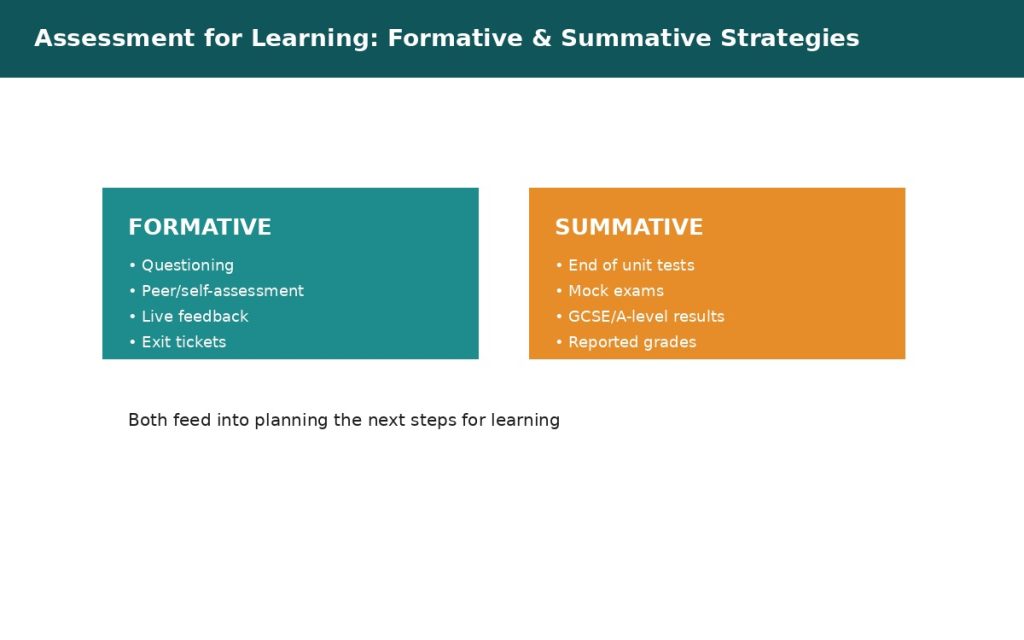
Formative assessment happens during the learning process and is used to adjust teaching and learning in real time. It is sometimes described using Wiliam’s phrase “assessment as learning,” because well-designed formative assessment doesn’t just measure learning — the act of engaging with it (e.g., through self-assessment or peer feedback) is itself part of the learning process.
Worked Example — Exit Tickets: At the end of a Year 10 science lesson on the reactivity series, a trainee hands out a small slip asking pupils to answer one question and note one thing they’re still unsure about. Reading these in five minutes that evening tells the trainee precisely which misconceptions to address at the start of the next lesson — a low-effort, high-impact formative tool that PGCE assignments frequently ask you to justify using specific evidence of impact.
Worked Example — Mini-Whiteboards: In a Year 5 maths lesson on fractions, the trainee asks a quick-fire question and every pupil holds up their whiteboard answer simultaneously. This gives instant, whole-class evidence of understanding (rather than relying on the two or three pupils who put their hands up), allowing the trainee to reteach a concept immediately if most whiteboards show a misconception — a much faster feedback loop than waiting to mark books.
2.2 Summative Assessment
Summative assessment happens after a period of learning, to evaluate what has been learned against a fixed standard, typically resulting in a grade, mark, or level. GCSE and A-level examinations are the clearest example, but end-of-unit tests and termly assessments also fall into this category.
Worked Example: A trainee’s Year 9 history department requires a standardised end-of-topic test on the causes of World War One, marked against a fixed markscheme, with results recorded centrally and reported to parents. This is summative: its primary purpose is to record and report attainment at a fixed point, not to shape the next lesson (although good departments do also use the results formatively, feeding common errors back into future teaching — showing that the formative/summative distinction is about purpose, not the assessment tool itself).
2.3 Why the Distinction Matters for Your Assignments
A common weakness in PGCE assignments is describing an assessment activity without being explicit about its purpose. Markers specifically look for you to identify why you chose a given strategy and what you did with the evidence it produced — simply stating “I used questioning” earns little credit; explaining that you used targeted, no-hands-up questioning to check understanding of a specific misconception before moving on, and then describing how you adapted your teaching in response, demonstrates genuine AfL practice in line with UK Teachers’ Standards and QTS, particularly Standard 6 (make accurate and productive use of assessment).
3. Effective Feedback: What the Research Says
3.1 The Feedback “Move Forward” Principle
Wiliam argues that feedback should always function to move the learner forward, not simply to judge past performance. Effective feedback answers three questions for the pupil: Where am I going? How am I doing? Where to next?
Worked Example — Effective vs. Ineffective Feedback: Writing “good effort, 6/10” on a piece of extended writing tells a pupil almost nothing actionable. By contrast, writing “you’ve used varied sentence openers well — now try embedding one piece of evidence with a clear explanation of its significance” gives the pupil a specific, achievable next step, directly addressing the “where to next?” question.
3.2 Feedback and Cognitive Load
Research on cognitive load theory (frequently referenced in PGCE assignments on feedback) suggests that overloading pupils with too many corrections at once reduces the impact of any single piece of feedback, since working memory is limited. A trainee marking a set of Year 7 books might therefore choose to focus feedback on just one or two specific, prioritised targets per pupil, rather than annotating every error — a deliberate pedagogical choice worth explicitly justifying in a written assignment.
3.3 Verbal vs. Written Feedback
Worked Example: In a Year 6 primary classroom, a trainee circulates during independent writing time, giving immediate verbal feedback (“try starting that sentence with a subordinate clause instead”) that pupils can act on within the same lesson — far more immediate and often more impactful than written feedback given after the lesson has ended, when the specific thinking behind the pupil’s original attempt has already faded. Many PGCE assignments on feedback benefit from comparing the relative strengths of verbal, in-the-moment feedback against delayed written feedback, rather than assuming written feedback is automatically superior simply because it creates a paper trail for evidence.
4. Peer and Self-Assessment
4.1 Structuring Peer Assessment Effectively
Peer assessment (Wiliam’s fourth key strategy) is often implemented poorly — simply asking pupils to “swap and mark” without clear success criteria tends to produce vague, unhelpful comments (“good,” “needs more detail”). Effective peer assessment requires explicit criteria and, often, sentence starters or structured prompts.
Worked Example: In a Year 9 geography lesson on evaluating flood management strategies, the trainee provides a simple checklist (Has the pupil named a strategy? Explained how it works? Evaluated its effectiveness with a specific example?) alongside two sentence starters (“One strength of your evaluation is… / To improve, try…”). This scaffolding produces substantially more useful peer feedback than an open-ended “swap and mark,” and demonstrates deliberate pedagogical design worth describing in an assignment.
4.2 Self-Assessment and Metacognition
Self-assessment develops pupils’ metacognitive awareness — their ability to reflect on and regulate their own learning, a skill increasingly emphasised in the Education Endowment Foundation’s guidance on metacognition and self-regulated learning, which many PGCE courses require trainees to reference.
Worked Example: A trainee uses “traffic-lighting,” asking pupils to mark their own confidence with a topic (green = confident, amber = partially confident, red = need more help) before starting an independent task. This not only informs the trainee’s grouping and support decisions for that lesson, but also builds pupils’ habit of honestly evaluating their own understanding — a skill connected to the kind of structured self-reflection covered in PGCE Reflective Practice: Using Gibbs’ Reflective Cycle Effectively, where trainees apply the same reflective habits to their own teaching practice.
5. Assessment and Differentiation
Assessment data should directly inform how you differentiate subsequent teaching — a connection that PGCE markers specifically look for, since differentiation without assessment evidence risks being generic rather than genuinely responsive to pupil need. This is covered in detail in Differentiation and Inclusive Teaching: Meeting SEND, EAL, and Diverse Learner Needs, but it’s worth noting here that formative assessment data (not just prior attainment or SEND status alone) should shape your in-lesson grouping and scaffolding decisions.
Worked Example: After a diagnostic quiz reveals that roughly a third of a Year 7 class have not secured the concept of place value, a trainee reorganises the next lesson’s seating and support plan specifically around this assessment evidence — rather than relying solely on a fixed, pre-set differentiation plan based on prior attainment data from September.
6. Common Assignment Pitfalls
Assessment also has a quieter but important link to classroom behaviour: pupils who are consistently unclear about what’s expected of them, or who are given tasks pitched well above or below their current level, are far more likely to disengage or act out. Well-calibrated formative assessment, feeding directly into appropriately pitched tasks, is one of the most effective preventative behaviour strategies available — a connection explored further in Behaviour Management for Trainee Teachers.
- Describing an assessment strategy without explaining its purpose (formative vs. summative) or what you actually did with the resulting evidence — always close the loop by describing your response to the data.
- Treating peer and self-assessment as simple time-fillers rather than structured, scaffolded activities requiring careful design.
- Overloading written feedback with too many corrections at once, without engaging with cognitive load research to justify a more targeted approach.
- Failing to link assessment practice explicitly to relevant Teachers’ Standards, particularly Standard 6, which markers expect to see referenced directly in assignments discussing assessment.
- Assuming summative assessment has no formative value — strong assignments note that summative data (e.g., end-of-unit test results) can and should still inform subsequent formative planning.
7. Applying These Concepts: A Sample Assignment Response
Question: “Evaluate the effectiveness of an assessment strategy you used on placement, with reference to relevant literature.”
Sample structured answer: Describe the specific strategy (e.g., exit tickets in a Year 8 lesson), explicitly identifying it as formative and linking it to Wiliam and Black’s five key strategies. Explain what evidence the strategy produced and how you used that evidence to adapt subsequent teaching (closing the assessment-feedback loop, per Section 6’s pitfall list). Evaluate strengths (quick, low-stakes, whole-class evidence) and limitations (relies on pupil honesty, brief responses may lack depth) with reference to relevant research (Wiliam, Black, or EEF guidance). Conclude by identifying one specific, evidence-based refinement you would make next time — showing the kind of forward-looking reflective evaluation that Gibbs’ cycle (see PGCE Reflective Practice) and most PGCE assignment rubrics both expect. If you are turning your placement evidence into a critical academic response, PGCE assignment support can help you structure your discussion, integrate educational research, and evaluate the effectiveness of your teaching practice.
Strong assessment practice underpins almost every other area of your PGCE portfolio, from the lesson planning decisions you make about pacing and task design, to the differentiation strategies you justify in written assignments, to the reflective evaluations you write after every observed lesson. Practice describing your assessment strategies with the specific formative/summative language and named research references covered in this guide — that precision is exactly what separates a merely descriptive assignment from an analytical one.
Frequently Asked Questions
What is the main difference between formative and summative assessment? Formative assessment happens during learning and is used to adjust teaching in real time. Summative assessment happens after a period of learning to record and report attainment against a fixed standard. The distinction is about purpose, not the specific tool used.
What are Dylan Wiliam’s five key AfL strategies? Clarifying learning intentions and success criteria; engineering effective questioning and discussion; giving feedback that moves learning forward; activating pupils as resources for one another (peer assessment); and activating pupils as owners of their own learning (self-assessment).
How should I write about assessment in a PGCE assignment? Always name the specific strategy you used, identify whether it is formative or summative, explain what evidence it produced, and describe exactly what you did with that evidence to adapt your teaching — this “closing the loop” is what distinguishes strong assignments from merely descriptive ones.
Why does feedback quality matter more than feedback quantity? Research on cognitive load suggests pupils cannot productively act on too many corrections at once. Feedback focused on one or two specific, actionable targets is generally more effective than exhaustive annotation of every error.
Which Teachers’ Standard is most relevant to assessment? Standard 6 (“make accurate and productive use of assessment”) is the most directly relevant, though assessment practice also supports Standard 4 (plan and teach well-structured lessons) and Standard 5 (adapt teaching to respond to strengths and needs of all pupils).