Differentiation is one of the most heavily assessed — and most frequently misunderstood — areas of PGCE practice. Trainees often default to producing three separate worksheets (“differentiation by outcome sheet”), which rarely reflects genuinely inclusive teaching or satisfies assignment markers looking for evidence-based practice. This guide explains what differentiation actually means in current UK educational practice, covers strategies for supporting pupils with SEND and English as an Additional Language (EAL), and shows how to write about inclusive teaching convincingly in assignments. This builds directly on the assessment principles covered in Assessment for Learning: Formative and Summative Strategies, since good differentiation depends on accurate, ongoing assessment of pupil need.
Table of Contents
Toggle1. Rethinking Differentiation: From “Three Worksheets” to Adaptive Teaching
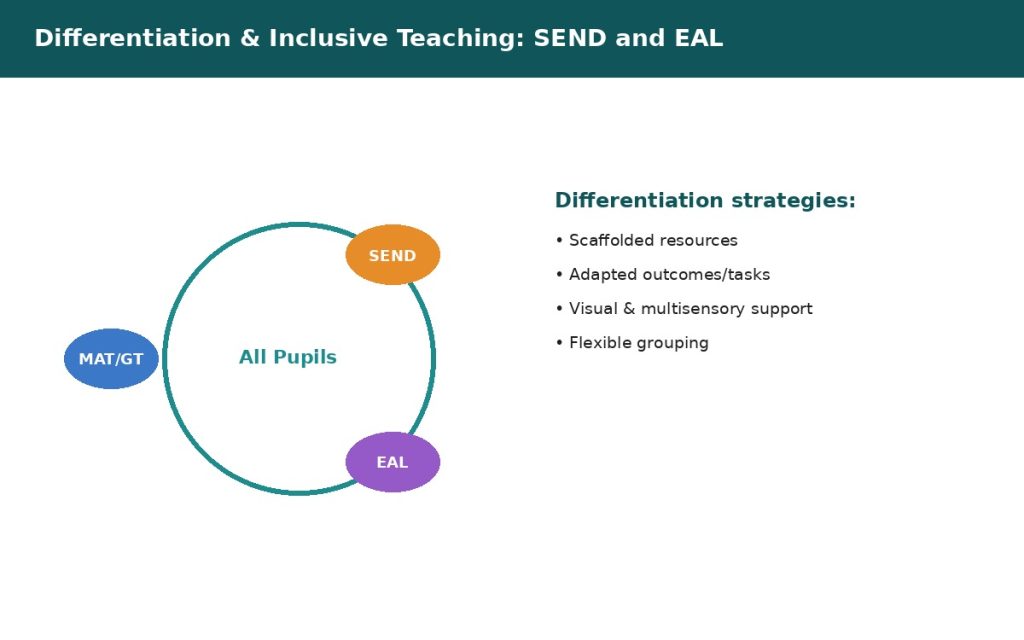
Ofsted’s 2019 Education Inspection Framework and subsequent guidance explicitly moved away from expecting differentiated worksheets as evidence of inclusive practice, favouring instead the language of “adaptive teaching” — responsive, in-the-moment adjustment of teaching based on assessment of need, rather than pre-planned, fixed task variations for different groups.
1.1 Why “Differentiation by Task” Can Backfire
Worked Example: A trainee planning a Year 8 English lesson creates three versions of a worksheet on analysing poetic imagery — a simplified version for the “lower” group, a standard version, and an extension version. In practice, this can inadvertently cap what lower-attaining pupils are exposed to (they never encounter the more challenging analysis at all) and can create a fixed, visible hierarchy within the classroom that undermines pupils’ sense of belonging and ambition — a criticism increasingly raised in PGCE literature on differentiation.
1.2 A More Effective Alternative: Same Task, Scaffolded Access
Worked Example: Instead of three separate worksheets, the same trainee sets a single, high-challenge task (analyse how the poet uses imagery to convey loss) for the whole class, but provides optional scaffolds available to any pupil who needs them: a glossary of key terms, a sentence-starter frame, and a worked example paragraph. Pupils who don’t need the scaffolds simply don’t use them, while pupils who do need support can still access the same core task and the same high expectations — this is the kind of “keep the challenge high, vary the support” approach that PGCE assignments on differentiation should describe and justify.
2. Understanding SEND: The Graduated Approach
2.1 The Four Broad Areas of Need
The SEND Code of Practice (2015) identifies four broad areas of need, useful for structuring assignment discussion of individual pupils:
- Communication and interaction (e.g., speech, language and communication needs, autism spectrum conditions).
- Cognition and learning (e.g., specific learning difficulties like dyslexia, moderate or severe learning difficulties).
- Social, emotional and mental health (e.g., anxiety, attachment difficulties, ADHD).
- Sensory and/or physical needs (e.g., visual or hearing impairment, physical disability).
2.2 The Graduated Approach: Assess, Plan, Do, Review
The Code of Practice sets out a cyclical “assess, plan, do, review” process that schools use to identify and respond to SEND, and PGCE assignments discussing individual pupils are often expected to reference this cycle explicitly.
Worked Example: A trainee notices a Year 4 pupil consistently struggling to decode multisyllabic words during guided reading (assess). In consultation with the SENCo, the trainee plans a specific intervention involving syllable-splitting strategies and targeted phonics practice. The trainee then delivers this support consistently over several weeks (do), before reviewing progress against the original assessment to decide whether the intervention should continue, be adjusted, or be stepped down — demonstrating the full cycle in a single, well-evidenced example, rather than describing SEND support as a vague, one-off adjustment.
2.3 Practical Classroom Strategies for Common SEND Needs
Worked Example — Dyslexia: Using a cream or pastel background rather than white on worksheets and slides (to reduce visual stress), a dyslexia-friendly font (like Arial or Comic Sans, which avoid easily-confused letter shapes), and chunking instructions into short, numbered steps rather than dense paragraphs of text.
Worked Example — Autism Spectrum Conditions: Providing a visual timetable so the pupil knows what to expect during the lesson, giving clear advance warning of any changes to routine, and using literal, unambiguous language rather than idiom or sarcasm, which can cause genuine confusion.
Worked Example — ADHD: Breaking a task into short, clearly signposted chunks with built-in movement breaks, using visual timers to make time limits concrete, and providing a clear, calm, consistently-applied structure rather than relying on the pupil’s self-regulation alone.
3. Supporting EAL Learners
3.1 Distinguishing Language Proficiency from Cognitive Ability
A crucial point PGCE assignments must get right: a pupil with English as an Additional Language may have age-appropriate or even advanced cognitive ability and subject knowledge in their first language, but limited English proficiency — these are entirely separate things, and treating limited English as equivalent to limited ability is a serious and common misconception.
3.2 BICS and CALP
Jim Cummins’ influential distinction between BICS (Basic Interpersonal Communicative Skills — everyday conversational fluency, typically developed within one to two years) and CALP (Cognitive Academic Language Proficiency — the more abstract, decontextualised academic language needed for subject learning, which can take five to seven years to fully develop) is frequently required reading on PGCE courses and directly explains a common classroom pattern.
Worked Example: A Year 9 pupil who arrived in the UK eighteen months ago converses fluently and confidently with peers in the playground (strong BICS) but struggles significantly with the abstract, subject-specific academic language required to write a structured history essay analysing causation (still-developing CALP). A trainee who assumes this pupil’s playground fluency means they need no further language support in written academic tasks is likely to under-support them — a mistake worth explicitly avoiding and discussing in an assignment.
3.3 Practical EAL Strategies
Worked Example: In a Year 7 science lesson introducing the topic of forces, the trainee pre-teaches key vocabulary (force, friction, resistance, gravity) with visual supports and translations where possible, provides sentence frames for the written task (“The force of ___ causes the object to ___”), and pairs the EAL pupil with a supportive peer for collaborative talk before independent writing — combining vocabulary instruction, structured language scaffolds, and oral rehearsal, three strategies commonly recommended in EAL-focused PGCE literature.
4. Differentiation for More Able Pupils
Inclusive teaching also means stretching more able pupils (sometimes referred to as “more able, talented” or MAT pupils), not just supporting those who are struggling — an area PGCE assignments sometimes neglect.
Worked Example: Rather than simply giving a more able Year 6 pupil “more of the same” (extra practice questions at the same difficulty level), a trainee provides a genuinely more demanding task requiring deeper reasoning — for instance, asking the pupil to construct and justify their own multi-step word problem for a peer to solve, rather than just completing additional standard calculations. This demonstrates genuine challenge through depth and complexity, rather than mere quantity, a distinction worth making explicit in a written assignment.
5. Universal Design for Learning (UDL)
Universal Design for Learning offers a framework for planning inclusively from the outset, rather than retrofitting adjustments after the fact. It proposes multiple means of engagement (why pupils learn), representation (how content is presented), and action/expression (how pupils demonstrate learning).
Worked Example: Planning a Year 10 geography lesson on climate change using UDL principles, a trainee offers content through a short video, a diagram, and a written text (multiple means of representation), allows pupils to demonstrate understanding through a written paragraph, an annotated diagram, or a short verbal explanation recorded on a tablet (multiple means of action/expression), and connects the topic to pupils’ own local environment to increase relevance and motivation (multiple means of engagement). Planning this way from the start, rather than adding SEND/EAL adjustments as an afterthought, is exactly the kind of proactive, inclusive design that strong PGCE assignments should describe.
6. Linking Differentiation to Assessment and the Teachers’ Standards
Effective differentiation depends on accurate, ongoing assessment of pupil need — the formative assessment strategies covered in Assessment for Learning are what should actually drive your differentiation decisions, rather than relying solely on a fixed SEND register or prior attainment data from the start of the year. This area of practice is most directly linked to Standard 5 of the UK Teachers’ Standards (“adapt teaching to respond to the strengths and needs of all pupils”), and assignments should reference this standard explicitly when discussing inclusive practice.
7. Common Assignment Pitfalls
Poorly matched challenge is also one of the most common root causes of disruptive behaviour — a task that is too hard produces frustration and avoidance, while a task that is too easy produces boredom and off-task behaviour. Recognising this link between differentiation and classroom behaviour is covered in more depth in Behaviour Management for Trainee Teachers.
- Describing differentiation only in terms of separate worksheets or tasks by “ability group,” without acknowledging current best practice around adaptive, scaffolded, same-task approaches.
- Conflating EAL learners’ language proficiency with their cognitive ability or general academic potential — always distinguish BICS from CALP explicitly.
- Discussing SEND support vaguely (“I gave extra help”) rather than referencing the specific graduated approach (assess, plan, do, review) and a specific, evidenced strategy.
- Forgetting to address more able pupils when discussing inclusive practice — strong assignments cover the full range of need, not just lower-attaining pupils.
- Failing to link differentiation explicitly to ongoing assessment evidence and to the relevant Teachers’ Standard.
8. Applying These Concepts: A Sample Assignment Response
Question: “Critically evaluate how you adapted your teaching to meet the needs of a specific pupil or group of pupils on placement.”
Sample structured answer: Identify the specific pupil(s) and need (e.g., an EAL pupil at an early stage of English acquisition, referencing the BICS/CALP distinction to explain the specific challenge). Describe the specific strategies used (vocabulary pre-teaching, sentence frames, peer talk) and explicitly connect them to relevant literature (Cummins, EAL-focused guidance). Reference the assessment evidence that informed your approach (e.g., initial written work revealing strong ideas but limited academic vocabulary), closing the loop between assessment and adaptation as covered in Assessment for Learning. Evaluate the impact using specific evidence (before/after writing samples, observed participation) and conclude with one refinement for next time, linking your discussion explicitly to Standard 5.
Inclusive, adaptive teaching should run through every part of your PGCE practice — from how you plan lessons with built-in scaffolds rather than bolted-on adjustments, to how you use assessment evidence to inform in-the-moment decisions, to how you reflect on the impact of your adaptations using Gibbs’ Reflective Cycle. Practice describing specific, named pupils (anonymised) and specific, evidenced strategies rather than generic statements — this concreteness is what distinguishes a strong differentiation assignment from a vague one.
If you need to develop your classroom observations and assessment evidence into a well-structured academic response, support for PGCE assignment writing can help you approach the task with stronger critical analysis and evidence-based evaluation.
Frequently Asked Questions
What is the difference between differentiation and adaptive teaching? “Differentiation” traditionally referred to planning separate tasks or resources for different ability groups in advance. “Adaptive teaching,” the term now favoured by Ofsted, emphasises responsive, in-the-moment adjustment based on assessment of need, often through scaffolding a single high-challenge task rather than creating multiple fixed versions of it.
What are the four broad areas of SEND need? Communication and interaction; cognition and learning; social, emotional and mental health; and sensory and/or physical needs, as set out in the SEND Code of Practice (2015).
What is the graduated approach in SEND support? A cyclical process of assess, plan, do, review — schools assess a pupil’s specific need, plan a targeted intervention, deliver it consistently, and then review its impact to decide whether to continue, adjust, or step down support.
What is the difference between BICS and CALP? BICS (Basic Interpersonal Communicative Skills) is everyday conversational fluency, typically developed within one to two years. CALP (Cognitive Academic Language Proficiency) is the more abstract academic language needed for subject learning, which can take five to seven years to develop fully — an EAL pupil can have strong BICS while still needing significant CALP support.
How should I write about differentiation in a PGCE assignment? Name the specific pupil or group and need, describe a specific, evidenced strategy (not a generic statement), link it to relevant research or frameworks (UDL, Cummins, the SEND Code of Practice), reference the assessment evidence that informed it, and connect your discussion explicitly to Teachers’ Standard 5.