Behaviour management is consistently rated by trainee teachers as one of the most anxiety-inducing aspects of placement, and it maps directly onto Teachers’ Standard 7 (“manage behaviour effectively to ensure a good and safe learning environment”). What makes it especially difficult to learn from generic advice is that effective behaviour management is rarely about individual dramatic interventions — it’s overwhelmingly about consistent, low-key routines and preventative structure, most of which is invisible to an untrained observer precisely because it prevents problems before they become visible incidents.
Table of Contents
ToggleReframing Behaviour Management: Prevention Before Reaction
The single most important conceptual shift for trainees is moving away from thinking about behaviour management as “what do I do when a pupil misbehaves” and toward “what structures prevent misbehaviour from arising in the first place.” Experienced teachers spend the overwhelming majority of their behaviour management effort on the second category — trainees, understandably, often fixate on the first, since reactive incidents are what feel most urgent and visible in the moment.
Establishing Routines: The Foundation
Routines reduce the number of moments where pupils have to make an independent behavioural choice, which reduces the opportunities for things to go wrong. Strong routines are explicit, taught deliberately (not assumed), and consistently reinforced.
Worked example — lesson entry routine: Rather than allowing pupils to enter chaotically and settle in their own time, a trainee establishes an explicit entry routine: pupils enter silently, collect an exercise book from a designated tray, and begin a “do now” starter task displayed on the board within 60 seconds of entering. This routine is explicitly taught and practiced in the first lesson of term (not merely announced once), with the teacher deliberately reinforcing it consistently for the first several weeks until it becomes automatic.
The behavioural payoff isn’t visible in any single lesson — it’s visible in the cumulative reduction of low-level disruption during the highest-risk transition point of the lesson (entry), which is exactly the kind of preventative structure that’s easy to underestimate as a trainee focused on more dramatic classroom moments.
The Escalation Ladder: Responding Proportionately
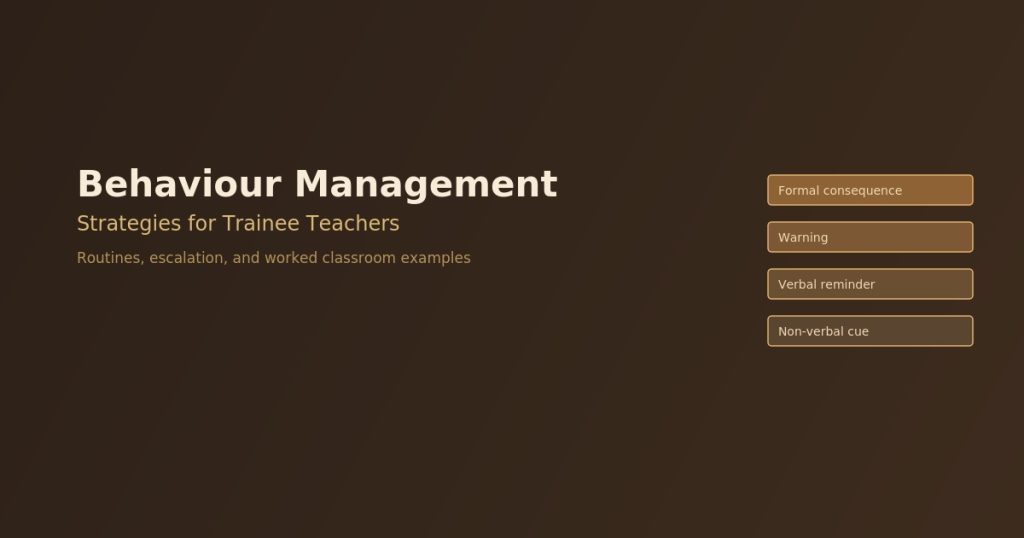
Most school behaviour policies are built around a graduated response — often called an escalation or consequence ladder — where responses to low-level disruption increase in a predictable, proportionate sequence rather than jumping straight to a severe consequence.
A typical structure (specifics vary by school policy):
- Non-verbal cue — eye contact, proximity, a gesture — the least disruptive possible intervention
- Verbal reminder — a quiet, private reminder of the expected behaviour, ideally not announced to the whole class
- Warning — an explicit, recorded warning that the behaviour needs to change
- Formal consequence — following the specific school policy (e.g., a logged incident, break-time reflection, parental contact)
Worked example: During independent work, a pupil begins talking to a neighbour. Rather than immediately issuing a verbal warning to the whole class (which draws attention and can escalate unnecessarily), the trainee first uses proximity — walking toward the pupil while continuing to circulate — which resolves the issue without any verbal intervention at all. Only if the behaviour continues does the trainee move to a quiet, private verbal reminder, addressed directly and briefly rather than as a public announcement.
The key pedagogical principle here is starting at the lowest effective level of intervention — over-escalating minor behaviour (jumping straight to a formal consequence for low-level talking) tends to damage the teacher-pupil relationship disproportionately to the offense, and can actually increase resistance and disruption rather than resolving it.
Positive Reinforcement: Often Underused by Trainees
Trainees frequently under-use positive reinforcement relative to correction, partly because correcting visible disruption feels more urgent than acknowledging pupils who are behaving as expected. Research on classroom management consistently suggests that a high ratio of positive-to-corrective interactions (some frameworks suggest as high as 4:1 or 5:1) supports a more effective learning climate than a correction-heavy approach.
Worked example: Rather than only addressing the two pupils off-task in the corner, a trainee deliberately narrates specific positive behaviour aloud: “I can see Row 2 has already started the starter task and is working silently — that’s exactly what I’m looking for.” This does two things simultaneously: it reinforces the desired behaviour publicly (increasing the likelihood other pupils replicate it) and indirectly signals the expectation to the off-task pupils without singling them out negatively in front of the class.
Clarity of Expectations: Stating, Not Assuming
A frequent trainee error is assuming pupils already know an expectation because it seems obvious, rather than stating it explicitly. Explicit expectations, stated before an activity begins (not after problems arise), significantly reduce ambiguity-driven misbehaviour.
Worked example — poor practice: “Okay, get into groups and discuss the question.” (No stated expectation for noise level, roles, or time limit — ambiguity that different pupils will interpret differently, some pushing boundaries more than others.)
Worked example — stronger practice: “You have 4 minutes. Stay at a level 2 voice — that means your partner can hear you, but the pair next to you shouldn’t be able to. One person per group will feed back afterward, so decide now who that will be.” This removes ambiguity about noise level, time, and expected outcome before any pupil has the opportunity to test the boundaries of an unstated expectation.
Managing a Specific Disruption: A Fuller Worked Scenario
A trainee is mid-explanation when a pupil calls out an unrelated, off-topic comment, prompting a few laughs from nearby pupils.
Weaker response: Stopping the lesson entirely to address the comment directly and at length, which inadvertently rewards the behaviour with significant attention and disrupts the flow of the explanation for the rest of the class.
Stronger response: The trainee briefly, calmly states “Not now, thank you” without breaking eye contact with the rest of the class or significantly pausing the explanation, then continues teaching. If the behaviour repeats, it’s addressed privately and briefly at a natural pause point (e.g., during independent work), rather than in an extended public exchange that gives the behaviour more classroom airtime and audience than it warrants.
This illustrates a broader principle: minimizing the “payoff” of attention-seeking behaviour while still addressing it, rather than either ignoring it entirely (which can be read as tacit permission) or over-responding (which inadvertently rewards it with disproportionate attention).
The Role of Relationships in Behaviour Management
While routines and consistent consequences form the structural backbone, the relational dimension matters substantially too — pupils are generally more responsive to behavioural expectations from a teacher they perceive as fair, consistent, and genuinely invested in their learning. This isn’t a substitute for clear structure and consequences, but it does explain why identical policies can produce different results depending on the relationship context they’re delivered within.
Practical implication for trainees: investing early in learning pupils’ names, showing genuine interest in non-academic aspects of their lives where appropriate, and following through consistently on both positive acknowledgment and stated consequences (rather than making empty threats that aren’t followed up) all contribute meaningfully to behaviour management effectiveness, even though none of these are “behaviour management techniques” in the narrow sense.
If you’re working on PGCE coursework involving behaviour management, classroom practice, lesson planning, or the Teachers’ Standards, our PGCE Assignment Help service provides guidance with educational theory, critical analysis, reflective writing, and teacher-training assignments.
Common Trainee Mistakes
- Over-escalating minor behaviour — jumping to a formal consequence for low-level disruption rather than starting with the least intrusive effective intervention
- Making empty threats — stating a consequence and then failing to follow through undermines the credibility of all future warnings, since pupils quickly learn which threats are genuine
- Public confrontation over private correction — addressing minor behaviour issues in front of the whole class, which can escalate the situation and create an audience effect, rather than addressing it quietly and individually where possible
- Assuming routines are self-evident — not explicitly teaching and reinforcing routines early, then being surprised when they aren’t followed consistently later
- Neglecting positive reinforcement — focusing disproportionately on correcting negative behaviour while under-acknowledging the majority of pupils behaving as expected
Frequently Asked Questions
Should behaviour management strategies be included explicitly in a lesson plan? Yes — PGCE lesson plans commonly expect an explicit note on anticipated behaviour management needs for that specific lesson and class, not just a generic statement, since this demonstrates the kind of proactive planning assessed under Teachers’ Standard 7.
What should a trainee do if a school’s specific behaviour policy differs from general best-practice advice? Follow the specific school policy — consistency with the whole-school approach matters significantly for behaviour management to work, and trainees are generally expected to operate within their placement school’s established systems rather than substituting personal preferences.
How long does it typically take for classroom routines to become automatic? This varies significantly by class and context, but consistent reinforcement over several weeks (rather than a single explanation) is generally necessary before a routine becomes genuinely automatic rather than requiring active reminder.
Is proximity really an effective behaviour management tool? Yes — simply moving physically closer to a pupil while continuing to teach is one of the lowest-disruption, most effective early-stage interventions available, since it addresses the behaviour without drawing classwide attention to it or interrupting the lesson’s flow.