
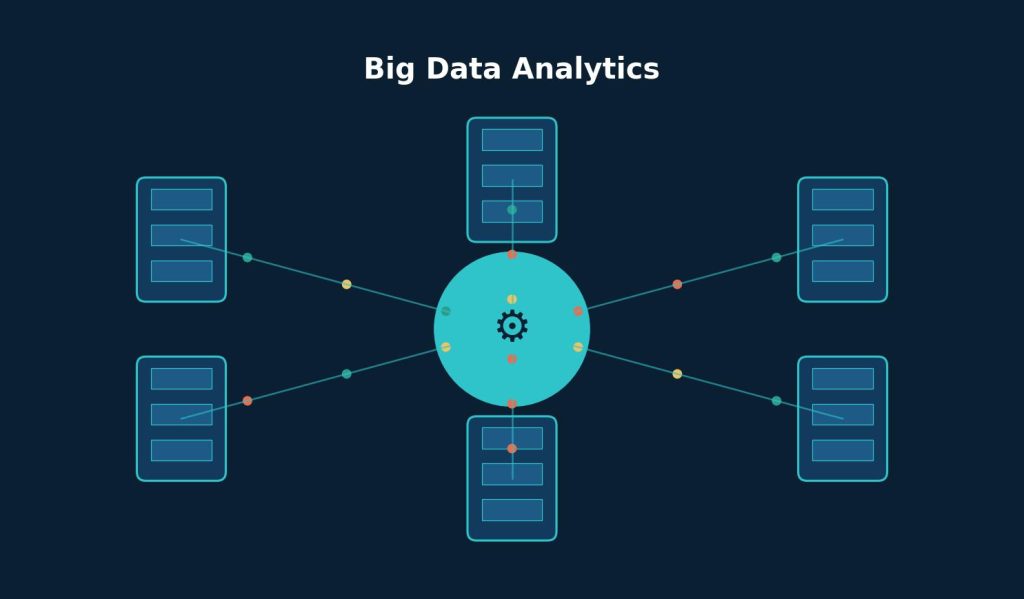
Every minute, users generate an enormous volume of data: social media posts, credit card swipes, GPS pings from delivery trucks, sensor readings from factory equipment. Traditional tools like Excel or even a single-server SQL database simply cannot process data at this scale. Big data analytics refers to the techniques, tools, and infrastructure designed specifically to analyze datasets too large, too fast-moving, or too unstructured for conventional analytics tools to handle.
This article covers the defining characteristics of big data, the two most important big data processing frameworks (Hadoop and Spark), and real-world use cases relevant to data analytics students.
Table of Contents
ToggleDefining Big Data: The 5 V’s
Big data is typically defined not by a specific size threshold, but by characteristics that break traditional analytics tools. The most widely taught framework is the “5 V’s”:
- Volume — The sheer scale of data, often measured in terabytes or petabytes. A single day of transaction logs at a large e-commerce company can exceed what a traditional database server can efficiently query.
- Velocity — The speed at which data is generated and must be processed. Stock trading systems, for example, generate and must analyze data in milliseconds.
- Variety — The mix of structured (tables), semi-structured (JSON, XML), and unstructured (text, images, video) data types, often combined in a single analysis.
- Veracity — The trustworthiness and quality of data, which becomes harder to guarantee as volume and variety increase (e.g., sensor data with occasional faulty readings).
- Value — The ultimate business or research value that can be extracted — a reminder that collecting big data is only useful if it produces actionable insight.
Worked example: A ride-sharing company generates GPS location pings (high velocity) from millions of drivers and riders (high volume), combined with unstructured customer support chat logs and structured trip/payment records (high variety). Some GPS readings are inaccurate due to signal loss in urban canyons (a veracity challenge). The company’s ability to use this data to reduce rider wait times by even a few seconds represents significant value at scale.
Why Traditional Tools Break Down at Big Data Scale
A single computer running Excel or a traditional relational database has a hard ceiling: it can only use the memory (RAM) and processing power of one machine. When a dataset exceeds several hundred gigabytes or requires complex computation across billions of rows, a single machine becomes too slow or runs out of memory entirely.
The solution is distributed computing — spreading both the data storage and the computation across many machines (a “cluster”) working in parallel. This is the foundational idea behind the two most important big data frameworks: Hadoop and Spark.
Apache Hadoop
Hadoop, one of the earliest and most influential big data frameworks, is built around two core components:
- HDFS (Hadoop Distributed File System) — splits large files into blocks and distributes them across many machines in a cluster, with built-in redundancy (each block is typically stored on 3 machines) to protect against hardware failure.
- MapReduce — a programming model for processing data in two phases: “Map” (splitting a large task into smaller sub-tasks distributed across the cluster) and “Reduce” (combining the results back into a final output).
Worked example: A company wants to count how many times each word appears across 10 million customer reviews stored across a Hadoop cluster. The “Map” phase has each machine in the cluster count words in its local portion of the data simultaneously. The “Reduce” phase then combines these partial counts from every machine into one final, accurate word count — a task that would take a single machine days, but a Hadoop cluster of 50 machines can complete in minutes by working in parallel.
Limitation: MapReduce writes intermediate results to disk between steps, which makes it reliable but relatively slow for iterative tasks (like machine learning algorithms that repeat calculations many times over the same data) — a limitation that led to the development of Apache Spark.
Apache Spark
Apache Spark was developed specifically to address MapReduce’s speed limitations. Its key innovation is processing data primarily in-memory (RAM) rather than constantly writing intermediate results to disk, making it dramatically faster for many workloads — commonly cited as 10 to 100 times faster than equivalent MapReduce jobs, particularly for iterative algorithms.
Spark also offers a broader, more flexible set of tools beyond basic MapReduce-style processing:
- Spark SQL — allows querying big data using familiar SQL syntax (if you’re new to SQL, start with SQL Programming Approaches | Learn Database Queries & Management)
- MLlib — a built-in machine learning library for distributed model training
- Spark Streaming — processes real-time data streams (e.g., live sensor feeds or clickstream data)
- GraphX — for graph-based analysis (e.g., social network analysis)
Worked example: A streaming platform wants to retrain its recommendation model daily using the last 30 days of viewing history across 200 million users — an iterative machine learning workload that would be prohibitively slow using disk-based MapReduce. Using Spark’s MLlib and in-memory processing, the same retraining job that might take many hours (or fail to complete at all) with MapReduce can be completed in a fraction of the time, allowing the platform to update recommendations more frequently. This kind of large-scale model training builds on the fundamentals covered in Introduction to Machine Learning for Data Analysts: Key Concepts and Algorithms.
Hadoop vs. Spark: Key Differences
| Feature | Hadoop (MapReduce) | Apache Spark |
|---|---|---|
| Processing | Disk-based | In-memory (much faster) |
| Best for | Large batch jobs where speed is less critical | Iterative jobs, real-time processing, machine learning |
| Ease of use | Lower-level, more code required | Higher-level APIs (Python, SQL, Scala) |
| Fault tolerance | Very high (built into HDFS) | High (uses lineage-based recovery) |
In practice, many organizations use both together: HDFS (or a cloud equivalent like Amazon S3) for durable, distributed storage, with Spark running on top for fast processing.
Cloud-Based Big Data Platforms
Increasingly, organizations use managed cloud services rather than maintaining their own Hadoop/Spark clusters, including:
- Amazon EMR (Elastic MapReduce) — managed Hadoop/Spark clusters on AWS
- Google BigQuery — a serverless, highly scalable data warehouse queryable via SQL
- Databricks — a managed platform built around Apache Spark, popular for combining data engineering and machine learning workflows
- Snowflake — a cloud data warehouse increasingly used for big data analytics with a SQL-first interface
These platforms reduce the need for organizations to manage physical infrastructure, letting analysts and data engineers focus on the analysis itself.
Real-World Big Data Analytics Use Cases
| Industry | Use Case |
|---|---|
| E-commerce | Real-time personalized product recommendations based on browsing behavior |
| Finance | Detecting fraudulent transactions across millions of daily transactions in real time |
| Healthcare | Analyzing genomic data (which can reach terabytes per patient) for personalized medicine |
| Transportation | Processing millions of GPS and sensor readings for route optimization |
| Social Media | Analyzing billions of posts for sentiment trends and content moderation |
| Manufacturing | Processing continuous sensor data (IoT) from factory equipment for predictive maintenance |
Worked example (fraud detection): A credit card company processes over 5,000 transactions per second globally. Using Spark Streaming, the company evaluates each transaction against a machine learning fraud model in near real time — comparing the transaction against a customer’s typical spending pattern, location, and recent activity — flagging suspicious transactions within milliseconds, before the payment is even fully authorized.
Should Data Analytics Students Learn Big Data Tools?
For students focused primarily on business analytics using SQL, Excel, and BI tools, deep Hadoop/Spark expertise may not be a day-one requirement. However, understanding the core concepts — distributed computing, the 5 V’s, and when traditional tools break down — is valuable foundational knowledge, especially as more organizations generate data at a scale where these tools become necessary. Students pursuing data engineering or advanced data science tracks typically go on to gain hands-on experience with Spark (often via PySpark, its Python interface) as a core skill — see Data Analytics Career Paths: Skills, Certifications, and Job Roles Explained for how these specializations map to job titles.
Students working on big data analytics assignments and coursework may also need to apply concepts such as distributed computing, Hadoop, Spark, PySpark, data processing, and large-scale analytics to practical problems. For additional academic guidance, see our Data Analytics Assignment Help guide.
FAQs
Q1: What is considered “big data,” in terms of actual size? There’s no fixed threshold — big data is better defined by the 5 V’s (volume, velocity, variety, veracity, value) than a specific number. In practice, data that exceeds the memory and processing capacity of a single machine, requiring distributed computing, is generally considered “big data.”
Q2: Is Spark simply a replacement for Hadoop? Not exactly. Spark is often used as a faster processing engine that can run on top of Hadoop’s storage system (HDFS) or independently on other storage systems (like cloud storage). Many organizations use Spark for processing while still relying on HDFS or a cloud equivalent for storage.
Q3: Do I need to learn Java to use Hadoop or Spark? Not necessarily. While Hadoop and Spark were originally built in Java and Scala, Spark offers a well-supported Python interface (PySpark) that’s commonly taught in data analytics and data science courses, allowing students to use familiar Python syntax for distributed computing.
Q4: What is the difference between a data warehouse and a big data platform like Hadoop? A traditional data warehouse is optimized for structured, relational data and complex SQL queries at a moderate scale, while big data platforms like Hadoop and Spark are designed to handle much larger volumes of data, including unstructured and semi-structured formats, across distributed clusters. Modern cloud data warehouses (like BigQuery and Snowflake) increasingly blur this distinction by scaling to big-data-level volumes while retaining a SQL-first interface.
Q5: Why is in-memory processing in Spark so much faster than Hadoop’s MapReduce? MapReduce writes intermediate results to disk between processing steps, and disk read/write operations are significantly slower than reading and writing to RAM. Spark keeps intermediate data in memory whenever possible, avoiding this repeated disk I/O, which is especially beneficial for iterative workloads like machine learning training.
Q6: What skills should I learn first before tackling Hadoop or Spark? Strong SQL skills, a solid understanding of Python (especially pandas), and familiarity with core data analytics concepts (data cleaning, aggregation, joins) provide the necessary foundation, since big data tools largely extend these same concepts to a distributed environment rather than replacing them.