Coordination chemistry applies concepts from atomic structure and chemical bonding to transition metal complexes, where a central metal ion is surrounded by electron-pair-donating ligands. This guide covers nomenclature, isomerism, and crystal field theory — the three pillars of most university coordination chemistry assignments — with detailed worked examples.
Table of Contents
Toggle1. Basic Terminology
- Coordination compound: a compound containing a central metal atom/ion bonded to surrounding molecules or ions called ligands.
- Ligand: a Lewis base (electron-pair donor) that bonds to the metal (a Lewis acid, electron-pair acceptor) — directly connecting to the Lewis acid-base definition introduced in acid-base chemistry.
- Coordination number: the number of donor atoms directly bonded to the central metal (commonly 4 or 6, though 2, 5, 7, and 8 also occur).
- Denticity: the number of donor atoms a single ligand uses to bind the metal. Monodentate ligands (e.g., NH₃, Cl⁻, H₂O) bind through one atom; bidentate ligands (e.g., ethylenediamine, “en”) bind through two; polydentate ligands like EDTA can bind through six donor atoms.
- Chelate effect: polydentate ligands form unusually stable complexes due to a favorable entropy change (fewer total particles are released/consumed compared to multiple monodentate ligands binding and leaving).
2. Common Ligands and Their Donor Atoms
| Ligand | Formula | Donor Atom(s) | Denticity |
|---|---|---|---|
| Ammine | NH₃ | N | Monodentate |
| Aqua | H₂O | O | Monodentate |
| Chloro | Cl⁻ | Cl | Monodentate |
| Cyano | CN⁻ | C | Monodentate |
| Hydroxo | OH⁻ | O | Monodentate |
| Ethylenediamine (en) | H₂NCH₂CH₂NH₂ | 2 × N | Bidentate |
| Oxalato (ox) | C₂O₄²⁻ | 2 × O | Bidentate |
| EDTA | — | 4 × O, 2 × N | Hexadentate |
3. Naming Coordination Compounds
The rules for IUPAC nomenclature of coordination compounds:
- Name the cation before the anion (as in ordinary ionic compounds).
- Within the complex ion, name ligands alphabetically before the metal (ignore multiplying prefixes when alphabetizing).
- Use prefixes di-, tri-, tetra- for simple ligands; use bis-, tris-, tetrakis- for ligands whose names already contain a prefix (like ethylenediamine) or are polysyllabic, to avoid ambiguity.
- Anionic ligands end in “-o” (chloro, cyano, oxalato); neutral ligands generally keep their name (ammine for NH₃, aqua for H₂O, carbonyl for CO).
- If the overall complex ion is an anion, the metal name ends in “-ate” (e.g., ferrate, cuprate); for cationic or neutral complexes, the ordinary metal name is used.
- The oxidation state of the metal is given in Roman numerals in parentheses immediately after the metal name.
Worked Example — Name [Co(NH₃)₄Cl₂]Cl:
First determine the metal’s oxidation state: overall compound is neutral, outer Cl⁻ contributes −1, inner ligands: 4×NH₃ (neutral) + 2×Cl⁻ (−2 total) + Co(x) = +1 (charge of the complex cation, to balance the outer Cl⁻) x − 2 = +1 → x = +3
Name: tetraamminedichlorocobalt(III) chloride
Worked Example — Name K₄[Fe(CN)₆]:
The complex ion is an anion: [Fe(CN)₆]⁴⁻. Fe oxidation state: x + 6(−1) = −4 → x = +2
Name: potassium hexacyanoferrate(II)
Worked Example — Write the formula for tetraaquadichlorochromium(III) chloride:
Complex cation: [Cr(H₂O)₄Cl₂]⁺ (Cr³⁺, 4 neutral water, 2 Cl⁻: +3 + 0 − 2 = +1) Formula: [Cr(H₂O)₄Cl₂]Cl
4. Isomerism in Coordination Compounds
4.1 Structural (Constitutional) Isomerism
- Ionization isomers: differ in which ion is inside vs. outside the coordination sphere. Example: [Co(NH₃)₅Br]SO₄ vs. [Co(NH₃)₅SO₄]Br — these give different ions in solution (test with BaCl₂ for sulfate, or AgNO₃ for bromide).
- Linkage isomers: a ligand that can bind through two different donor atoms. Example: the nitrite ion, NO₂⁻, can bind through N (nitro) or O (nitrito).
- Coordination isomers: occur in compounds with both a complex cation and complex anion, where ligand distribution between the two metal centers differs.
4.2 Stereoisomerism
- Geometric (cis-trans) isomerism: most common in square planar and octahedral complexes with two or more types of ligands.
Worked Example: For square planar [Pt(NH₃)₂Cl₂], cis-isomer has the two Cl (or NH₃) ligands adjacent (90° apart); trans-isomer has them opposite (180° apart). This distinction is clinically important: cisplatin (the cis isomer) is an effective anticancer drug, while the trans isomer is not.
- Optical isomerism: occurs when a complex is chiral (non-superimposable on its mirror image), common in octahedral complexes with three bidentate ligands, e.g., [Co(en)₃]³⁺, which exists as non-superimposable Δ and Λ enantiomers.
5. Crystal Field Theory (CFT)
Crystal field theory explains the electronic structure, color, and magnetism of transition metal complexes by considering how the five d orbitals are affected by the electrostatic field of approaching ligands.
5.1 Octahedral Splitting
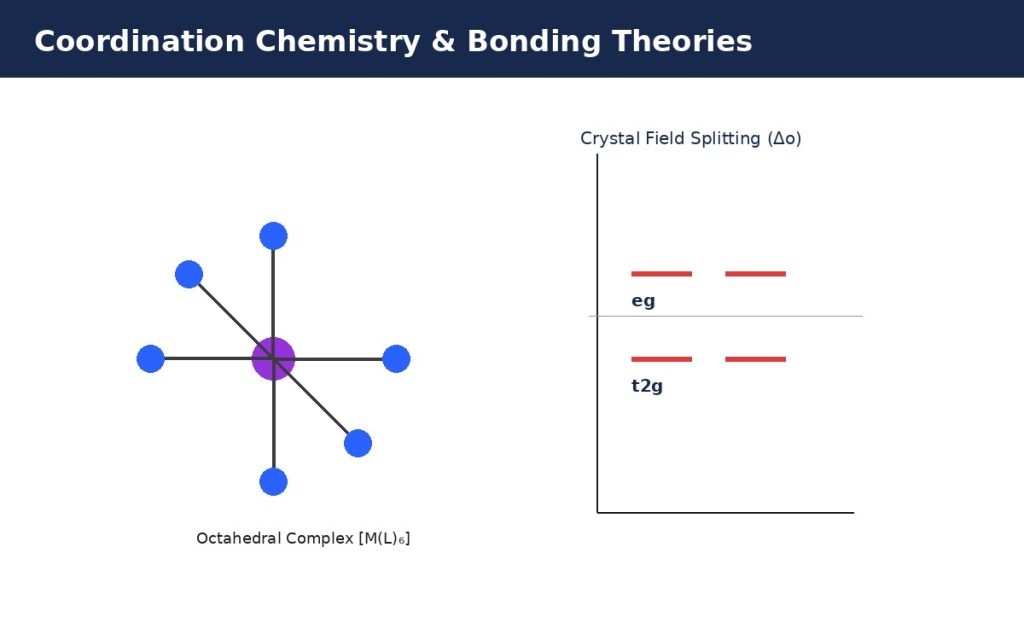
In an octahedral field, the five degenerate d orbitals split into two sets:
- t2g set (d_xy, d_xz, d_yz): lower in energy, point between the ligand axes, experiencing less repulsion.
- eg set (d_z², d_x²−y²): higher in energy, point directly at the incoming ligands, experiencing more repulsion.
The energy gap between these sets is called Δo (or 10Dq), the crystal field splitting energy.
5.2 High-Spin vs. Low-Spin Complexes
For d⁴ through d⁷ configurations, electrons can fill orbitals in two possible ways:
- High-spin: electrons fill all five orbitals singly (following Hund’s rule, as in atomic structure) before pairing, favored by weak-field ligands (small Δo).
- Low-spin: electrons pair up in the lower t2g set before occupying the higher eg set, favored by strong-field ligands (large Δo).
This depends on the balance between Δo (energy cost of promoting an electron to eg) and the pairing energy, P (energy cost of pairing two electrons in the same orbital): if Δo > P, low-spin is favored; if Δo < P, high-spin is favored.
5.3 The Spectrochemical Series
Ligands are ranked by their ability to split d orbitals (field strength), from weak to strong:
I⁻ < Br⁻ < Cl⁻ < F⁻ < H₂O < NH₃ < en < CN⁻ ≈ CO
Worked Example: Determine whether [Fe(H₂O)₆]³⁺ (d⁵, weak field H₂O) is high-spin or low-spin, and count unpaired electrons.
Since H₂O is a weak-field ligand, the complex is high-spin. For d⁵ high-spin: t2g³ eg² (each of the five orbitals singly occupied) → 5 unpaired electrons, making this complex strongly paramagnetic.
Worked Example: Determine the same for [Fe(CN)₆]³⁻ (d⁵, strong field CN⁻).
CN⁻ is a strong-field ligand, so the complex is low-spin: t2g⁵ eg⁰ (electrons pair up in the lower set before occupying eg) → 1 unpaired electron.
5.4 Color and the Origin of d-d Transitions
Complexes are colored because electrons absorb visible light to jump from t2g to eg orbitals (a d-d transition), and the color observed is complementary to the wavelength absorbed. Larger Δo (from stronger-field ligands or higher oxidation states) shifts absorption to higher energy (shorter wavelength), changing the observed color.
Worked Example: [Ti(H₂O)₆]³⁺ absorbs in the yellow-green region (~500 nm) and appears violet/purple to the eye — the complementary color to what is absorbed, a direct visual consequence of Δo matching the energy of visible light for this particular d¹ complex.
5.5 Tetrahedral Splitting
In a tetrahedral field, the splitting pattern inverts compared to octahedral: the e set (2 orbitals) is lower in energy, and the t2 set (3 orbitals) is higher. The splitting energy, Δt, is smaller than Δo (roughly Δt ≈ 4/9 Δo for the same metal/ligand), because tetrahedral complexes have fewer ligands and none point directly at the orbitals. As a result, tetrahedral complexes are almost always high-spin, since Δt is rarely large enough to exceed the pairing energy.
6. Magnetic Properties
- Paramagnetic: contains unpaired electrons; attracted into a magnetic field.
- Diamagnetic: all electrons paired; weakly repelled by a magnetic field.
Worked Example: Is [Ni(NH₃)₆]²⁺ (d⁸, octahedral) paramagnetic or diamagnetic?
For d⁸ in an octahedral field, regardless of field strength, the configuration is always t2g⁶ eg² (only one arrangement is possible for d⁸: eg must hold 2 electrons in 2 orbitals, which by Hund’s rule are unpaired) → 2 unpaired electrons, paramagnetic. This is a useful shortcut: d⁸ octahedral complexes are always paramagnetic with 2 unpaired electrons, regardless of ligand field strength — only d⁴–d⁷ configurations show high-spin/low-spin variability.
7. Common Assignment Pitfalls
Students who need additional support with university-level coordination chemistry coursework can explore Chemistry Assignment Help for further academic assistance.
- Forgetting to alphabetize ligands correctly when multiple prefixes are involved (ignore “di-,” “tri-,” etc. when alphabetizing, but not “bis-,” “tris-,” which are treated the same way — alphabetize by the ligand name itself).
- Confusing which set (t2g or eg) is higher in energy for octahedral vs. tetrahedral fields — they are inverted relative to each other.
- Forgetting that only d⁴–d⁷ configurations show a high-spin/low-spin distinction; d¹–d³ and d⁸–d¹⁰ have only one possible arrangement.
- Mixing up oxidation state (a bookkeeping charge) with actual physical charge, especially for complexes with unusual ligand charges.
8. Full Worked Problem
Question: For [CoCl₄]²⁻ (tetrahedral, Co²⁺, d⁷), determine the spin state, number of unpaired electrons, and magnetic behavior.
Solution: Tetrahedral complexes are almost always high-spin because Δt is small. For d⁷ in a tetrahedral high-spin arrangement: e⁴ t2³ (the lower e set fills to 4 electrons — 2 pairs — while the upper t2 set holds 3 electrons, one in each orbital).
Unpaired electrons: e set has 0 unpaired (fully paired, 2+2), t2 set has 3 unpaired (one per orbital) → 3 unpaired electrons total, and the complex is paramagnetic.
Coordination chemistry draws together ideas from atomic structure (d-orbital shapes and electron configuration), chemical bonding (geometry and hybridization), and acid-base theory (Lewis acid-base interactions between metal and ligand). Practice naming compounds and predicting high-spin/low-spin configurations across the full d¹–d¹⁰ range — this is the most reliable way to build fluency for exams.