Table of Contents
ToggleIntroduction
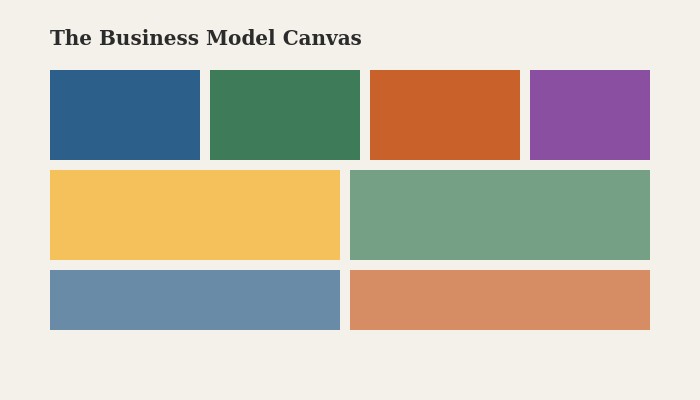
If you’re an MBA student working on a venture project, a consulting case, or a capstone business plan, you’ve almost certainly encountered — or will soon encounter — the Business Model Canvas (BMC). Developed by Alexander Osterwalder and popularized in the 2010 book Business Model Generation, the BMC has become one of the most widely used frameworks in entrepreneurship education for a simple reason: it forces you to think through an entire business model on a single page, making gaps and inconsistencies in your logic immediately visible in a way a traditional 40-page business plan often doesn’t. This guide walks through all nine building blocks, a fully worked example, and the mistakes instructors most commonly flag in student submissions.
Why the Canvas Matters for Coursework (Not Just Startups)
Beyond its use by actual founders, the BMC is heavily used in MBA coursework because it teaches a specific, transferable skill: seeing a business as an interconnected system rather than a list of separate functions. A change in one block (say, switching from a direct sales channel to a marketplace) has ripple effects across nearly every other block — cost structure, customer relationships, key partners. Instructors frequently use the canvas specifically to test whether students understand these interdependencies, not just whether they can fill in nine boxes.
The Nine Building Blocks
1. Customer Segments
Defines the specific groups of people or organizations the business aims to serve. A common student mistake is writing an overly broad segment (“everyone who likes coffee”) rather than a specific, addressable segment.
Example: Rather than “students,” a well-defined segment might be “commuter students at large urban universities who don’t have easy access to campus dining between classes.”
2. Value Propositions
Describes the specific bundle of products and services that creates value for each customer segment — what problem is being solved, or what need is being satisfied.
Example: For the commuter student segment above, the value proposition might be: “Pre-ordered, ready-in-90-seconds meals available at high-traffic transit points near campus, eliminating the trade-off between eating and making it to class on time.”
3. Channels
Describes how the business reaches and delivers its value proposition to customers — including awareness, purchase, delivery, and after-sales channels.
Example: A campus food delivery startup might use a mobile app (purchase channel), physical pickup kiosks (delivery channel), and student organization partnerships (awareness channel).
4. Customer Relationships
Describes the type of relationship established with each customer segment — ranging from personal assistance to fully automated self-service.
Example: A B2B SaaS startup targeting enterprise clients might require dedicated account management (personal relationship), while a consumer mobile app might rely entirely on automated onboarding and self-service support.
5. Revenue Streams
Describes how the business generates income from each customer segment, and the pricing mechanism used.
| Revenue Model | Description | Example |
|---|---|---|
| Transaction-based | One-time payment per unit or use | E-commerce product sale |
| Subscription | Recurring payment for ongoing access | SaaS monthly subscription |
| Usage-based | Payment scaled to consumption | Cloud computing charged per gigabyte |
| Licensing | Payment for rights to use intellectual property | Software licensing to enterprise clients |
| Freemium | Free basic tier, paid premium tier | Many mobile apps and productivity tools |
6. Key Resources
Describes the most important assets required to make the business model work — physical, intellectual, human, or financial.
Example: For a biotech startup, key resources might include patented intellectual property (intellectual) and specialized research scientists (human); for the campus food delivery example, key resources might include the mobile app technology and kiosk locations (physical).
7. Key Activities
Describes the most important actions the business must perform to deliver its value proposition — the core operational work.
Example: For a marketplace platform, key activities typically include platform maintenance, supplier/buyer matching algorithm development, and trust and safety moderation.
8. Key Partnerships
Describes the network of suppliers and partners that make the business model work, and why those partnerships are necessary (to reduce risk, acquire resources, or achieve economies of scale).
Example: A ride-sharing startup’s key partnerships might include insurance providers (risk reduction), vehicle financing companies (resource acquisition for drivers), and local government transportation authorities (regulatory compliance).
9. Cost Structure
Describes the most significant costs incurred in operating the business model, and whether the business is more cost-driven (minimizing costs wherever possible) or value-driven (prioritizing premium value creation over cost minimization).
Example: A budget airline exemplifies a cost-driven structure (standardized fleet, minimal service, high aircraft utilization), while a luxury hotel chain exemplifies a value-driven structure (premium locations, extensive staffing, high-end amenities).
A Fully Worked Example: Campus Food Delivery Startup
| Block | Content |
|---|---|
| Customer Segments | Commuter students at large urban universities |
| Value Proposition | Pre-ordered meals ready in 90 seconds at high-traffic transit points |
| Channels | Mobile app, campus transit kiosks, student org partnerships |
| Customer Relationships | Automated self-service via app, occasional promotional engagement |
| Revenue Streams | Per-transaction markup on food items, optional subscription for free delivery |
| Key Resources | Mobile app platform, kiosk locations, food preparation partnerships |
| Key Activities | App development/maintenance, kiosk logistics, food safety compliance |
| Key Partnerships | Local restaurants/food vendors, campus facilities management, payment processors |
| Cost Structure | Kiosk lease costs, food vendor commissions, app development and maintenance |
Notice how each block connects logically to the others — the automated customer relationship (block 4) is consistent with the low-margin, transaction-based revenue model (block 5), which in turn requires the cost-driven structure implied by kiosk logistics and vendor commissions (block 9). Instructors specifically look for this kind of internal consistency across the canvas.
How the Canvas Connects to the Lean Startup Methodology
The Business Model Canvas is frequently taught alongside the lean startup methodology, since each block of the canvas represents a hypothesis to be tested through customer interviews and experimentation, rather than an assumption to be written once and left unchanged (see our companion article on the Lean Startup framework for how this validation process works in practice).
Common Mistakes MBA Students Make with the Canvas
- Writing customer segments too broadly, making it impossible to design a coherent value proposition or channel strategy targeted at a specific group’s actual needs.
- Treating each block independently, without checking that choices in one block (e.g., revenue model) are logically consistent with choices in another (e.g., customer relationship type).
- Confusing the value proposition with a product feature list, rather than clearly articulating the customer problem being solved.
- Overlooking the cost structure and revenue streams blocks, often the two most quantitatively important blocks, in favor of spending disproportionate time on the more creative blocks like value proposition and channels.
- Failing to revise the canvas after research, treating the first draft as final rather than as a living hypothesis to be tested and updated — a canvas produced entirely from assumptions, without any market validation, is generally considered weak coursework at the MBA level.
Avoiding these common mistakes requires more than simply completing each section of the canvas; MBA students must demonstrate how their business model decisions connect to market research, feasibility, and entrepreneurial strategy. For students needing additional guidance with this type of coursework, MBA entrepreneurship assignment guidance can provide support with developing and analysing venture-focused academic projects.
Frequently Asked Questions
Q: How is the Business Model Canvas different from a traditional business plan? A: A traditional business plan is typically a lengthy, linear document (often 20–40 pages) written before significant market validation, while the Business Model Canvas is a single-page visual summary designed to be quickly iterated and tested against real customer feedback, making it particularly well-suited to early-stage venture development.
Q: Do all nine blocks need to be equally developed? A: Not necessarily — the relative importance of each block varies by business model, but instructors typically expect all nine to be addressed with enough specificity to demonstrate you’ve thought through the model’s internal logic, even if some blocks receive more elaboration than others.
Q: Can the Business Model Canvas be used for non-profit or social ventures? A: Yes, though some educators use adapted versions (such as the Social Business Model Canvas) that separate financial and social/environmental value creation more explicitly, since traditional revenue-focused blocks don’t always map cleanly onto non-profit or hybrid venture models.
Q: Should the canvas be completed before or after customer research? A: Best practice is to draft an initial canvas based on your best assumptions, then revise it iteratively as you conduct customer interviews and gather market evidence — treating the first draft as a set of testable hypotheses rather than a finished, static document.
Q: How does the canvas relate to a feasibility analysis? A: The canvas describes what the business model is, while a feasibility analysis assesses whether that model is likely to succeed given market, technical, and financial realities — the two are often used together, with feasibility analysis testing the assumptions embedded in the canvas (see our companion article on entrepreneurial feasibility analysis).