Table of Contents
ToggleIntroduction
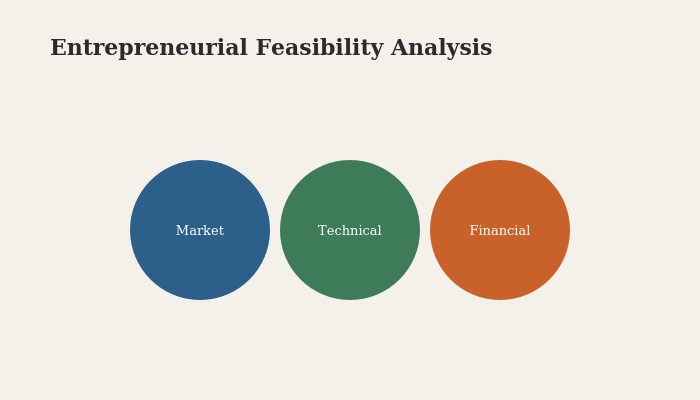
Not every promising idea is a viable business. A feasibility analysis is the structured process of evaluating whether a proposed venture is likely to succeed, examined across multiple dimensions, before significant time and capital are committed to full-scale execution. For MBA entrepreneurship students, feasibility analysis is often an explicit deliverable — required before a full business plan or venture pitch — precisely because instructors want to see disciplined, evidence-based evaluation rather than enthusiasm alone driving a venture forward. This guide covers the major dimensions of feasibility analysis, how to conduct each one, and a fully worked example.
Why Feasibility Analysis Comes Before the Business Plan
A full business plan or Business Model Canvas describes how a venture will operate; a feasibility analysis asks the more fundamental question of whether it should be pursued at all in its current form. Conducting feasibility analysis first prevents the common mistake of investing significant time developing a detailed plan for a venture that has a fundamental, disqualifying flaw — such as insufficient market size or a fatal technical constraint — that could have been identified far more cheaply and quickly through structured upfront analysis.
The Four Core Dimensions of Feasibility Analysis
1. Market Feasibility
Assesses whether sufficient customer demand exists, at a price point that supports a viable business, within a market the venture can realistically reach.
Key questions to address:
- What is the target market’s size, and is it large enough to support the venture’s growth ambitions? (Often assessed using Total Addressable Market, Serviceable Addressable Market, and Serviceable Obtainable Market — the TAM/SAM/SOM framework)
- Is there evidence of genuine customer demand (through surveys, interviews, pre-orders, or comparable market data), rather than assumed demand?
- Who are the existing competitors, and what is the venture’s meaningful differentiation from them?
- What barriers to customer acquisition exist, and are they surmountable given the venture’s likely resources?
Example: For a proposed subscription meal-kit service, market feasibility analysis would examine the total addressable market of relevant consumers, existing competitor market share and pricing, and evidence (from surveys or a landing page test — see our companion article on the Lean Startup methodology) that target customers are willing to pay the proposed price point.
2. Technical/Operational Feasibility
Assesses whether the venture can actually be built and delivered as conceived, given available technology, resources, and operational capability.
Key questions to address:
- Does the required technology or production process currently exist, or does it require significant, uncertain development?
- Can the venture reliably source necessary inputs, suppliers, or partners?
- What operational capacity (facilities, staffing, logistics) is required, and is it realistically achievable at the proposed scale?
- Are there regulatory or compliance requirements that could delay or block operations?
Example: A venture proposing an at-home diagnostic testing device would need to assess technical feasibility around whether the required sensor technology exists at an appropriate cost and accuracy level, and whether necessary regulatory approvals (such as from a relevant health authority) are achievable within a reasonable timeframe.
3. Financial Feasibility
Assesses whether the venture can generate sufficient revenue to be sustainable, and whether the capital required to reach that point is realistically obtainable.
Key questions to address:
- What are the projected startup costs, and how do they compare to realistically available funding sources (see our companion article on sources of startup funding)?
- What is the projected unit economics — cost to acquire a customer versus the revenue/profit generated per customer over their relationship with the business?
- What is the estimated break-even point, and is the timeline to reach it realistic given available capital?
- What are the key financial risks or sensitivities (e.g., dependence on a single major cost input, seasonal demand fluctuation)?
Example — a simplified unit economics check: A subscription service with a customer acquisition cost (CAC) of $80 and average monthly revenue per customer of $25, with an average customer retention of 8 months, generates lifetime revenue of $200 per customer — comfortably exceeding the $80 acquisition cost, suggesting reasonable unit economics, assuming the retention estimate is well-supported by evidence rather than optimistic assumption.
4. Organizational/Management Feasibility
Assesses whether the founding team has (or can realistically acquire) the skills, experience, and capacity needed to execute the venture successfully.
Key questions to address:
- Does the founding team have relevant industry experience or complementary skill sets (e.g., technical, commercial, operational)?
- Are there critical skill or experience gaps, and is there a credible plan to fill them (through hiring, advisors, or co-founders)?
- Is the team’s capacity realistic given the scope of the venture (a small team taking on an operationally complex venture may face significant execution risk)?
Example: A technically strong founding team building a complex healthcare software product, but with no team member possessing healthcare industry or regulatory experience, would represent an organizational feasibility gap worth explicitly addressing — potentially through advisory board recruitment or a strategic co-founder search — before proceeding to full execution.
A Worked Example: Full Feasibility Analysis
Venture concept: A subscription-based platform connecting small local businesses with freelance graphic designers for recurring marketing material needs.
| Dimension | Key Findings |
|---|---|
| Market feasibility | TAM estimated at a large number of small businesses nationally; survey of 50 local business owners shows moderate interest but price sensitivity below the proposed subscription price; three direct competitors identified with unclear differentiation |
| Technical feasibility | Platform technology (marketplace matching, payment processing) is well-established and low-risk to build using existing tools |
| Financial feasibility | Customer acquisition cost estimated at $150; average customer lifetime value estimated at $600, suggesting acceptable unit economics if retention assumptions hold; initial capital requirement is modest and within bootstrapping range |
| Organizational feasibility | Founding team has relevant design industry experience but lacks sales/marketing expertise needed for customer acquisition at scale |
Overall feasibility conclusion: While technical and financial feasibility appear reasonably sound, the market feasibility findings (price sensitivity, unclear competitive differentiation) and the organizational gap in sales/marketing expertise represent the most significant risks. A credible venture plan would need to directly address how the venture will differentiate from existing competitors and either recruit relevant sales/marketing expertise or adjust the go-to-market strategy accordingly — rather than proceeding to a full business plan without addressing these identified gaps.
This worked example illustrates an important principle: a feasibility analysis doesn’t need to conclude a venture is entirely infeasible to be valuable — often its greatest value is in clearly identifying the specific risks and gaps that a subsequent business plan or pivot needs to directly address.
A strong feasibility analysis can form the foundation of a wider entrepreneurship project, particularly when you need to turn market, financial, operational, and organizational findings into a coherent venture recommendation. If you need support developing this type of coursework, MBA entrepreneurship assignment support can help you structure and develop your analysis.
Feasibility Analysis vs. Related Concepts
| Concept | Focus | Typical Timing |
|---|---|---|
| Feasibility Analysis | Whether the venture concept is viable at all | Before detailed planning |
| Business Model Canvas | What the business model looks like | Early planning, iterated throughout |
| Lean Startup MVP Testing | Testing specific hypotheses within the model | Ongoing, after initial concept validation |
| Full Business Plan | Detailed operational and financial planning | After feasibility is reasonably established |
Common Mistakes MBA Students Make
- Relying on assumed rather than evidenced market demand, treating personal enthusiasm or anecdotal conversations as sufficient evidence of genuine market feasibility.
- Overlooking organizational feasibility entirely, focusing exclusively on market and financial dimensions while ignoring whether the specific founding team can actually execute the plan.
- Treating feasibility analysis as a one-time gate rather than an ongoing discipline — market conditions, competitive landscape, and team composition can all change, meaning feasibility should be revisited as new evidence emerges.
- Confusing feasibility analysis with a full business plan, producing an overly detailed operational plan prematurely, before confirming the fundamental viability questions feasibility analysis is meant to answer first.
Frequently Asked Questions
Q: What’s the difference between feasibility analysis and a SWOT analysis? A: A SWOT analysis (Strengths, Weaknesses, Opportunities, Threats) is a broader strategic framework often used for existing businesses or general strategic planning, while feasibility analysis is specifically structured around whether a new venture concept is viable across defined dimensions (market, technical, financial, organizational) before significant resources are committed.
Q: How much market research is enough to support market feasibility conclusions? A: There’s no fixed universal threshold, but instructors generally expect evidence beyond personal opinion or a small, informal sample — structured surveys, customer interviews, comparable market data, or a validated MVP test (see our companion article on Lean Startup methodology) all provide considerably stronger evidence than anecdotal impressions alone.
Q: Can a venture proceed if one feasibility dimension is weak but others are strong? A: Often yes, provided the weakness is explicitly acknowledged and addressed with a credible mitigation plan (such as adjusting strategy, recruiting missing expertise, or revising the business model) rather than ignored — a feasibility analysis that transparently identifies and addresses weaknesses is generally viewed more favorably than one presenting an unrealistically uniform positive assessment.
Q: How does feasibility analysis relate to the Business Model Canvas? A: Feasibility analysis and the Business Model Canvas are complementary — the canvas describes the proposed business model’s structure, while feasibility analysis critically tests whether the assumptions embedded in that model (market demand, technical capability, financial viability, team capacity) are actually well-founded.
Q: Is financial feasibility just about having enough startup capital? A: No — financial feasibility also includes ongoing unit economics (whether each customer relationship is profitable over time) and the venture’s overall path to sustainability, not simply whether enough capital exists to launch; a venture can be adequately funded at launch but still financially infeasible if its underlying unit economics don’t support long-term viability.