Table of Contents
ToggleIntroduction
For decades, standard entrepreneurship education centered on the traditional business plan: a comprehensive, carefully researched document projecting five years of revenue, market analysis, and operations before a single customer had been contacted. Eric Ries’s 2011 book The Lean Startup challenged this model directly, arguing that in conditions of extreme uncertainty — which describes nearly every early-stage venture — detailed long-term planning is often an exercise in confidently building on unvalidated assumptions. This guide introduces the Lean Startup methodology as it’s typically taught in MBA entrepreneurship courses: the Build-Measure-Learn loop, minimum viable products, and the concept of validated learning, with a fully worked example.
The Core Problem Lean Startup Addresses
Traditional business planning assumes you can accurately predict customer demand, pricing sensitivity, and operational requirements in advance, then execute against that plan. Lean Startup methodology instead treats a new venture as a set of untested hypotheses — about the customer problem, the proposed solution, the business model, and more — that need to be tested against real-world evidence as quickly and cheaply as possible, before large amounts of capital and time are committed based on unvalidated assumptions.
The Build-Measure-Learn Loop
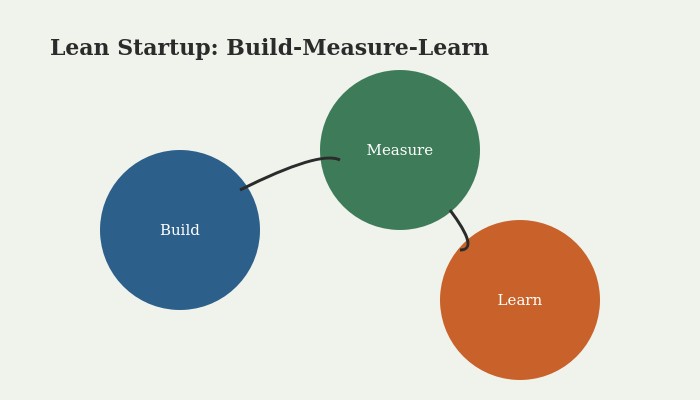
This feedback loop is the operational core of Lean Startup methodology:
Build
Create the smallest possible version of a product or feature that allows you to test a specific hypothesis — this is the Minimum Viable Product (MVP), discussed in detail below.
Measure
Collect data on how real customers actually interact with the MVP, using specific, predetermined metrics tied to your hypothesis — not vague impressions, but quantifiable evidence.
Learn
Analyze the data to determine whether your hypothesis was validated, invalidated, or requires refinement — this learning then informs the next iteration of the loop, whether that means adjusting the product, targeting a different customer segment, or, in more significant cases, pivoting the business model entirely.
Why the loop matters for coursework: MBA instructors frequently ask students to design a specific Build-Measure-Learn cycle for their venture project — not just describe the product, but specify exactly what will be tested, how it will be measured, and what result would validate or invalidate the underlying assumption. A venture plan that skips this and jumps straight to “the product will work because…” is a common way students lose marks in Lean Startup-based assignments.
The Minimum Viable Product (MVP)
An MVP is not simply “a smaller, cheaper version of your final product” — it’s specifically designed to test a particular hypothesis with the least possible effort and investment. Different hypotheses call for different MVP formats.
| MVP Type | Description | Example |
|---|---|---|
| Landing page MVP | A webpage describing the product with a signup or purchase button, before the product exists, to test demand | A startup measures signup conversion rate before building the actual app |
| Concierge MVP | The founder manually performs the service the product will eventually automate | A meal-planning startup founder manually creates personalized meal plans by email before building recommendation software |
| Wizard of Oz MVP | The product appears automated to the customer but is manually operated behind the scenes | An early ride-sharing MVP where a founder manually matches riders and drivers via text message |
| Piecemeal MVP | Combining existing third-party tools to simulate the product experience | Using existing scheduling and payment tools stitched together rather than building custom software |
Worked example: A team of MBA students proposing a subscription meal-kit service targeted at busy graduate students might test demand using a landing page MVP — describing the service, its price point, and a “reserve your spot” button — before investing any time in sourcing ingredients or building fulfillment logistics. If the landing page achieves a strong conversion rate from targeted ad traffic, this provides validated evidence of demand; if conversion is very low, the team has learned this cheaply, before committing significant resources.
Validated Learning vs. Vanity Metrics
A central Lean Startup concept is distinguishing between validated learning (evidence that genuinely tests a risky assumption) and vanity metrics (numbers that look impressive but don’t actually inform a critical business decision).
Example of a vanity metric: Total website visitors, without context on conversion or engagement, can look impressive in a pitch deck but tells you little about whether customers actually want to pay for your product.
Example of an actionable metric: Conversion rate from landing page visit to paid signup, segmented by customer acquisition channel, directly informs whether your value proposition resonates and which channels are worth further investment — a far more decision-relevant metric than raw traffic alone.
Pivoting: Responding to Invalidated Hypotheses
When the Build-Measure-Learn loop invalidates a core hypothesis, Lean Startup methodology calls for a pivot — a structured change in strategy while retaining validated learning from the previous iteration, rather than abandoning the venture entirely or stubbornly continuing without adjustment.
| Pivot Type | Description |
|---|---|
| Customer segment pivot | Same product, different target customer than originally assumed |
| Zoom-in pivot | A single feature becomes the entire product |
| Zoom-out pivot | The original product becomes one feature of a broader product |
| Business model pivot | Same product, different revenue model (e.g., shifting from one-time purchase to subscription) |
| Channel pivot | Same value proposition, different distribution/sales channel |
Worked example: The meal-kit startup from the earlier example discovers through its landing page MVP that busy graduate students show low interest, but that new parents show unexpectedly strong interest and higher willingness to pay. This would represent a customer segment pivot — retaining the core value proposition and product concept, while redirecting toward a different target market supported by the actual evidence gathered.
How Lean Startup Methodology Fits Into an MBA Venture Plan
Instructors commonly expect a Lean Startup-informed venture plan to include:
- A clearly stated riskiest assumption — the single hypothesis that, if wrong, would most undermine the entire venture
- A specific MVP design intended to test that assumption efficiently
- Predetermined success/failure metrics defined before the test is run, avoiding the temptation to retroactively reinterpret ambiguous results as success
- A clear plan for what happens next under each possible outcome (validated, invalidated, or ambiguous)
If you’re developing a venture concept, startup validation plan, or other entrepreneurship-focused coursework, MBA entrepreneurship assignment support can help you structure your ideas, apply the relevant frameworks, and develop your analysis into a stronger academic submission.
Lean Startup vs. Traditional Business Planning
| Feature | Traditional Business Plan | Lean Startup Approach |
|---|---|---|
| Primary tool | Detailed written business plan | Business Model Canvas, tested iteratively |
| Approach to uncertainty | Detailed upfront forecasting | Rapid, cheap experimentation |
| Timeline | Often months of planning before launch | Short iterative cycles, launch quickly |
| Response to being wrong | Revise the plan extensively | Pivot based on validated learning |
| Best suited for | Established markets with predictable demand | High-uncertainty, novel markets |
It’s worth noting that Lean Startup methodology doesn’t argue that planning is unnecessary altogether — rather, it argues that planning should be structured around testing the riskiest assumptions first, often starting with the hypotheses laid out in a Business Model Canvas, rather than assuming they’re already correct.
Common Mistakes MBA Students Make
- Building a fully-featured MVP rather than the minimum version needed to test a specific hypothesis, defeating the purpose of rapid, low-cost validation.
- Defining success metrics after seeing the results, rather than committing to specific thresholds beforehand — this undermines the rigor of the validated learning process.
- Confusing a pivot with simply giving up, rather than understanding it as a structured strategic response that retains and builds on prior learning.
- Treating vanity metrics as evidence of traction in a venture pitch, without connecting them to metrics that actually inform a critical business decision.
Frequently Asked Questions
Q: Does Lean Startup methodology mean you shouldn’t write a business plan at all? A: Not necessarily — many programs use a hybrid approach, using tools like the Business Model Canvas for rapid iteration in early stages, while still developing a more detailed traditional business plan once core assumptions have been validated and the venture requires it for fundraising or operational purposes.
Q: What’s the difference between an MVP and a prototype? A: A prototype typically demonstrates a product’s functionality or design without necessarily involving real customers or measuring real behavioral data, while an MVP is specifically deployed to real (or realistic) customers to gather measurable, decision-relevant evidence about a business hypothesis.
Q: How do you decide which assumption is the “riskiest” to test first? A: Generally, the riskiest assumption is the one that, if false, would most undermine the entire venture’s viability — often related to core customer demand or willingness to pay — and testing this first avoids investing significant resources in secondary details before confirming the fundamental premise holds.
Q: Can Lean Startup methodology apply to non-tech ventures? A: Yes — while the methodology is closely associated with tech startups, the core principles of testing assumptions cheaply before major investment apply broadly, including to service businesses, retail concepts, and social ventures, though the specific MVP format will vary by industry.
Q: How many Build-Measure-Learn cycles should an MBA venture project include? A: This varies by course requirements and project timeline, but demonstrating at least one complete, well-designed cycle — including a clear hypothesis, MVP design, and honest interpretation of results — is generally more valuable to instructors than superficially describing many cycles without genuine rigor in any of them.