
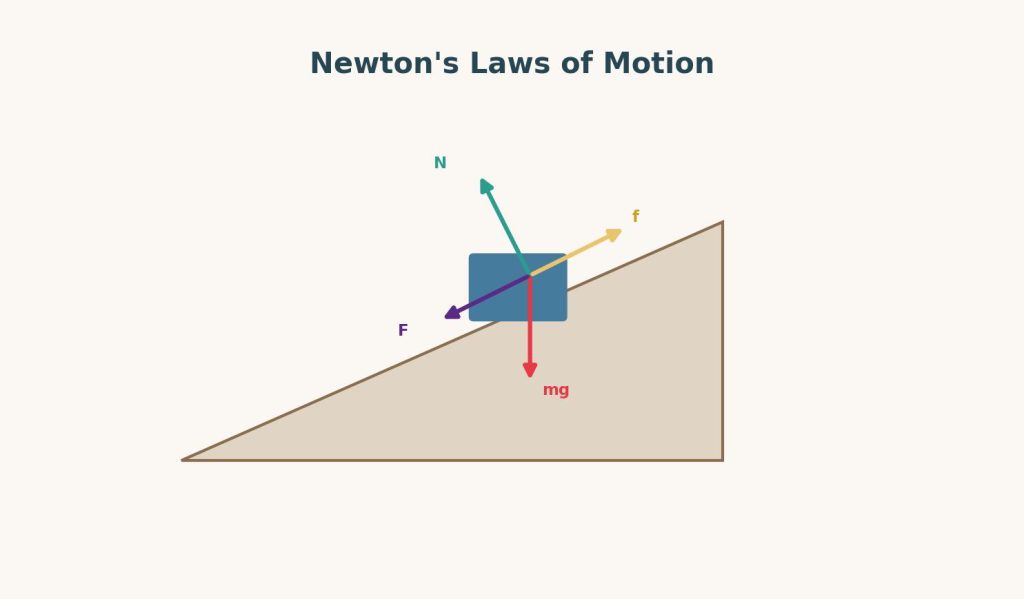
Newton’s laws sound simple when you first read them — an object at rest stays at rest, force equals mass times acceleration, every action has an equal and opposite reaction — but the assignments built around them are where many students hit their first real wall in physics. The theory isn’t the hard part; drawing a correct free-body diagram and translating it into the right equations is. This guide walks through a reliable method for force problems and works through the scenarios that appear most often in university assignments: friction, inclined planes, connected objects, and Newton’s third law pairs.
Table of Contents
ToggleNewton’s Three Laws: A Quick, Precise Recap
- First Law (Inertia): An object remains at rest or in uniform motion unless acted on by a net external force.
- Second Law: The net force on an object equals its mass times its acceleration: F_net = ma.
- Third Law: For every action force, there is an equal and opposite reaction force, acting on a different object.
A distinction worth getting right for assignments: The third law pair always acts on two different objects — this is why third-law pairs never cancel each other out within a single free-body diagram (they can’t, since they act on different bodies). Confusing this is one of the most common conceptual errors in introductory mechanics.
The Free-Body Diagram: The Skill That Determines Everything Else
Nearly every force problem in an introductory physics course is solved the same way — a skill that carries over directly once you reach How to Solve Kinematics Problems-style questions that give you a force and ask for resulting motion: draw a free-body diagram (FBD) isolating one object, identify every force acting on it, resolve forces into components along convenient axes, and apply Newton’s second law separately along each axis.
The four most common forces you’ll need to identify:
- Weight (gravity): W = mg, always straight down
- Normal force (N): perpendicular to the contact surface
- Friction (f): parallel to the surface, opposing relative motion (or opposing the tendency to move, for static friction)
- Applied/tension force: whatever external push, pull, or string tension is acting
A reliable method for any Newton’s second law problem:
- Isolate one object and draw only the forces acting on it (never forces it exerts on something else).
- Choose a coordinate system — for inclined planes, tilting the axes to align with the surface is usually easier than sticking with standard horizontal/vertical.
- Resolve every force into components along your chosen axes.
- Write ΣF = ma separately for each axis.
- Solve the resulting system of equations.
Worked Example 1: Basic Horizontal Force with Friction
Problem: A 10 kg box is pushed across a horizontal floor with a force of 40 N. The coefficient of kinetic friction between the box and floor is 0.25. Find the box’s acceleration. (Use g = 9.8 m/s².)
Step 1 — Free-body diagram: Forces acting: applied force (40 N, horizontal), weight (mg, down), normal force (N, up), kinetic friction (f_k, opposing motion, so horizontal, pointing backward).
Step 2 — Vertical equation (no vertical acceleration): N − mg = 0 N = mg = (10)(9.8) = 98 N
Step 3 — Friction force: f_k = μ_k N = (0.25)(98) = 24.5 N
Step 4 — Horizontal equation (Newton’s second law): F_applied − f_k = ma 40 − 24.5 = 10a 15.5 = 10a a = 1.55 m/s²
Answer: The box accelerates at 1.55 m/s².
Common mistake to avoid: Using the applied force’s magnitude directly in the friction calculation, instead of first finding the normal force from the vertical equilibrium equation. Friction depends on the normal force, not on the applied force — these are only equal in specific cases (like this one, where there’s no vertical applied force component), and treating them as always equal leads to errors as soon as a problem includes an angled applied force.
Worked Example 2: Inclined Plane With Friction
Problem: A 5 kg block sits on a frictionless-free 30° incline with a coefficient of kinetic friction of 0.2. Find the block’s acceleration as it slides down.
Step 1 — Tilt your axes so the x-axis runs along the incline surface (positive pointing down-slope) and the y-axis is perpendicular to the surface.
Step 2 — Resolve gravity into components: Gravity component along the incline: mg sin(θ) = (5)(9.8)sin(30°) = 24.5 N (down-slope) Gravity component perpendicular to incline: mg cos(θ) = (5)(9.8)cos(30°) = 42.4 N
Step 3 — Perpendicular equation (no acceleration perpendicular to the surface): N − mg cos(θ) = 0 N = 42.4 N
Step 4 — Friction force (opposing motion, so pointing up-slope as the block slides down): f_k = μ_k N = (0.2)(42.4) = 8.48 N
Step 5 — Along-incline equation: mg sin(θ) − f_k = ma 24.5 − 8.48 = 5a 16.02 = 5a a = 3.2 m/s²
Answer: The block accelerates down the incline at 3.2 m/s².
Common mistake to avoid: Using mg instead of mg cos(θ) when calculating the normal force. On an incline, the normal force balances only the perpendicular component of gravity, not the full weight — this single substitution error is probably the most common mistake in inclined-plane problems.
Worked Example 3: Connected Objects (Atwood-Style Problem)
Problem: Two blocks are connected by a massless string over a frictionless pulley. Block A (mass 4 kg) hangs on one side, and Block B (mass 6 kg) hangs on the other. Find the acceleration of the system and the tension in the string.
Step 1 — Recognize the system moves as one unit, since the string is inextensible: both blocks share the same magnitude of acceleration, though Block B (heavier) will accelerate downward and Block A will accelerate upward.
Step 2 — Write Newton’s second law for each block separately, defining “positive” as the direction each block actually moves (down for B, up for A):
Block B (heavier, accelerates down): m_B g − T = m_B a Block A (lighter, accelerates up): T − m_A g = m_A a
Step 3 — Add the two equations to eliminate T: m_B g − T + T − m_A g = m_B a + m_A a (m_B − m_A)g = (m_A + m_B)a (6 − 4)(9.8) = (4 + 6)a 19.6 = 10a a = 1.96 m/s²
Step 4 — Solve for tension using either original equation: T − m_A g = m_A a T = m_A(g + a) = 4(9.8 + 1.96) = 4(11.76) = 47.04 N
Answer: The system accelerates at 1.96 m/s², and the string tension is 47.04 N.
Common mistake to avoid: Using the same sign convention (e.g., “up is positive”) for both blocks, which produces an inconsistent equation, since the two blocks move in opposite absolute directions. Defining “positive” as the direction each individual block moves — as done here — keeps the algebra consistent and is the standard approach for connected-object problems.
Worked Example 4: Newton’s Third Law in Context
Problem: A 70 kg person stands on a bathroom scale inside an elevator accelerating upward at 2 m/s². What does the scale read?
Step 1 — Recognize what the scale actually measures: the normal force the scale exerts on the person (which, by Newton’s third law, equals the force the person exerts on the scale — this is what the scale displays).
Step 2 — Free-body diagram of the person: Normal force (N, up) and weight (mg, down). Since the elevator accelerates upward, net force must point upward.
Step 3 — Apply Newton’s second law: N − mg = ma N = m(g + a) = 70(9.8 + 2) = 70(11.8) = 826 N
Answer: The scale reads 826 N (equivalent to about 84.3 kg), higher than the person’s true weight of 686 N, because the elevator’s upward acceleration requires an additional upward net force.
Common mistake to avoid: Assuming the scale always reads the person’s actual weight (mg). The scale reads the normal force, which only equals mg when acceleration is zero — this is a classic conceptual check that assignments use specifically to test whether students understand what a “weight” reading physically represents.
A Step-by-Step Checklist for Students Stuck on a Newton’s Laws Problem
- Draw a free-body diagram for one object at a time, including only forces acting on that object.
- For inclined planes, tilt your coordinate axes to align with the surface rather than forcing a horizontal/vertical system.
- Resolve every force into components along your chosen axes before writing any equations.
- Write ΣF = ma separately for each axis, and solve the resulting system algebraically.
- For connected objects, define “positive” as the direction each object actually moves, and use the constraint that connected objects share the same acceleration magnitude.
If you’re working through a mechanics assignment and need help applying free-body diagrams, Newton’s laws, friction, inclined planes, or connected-object equations, Physics Assignment Help can provide step-by-step guidance with challenging physics problems.
FAQs
Q1: Why doesn’t Newton’s third law pair cancel out in a free-body diagram? Because the two forces in a third-law pair act on two different objects — a free-body diagram only includes forces acting on the one object you’re analyzing, so you’ll never see both members of a third-law pair on the same diagram, which is exactly why they don’t cancel within that diagram.
Q2: How do I know when to use kinetic friction versus static friction? Use kinetic friction (μ_k) once an object is already sliding, and static friction (up to a maximum of μ_s N) when an object is stationary but a force is being applied — static friction adjusts to match the applied force exactly, up to that maximum, rather than always equaling μ_s N.
Q3: Why do we tilt the coordinate axes for inclined plane problems? Tilting the axes so one axis runs along the incline surface means the object’s acceleration lies entirely along one axis (with zero acceleration perpendicular to the surface), which significantly simplifies the equations compared to using standard horizontal/vertical axes, where both gravity and the normal force would need to be broken into components along both axes.
Q4: What’s the difference between mass and weight, and why does it matter for these problems? Mass is a measure of an object’s inertia and is constant regardless of location (measured in kg), while weight is the force of gravity on that mass (W = mg, measured in newtons) and changes depending on the local gravitational field. Mixing these up — using mass where a force is needed, or vice versa — is a common source of unit errors in force problems.
Q5: How do I handle a problem with more than two connected objects? The same principle extends: write a separate Newton’s second law equation for each object, using a consistent constraint (usually that all connected objects share the same acceleration magnitude), then solve the resulting system of equations simultaneously, typically by adding equations together to eliminate unknown tension forces between objects, similar to the two-block method shown above.
Q6: How do these force problems connect to what comes next in mechanics? Once you can build a free-body diagram confidently, the same skill transfers directly to Circular Motion and Centripetal Force, where the net inward force is just F_net = ma applied to a curved path instead of a straight one. Force and acceleration also feed directly into Work, Energy, and Power, which gives you a faster route to many of the same answers without needing a full free-body diagram at every step.