
Work and energy problems trip up a lot of students for a subtle reason: after a semester of force problems solved with Newton’s Laws of Motion and its second law, energy methods feel like a completely different toolkit — and knowing when to switch from forces to energy (or combine both) isn’t always obvious from the problem statement. This guide clarifies exactly when energy methods are the right tool, walks through the key formulas, and works through the scenarios — including friction, springs, and roller-coaster-style problems — that show up most often in university physics assignments.
Table of Contents
ToggleThe Core Definitions You Need
- Work: W = Fd·cos(θ), where F is the applied force, d is displacement, and θ is the angle between the force and displacement directions. Work is zero if the force is perpendicular to motion, or if there’s no displacement at all.
- Kinetic energy: KE = ½mv²
- Gravitational potential energy: PE = mgh (relative to a chosen reference height)
- Elastic potential energy (spring): PE_spring = ½kx², where k is the spring constant and x is the displacement from equilibrium
- Power: P = W/t (average power) or P = Fv (instantaneous power, when force and velocity are in the same direction)
The Work-Energy Theorem: When to Use It
The work-energy theorem states that the net work done on an object equals its change in kinetic energy:
W_net = ΔKE = ½mv² − ½mv₀²
This is the tool of choice whenever a problem asks about speed or kinetic energy changes, and you either don’t know (or don’t need) the time taken or the detailed force profile throughout the motion — this is exactly where energy methods outperform a Newton’s second law approach.
Worked Example 1: Work-Energy Theorem With Friction
Problem: A 1200 kg car traveling at 25 m/s brakes and comes to a stop over a distance of 60 m. Find the average braking force.
Step 1 — Apply the work-energy theorem: W_net = ΔKE = ½mv² − ½mv₀² W_net = ½(1200)(0)² − ½(1200)(25)² = 0 − 375,000 = −375,000 J
Step 2 — Relate work to force (braking force acts opposite to displacement, so θ = 180°, cos(180°) = −1): W_net = F·d·cos(180°) = −F·d −375,000 = −F(60) F = 6250 N
Answer: The average braking force is 6250 N.
Common mistake to avoid: Trying to solve this using kinematics and Newton’s second law, which would require first finding acceleration and then force — a valid but longer route. The work-energy theorem gets there directly since the problem only asks for force via energy change, without needing time or a full kinematic breakdown.
Conservation of Mechanical Energy: When to Use It
When only conservative forces act on a system (gravity, ideal springs — not friction or air resistance), total mechanical energy is conserved:
KE₁ + PE₁ = KE₂ + PE₂
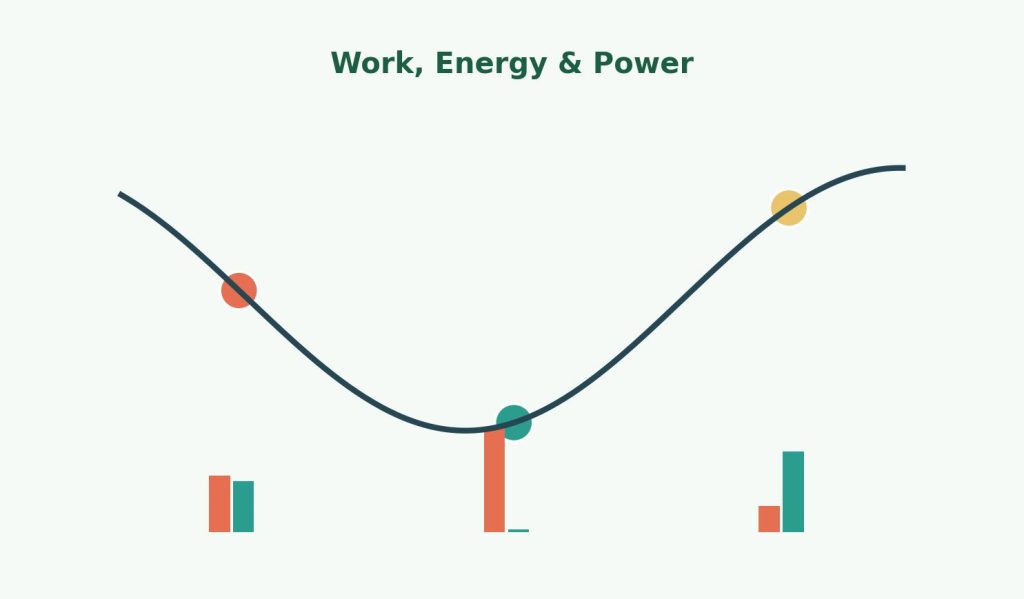
This is the go-to method for problems involving height changes with no friction — roller coasters, pendulums, objects sliding down frictionless curves — where you want to relate speed at one point to speed or height at another, without needing to know the shape of the path in between.
Worked Example 2: Conservation of Energy on a Frictionless Track
Problem: A 500 g ball is released from rest at the top of a frictionless track, 4 m above the ground. Find its speed when it reaches a point 1.5 m above the ground.
Step 1 — Set up conservation of energy (taking the ground as the reference height, PE = 0 there):
KE₁ + PE₁ = KE₂ + PE₂ 0 + mgh₁ = ½mv₂² + mgh₂
Step 2 — Notice mass cancels out (divide through by m): gh₁ = ½v₂² + gh₂ (9.8)(4) = ½v₂² + (9.8)(1.5) 39.2 = ½v₂² + 14.7 ½v₂² = 24.5 v₂² = 49 v₂ = 7 m/s
Answer: The ball’s speed at 1.5 m height is 7 m/s.
Common mistake to avoid: Trying to account for the exact shape of the track (curves, loops). Conservation of energy on a frictionless track depends only on height, not path shape — this is precisely why energy methods are so much faster than force analysis for problems with complicated, curving paths.
Worked Example 3: Energy With Friction (A Non-Conservative Force)
Problem: The same 500 g ball is released from the same 4 m height, but this time the track has friction, and the ball’s actual speed at ground level is measured to be 8 m/s (rather than the frictionless prediction). Find the energy lost to friction.
Step 1 — Find the frictionless prediction for comparison (using conservation of energy, ground level as reference): mgh = ½mv² v = √(2gh) = √(2 × 9.8 × 4) = √78.4 = 8.85 m/s
Step 2 — Calculate actual kinetic energy at ground level: KE_actual = ½mv² = ½(0.5)(8²) = ½(0.5)(64) = 16 J
Step 3 — Calculate the initial potential energy (total mechanical energy at the start): PE_initial = mgh = (0.5)(9.8)(4) = 19.6 J
Step 4 — Energy lost to friction is the difference: Energy lost = PE_initial − KE_actual = 19.6 − 16 = 3.6 J
Answer: 3.6 J of mechanical energy was lost to friction (converted to heat and sound).
Common mistake to avoid: Assuming mechanical energy is always conserved regardless of the problem setup. Whenever a problem explicitly involves friction, air resistance, or states the object’s actual speed differs from a frictionless prediction, mechanical energy is not conserved — the “missing” energy went somewhere (usually heat), and this missing amount is exactly what a work-energy approach including non-conservative work can calculate.
Worked Example 4: Elastic Potential Energy (Springs)
Problem: A 2 kg block is pushed against a spring (k = 500 N/m), compressing it 0.2 m, then released on a frictionless horizontal surface. Find the block’s speed as it leaves the spring.
Step 1 — All spring potential energy converts to kinetic energy (frictionless, horizontal, so no height change): PE_spring = KE ½kx² = ½mv²
Step 2 — Solve for v (mass and the factor of ½ both present, so simplify directly): kx² = mv² v = x√(k/m) = 0.2√(500/2) = 0.2√250 = 0.2(15.81) = 3.16 m/s
Answer: The block leaves the spring at 3.16 m/s.
Common mistake to avoid: Confusing the spring constant’s role — a stiffer spring (higher k) or greater compression (higher x) both increase stored energy, but note the energy depends on x², not x, so doubling the compression quadruples the stored energy, not just doubles it.
Worked Example 5: Power
Problem: A motor lifts a 200 kg elevator car at a constant speed of 1.5 m/s. Find the power output of the motor (ignoring friction).
Step 1 — At constant speed, the motor’s force equals the elevator’s weight: F = mg = (200)(9.8) = 1960 N
Step 2 — Apply P = Fv (force and velocity are in the same direction, both vertical): P = (1960)(1.5) = 2940 W
Answer: The motor’s power output is 2940 W (about 3.94 horsepower).
Common mistake to avoid: Using P = W/t with an unclear or unnecessary time value when P = Fv is more direct for constant-velocity problems where force and speed are both already known — recognizing which power formula fits the given information saves an unnecessary extra step.
A Step-by-Step Checklist for Students Stuck on a Work/Energy Problem
- Identify whether the problem involves only conservative forces (use conservation of mechanical energy) or includes friction/non-conservative forces (use the work-energy theorem, accounting for the “missing” energy).
- For height-change problems on a frictionless path, remember the path’s shape doesn’t matter — only the start and end heights.
- For spring problems, remember elastic potential energy depends on the square of the displacement from equilibrium, not the displacement itself.
- Choose the appropriate power formula: P = W/t when you know work and time, or P = Fv when you know force and velocity directly (and they’re aligned in direction).
- Always check whether mass cancels out of an equation (common in free-fall and simple conservation problems) — if it does, you don’t need the mass value to solve for speed.
Working Through a Multi-Step Energy Problem?
Physics assignments often combine work, energy conservation, friction, springs, and power in a single problem, making it important to choose the right method before starting the calculations. If you need additional support with a physics assignment, you can explore our Physics Assignment Help service.
FAQs
Q1: When should I use the work-energy theorem instead of Newton’s second law? Use the work-energy theorem when a problem asks about speed or kinetic energy changes and you don’t know (or don’t need) the time taken or the detailed force profile along the path — it’s especially useful when force or acceleration varies, since Newton’s second law alone would require calculus to handle that directly.
Q2: Why does mass sometimes cancel out of energy conservation problems? Because both kinetic energy (½mv²) and gravitational potential energy (mgh) are directly proportional to mass — when you set the total energy at two points equal to each other, the mass term appears on both sides and divides out, meaning the final speed in a simple free-fall or frictionless-track problem doesn’t depend on the object’s mass at all.
Q3: Is mechanical energy ever truly conserved in real-world problems? Not perfectly — friction and air resistance are almost always present to some degree in real systems, converting some mechanical energy to heat. “Frictionless” and “ideal spring” assumptions in textbook problems are simplifications that let you use conservation of energy directly; real-world engineering problems typically need to account for these losses explicitly.
Q4: What’s the difference between average power and instantaneous power? Average power (P = W/t) describes the overall rate of energy transfer over an entire time interval, while instantaneous power (P = Fv) describes the rate at a specific moment — for a system moving at constant velocity with constant force, these two values happen to be equal, but they can differ significantly when speed or force changes over time.
Q5: How do I know if a force is “conservative” or not? A conservative force (like gravity or an ideal spring force) does work that depends only on an object’s initial and final position, not on the path taken between them, and the total work done by a conservative force over a closed path is always zero. Friction and air resistance are non-conservative because the work they do depends on the specific path length traveled, and they always remove mechanical energy from a system.
Q6: Where do work and energy methods lead next? Energy conservation is the same tool that makes Simple Harmonic Motion tractable, since a spring or pendulum’s speed at any position can be found by tracking how energy shifts between kinetic and potential forms exactly as shown above. The same accounting approach also extends to spinning objects — see Rotational Motion and Moment of Inertia for how kinetic energy splits between translational and rotational forms.