A completed SWOT analysis is genuinely useful, but it has one structural limitation that trips up a lot of students at the exact moment their assignment asks for “recommendations” or “strategic options”: a SWOT is a list, not a strategy. Four separate quadrants of bullet points don’t, on their own, tell you what a company should actually do. The TOWS matrix — developed by Heinz Weihrich as a direct extension of SWOT — solves exactly this problem, by systematically pairing each internal factor with each external factor to generate four distinct types of strategy. This guide explains how the TOWS matrix works, why it’s more useful than SWOT alone for the “so what” part of an assignment, and walks through a complete worked example.
Table of Contents
ToggleWhy SWOT Alone Often Isn’t Enough for a Strategy Assignment
A SWOT tells you what is true about an organization and its environment. It doesn’t, by itself, tell you what to do about it. This is precisely the gap that shows up when a rubric includes a “strategic recommendations” section, and students who’ve written a strong SWOT still struggle to produce anything beyond generic advice like “the company should leverage its strengths” — a sentence that says almost nothing concrete.
The TOWS matrix (the name is simply SWOT spelled backward, reflecting its role as the output stage that follows the SWOT input stage) forces you to systematically consider every combination of internal and external factors, producing four distinct categories of strategy rather than one vague pile of “recommendations.”
The Four TOWS Strategy Types
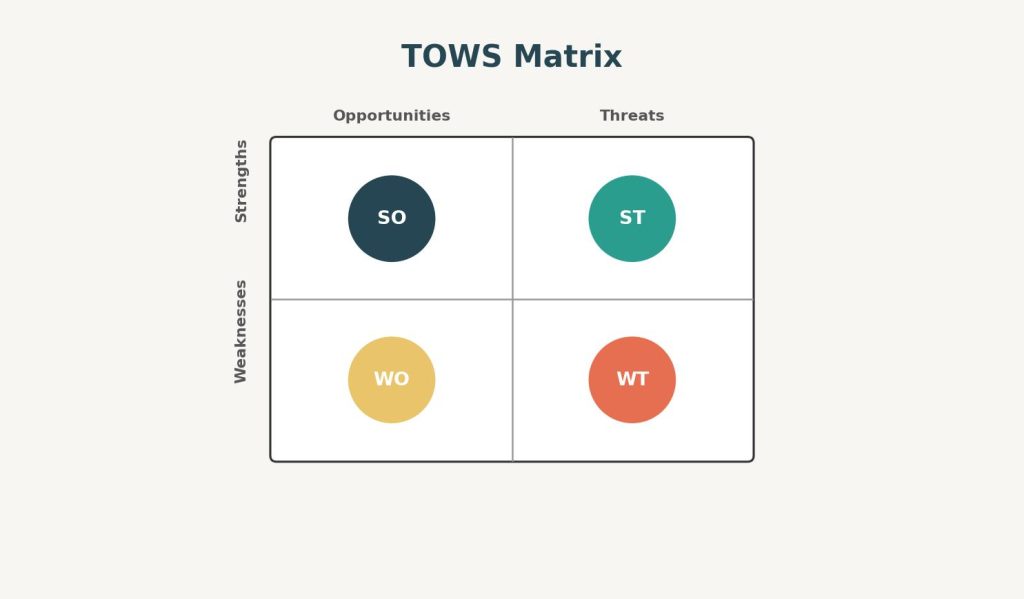
The TOWS matrix is built by crossing each internal category (Strengths, Weaknesses) with each external category (Opportunities, Threats), producing a 2×2 grid of strategy types:
| Opportunities (O) | Threats (T) | |
|---|---|---|
| Strengths (S) | SO Strategies — Use strengths to pursue opportunities | ST Strategies — Use strengths to avoid or reduce threats |
| Weaknesses (W) | WO Strategies — Overcome weaknesses by pursuing opportunities | WT Strategies — Minimize weaknesses and avoid threats (defensive) |
Each of the four cells asks a genuinely different strategic question, which is exactly why working through all four — rather than stopping after the first one or two that come to mind — tends to produce a much richer set of recommendations.
SO Strategies (Strength–Opportunity): The “Attack” Quadrant
The question this quadrant answers: How can we use what we’re good at to take advantage of what’s happening in our favor externally?
Worked example (continuing the global coffee retail chain case study used elsewhere on this site):
- Relevant Strength: A loyalty/rewards app with strong customer data and engagement.
- Relevant Opportunity: Growing consumer interest in plant-based milk alternatives.
- SO Strategy: “Use the existing loyalty app’s customer data and engagement infrastructure to launch a targeted marketing campaign promoting new plant-based menu options directly to customers whose past order history suggests dietary interest, accelerating adoption of this growth category faster than a generic, untargeted product launch would achieve.”
Why this is a genuine SO strategy, not just a restated strength or opportunity: notice the strategy explicitly names both the strength (the app’s data capability) and the opportunity (plant-based demand growth), and describes a specific action connecting them — not just a hopeful statement that both exist.
ST Strategies (Strength–Threat): The “Defend” Quadrant
The question this quadrant answers: How can we use what we’re good at to protect ourselves from external dangers?
Worked example:
- Relevant Strength: Significant capital reserves.
- Relevant Threat: Rising global coffee bean prices due to climate change.
- ST Strategy: “Use existing capital reserves to secure long-term, fixed-price supply contracts with coffee growers in geographically diversified regions, reducing exposure to short-term price volatility and climate-related supply disruption in any single growing region, while smaller competitors without comparable capital reserves remain fully exposed to spot-market price swings.”
Why this matters strategically: an ST strategy often highlights a competitive advantage specifically because it uses a strength the company has that competitors may lack — in this case, the ability to make large upfront capital commitments that a smaller, less capitalized competitor couldn’t match.
WO Strategies (Weakness–Opportunity): The “Turnaround” Quadrant
The question this quadrant answers: How can we take advantage of an external opportunity specifically to help fix an internal weakness?
Worked example:
- Relevant Weakness: Heavy reliance on a small number of core coffee-based products, limited diversification.
- Relevant Opportunity: Potential expansion into adjacent product categories (packaged goods, ready-to-drink beverages) sold through retail partners.
- WO Strategy: “Launch a line of ready-to-drink bottled beverages sold through existing grocery retail partnerships, directly addressing the company’s over-reliance on in-store coffee sales by establishing a new, diversified revenue channel that doesn’t depend on store foot traffic or in-person visits.”
Why this quadrant is often the most valuable, and the most commonly under-used by students: WO strategies specifically show growth-oriented thinking about weaknesses — rather than simply flagging a weakness as a problem to minimize (as WT strategies do), they ask how an external opportunity could specifically be used to convert that same weakness into newly created strength. Assignments that include a genuine WO strategy, rather than only SO and WT strategies, generally demonstrate more complete strategic thinking.
WT Strategies (Weakness–Threat): The “Defensive/Survival” Quadrant
The question this quadrant answers: How can we minimize this weakness and avoid this threat, when both are working against us at the same time?
Worked example:
- Relevant Weakness: Premium pricing makes the brand vulnerable to price-sensitive customers.
- Relevant Threat: Intensifying competition from budget-focused chains.
- WT Strategy: “Introduce a smaller-portion, lower-priced product tier specifically targeting price-sensitive occasions (such as a smaller-sized daily coffee option), allowing the company to defend market share among increasingly price-conscious customers without fully abandoning its premium brand positioning across its core product range.”
Why WT strategies tend to be more cautious and defensive than the other three quadrants: by definition, this quadrant combines an internal weakness with an external threat — the least favorable combination of factors — so WT strategies are typically about damage limitation and risk reduction rather than aggressive growth, which is a reasonable and expected characteristic of this specific quadrant, not a sign of a weak analysis.
A Full Worked TOWS Matrix: Bringing All Four Together
Using the same coffee retail chain SWOT referenced throughout this guide (and covered in full in SWOT Analysis Examples: Real-World Case Studies for Business Students):
| O: Plant-based demand growth | T: Rising bean prices | |
|---|---|---|
| S: Loyalty app data | SO: Targeted marketing of new plant-based options to app users showing dietary interest | — |
| S: Capital reserves | — | ST: Long-term diversified supply contracts locking in favorable pricing |
| W: Product concentration | WO: Launch retail-distributed bottled beverage line for revenue diversification | — |
| W: Premium pricing vulnerability | — | WT: Introduce a smaller, lower-priced product tier to retain price-sensitive customers |
A note on this table structure: not every Strength needs to be paired with every Opportunity and every Threat — the matrix is a tool for systematically considering every combination, not a requirement to fill every single cell. A strong assignment typically selects the two or three most strategically significant pairings per quadrant (SO, ST, WO, WT) rather than mechanically forcing every possible combination into the grid.
Common Mistakes When Building a TOWS Matrix
- Restating the SWOT point instead of proposing a strategy. Writing “leverage strong brand recognition” under SO is not a strategy — it’s just repeating the strength. A genuine SO strategy names a specific action connecting a specific strength to a specific opportunity.
- Only completing SO and WT, skipping ST and WO. These are the two quadrants students most often forget, but they frequently produce the most interesting and differentiated strategic insight, particularly WO strategies.
- Pairing unrelated factors just to fill the grid. Not every strength meaningfully connects to every opportunity — forcing a weak, unconvincing pairing to complete the matrix produces a strategy that doesn’t hold up to scrutiny. It’s better to have three strong, well-reasoned pairings than eight forced, unconvincing ones.
- Treating all four strategy types as equally aggressive. WT strategies are supposed to be more defensive and risk-focused than SO strategies — an assignment that proposes an aggressive market expansion as a “WT strategy” has likely mismatched the strategy to the wrong quadrant.
A Step-by-Step Checklist for Students Building Their Own TOWS Matrix
- Start from a completed, well-developed SWOT analysis — the TOWS matrix is only as strong as the underlying SWOT points feeding into it.
- Work through each of the four quadrants (SO, ST, WO, WT) separately, selecting the two or three strongest, most strategically meaningful pairings for each rather than forcing every possible combination.
- For every strategy, explicitly name both the internal factor and the external factor it connects, followed by a specific proposed action — not just a restatement of the SWOT points themselves.
- Check that your WT strategies are genuinely defensive/risk-reducing in tone, and that your SO strategies are genuinely growth/opportunity-oriented — mismatched tone is a sign the strategy belongs in a different quadrant.
- If your assignment allows it, briefly justify why each selected pairing is more strategically significant than other possible combinations you could have chosen instead.
FAQs
Q1: What does TOWS actually stand for, and how is it different from SWOT? TOWS uses the same four categories as SWOT (Threats, Opportunities, Weaknesses, Strengths) but reorders the letters to emphasize that it’s an action-oriented extension of SWOT — rather than just listing the four categories separately, TOWS systematically pairs internal factors (Strengths, Weaknesses) with external factors (Opportunities, Threats) to generate specific strategic options.
Q2: Do I need to fill in every single cell of the TOWS matrix? No — the matrix is a systematic tool for considering every type of pairing, not a requirement to force a strategy out of every single possible strength-opportunity, strength-threat, weakness-opportunity, and weakness-threat combination. Most strong assignments select the two or three most strategically significant and well-justified pairings within each of the four quadrants (SO, ST, WO, WT).
Q3: Which TOWS quadrant is most important? None is universally “most important” — each answers a genuinely different strategic question, and a well-rounded assignment typically includes at least one strategy from each of the four quadrants. That said, WO strategies (using an opportunity to overcome a weakness) are the quadrant students most often skip, despite frequently producing some of the most valuable, growth-oriented strategic insight.
Q4: How is a TOWS strategy different from just restating a SWOT point? A TOWS strategy must explicitly connect one internal factor to one external factor and propose a specific action — simply restating “the company has strong brand recognition” (a Strength) is not a TOWS strategy on its own; “use strong brand recognition to command premium pricing that offsets rising input costs” (connecting a Strength to a Threat) is a genuine ST strategy.
Q5: Can I use the TOWS matrix for a personal SWOT analysis too? Yes — the same logic applies, adapted to an individual rather than an organization. For example, a WO strategy in a personal context might connect a specific skills gap (Weakness) to an available training opportunity (Opportunity), producing a concrete action like enrolling in a specific certification program — this connects directly to the action-planning approach covered in Personal SWOT Analysis: How to Analyze Your Own Strengths and Weaknesses.
Building the SWOT This Matrix Depends On
The TOWS matrix only works as well as the SWOT analysis feeding into it — if you haven’t yet built a strong, specific, well-evidenced SWOT, start with How to Write a SWOT Analysis for a Business Plan or Assignment, or review What Is SWOT Analysis and How to Do It Right for the foundational framework this entire guide builds on.